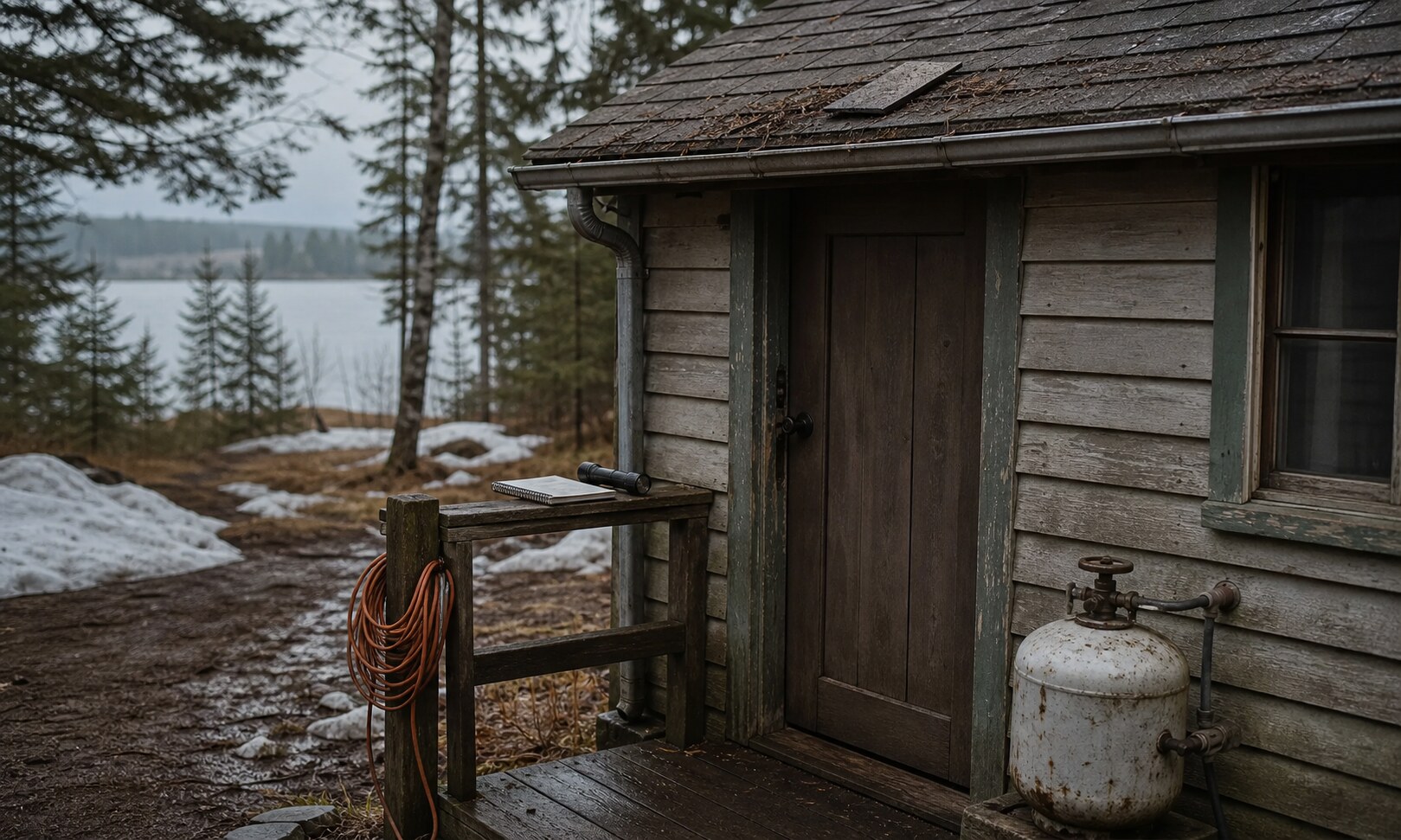
Opening a cottage is not the happy reverse of closing it. Closing is careful and calm because you have all fall. Opening is where the winter hands you the bill, and you have to read it in the right order or you’ll add to it.
There is a sequence, and it isn’t arbitrary. Look, then power, then water, then flame — then detectors, then the mess the mice made, then the septic and the dock. Each step guards the one after it. Do them out of order and you energize a water heater with no water in it, or light a stove into a chimney a squirrel spent the winter in.
If you close the way I do — up here — this is the other half of the year.
When should you even go up?
Later than you want to. Not on the first warm weekend.
Don’t recommission the water while the nights still drop below freezing — you’ll fill the lines and refreeze them, and undo a winter of careful drying in a single cold night. In the Yukon that means waiting out breakup properly, not jumping the gun in April because the sun came out. A couple of weeks ahead, arrange your power and propane reconnection so you’re not doing everything the same afternoon.
What do you do before you touch a switch?
Walk the outside first, with the power still off.
Look up and look around before you look at the panel. Storm-damaged or leaning trees. A branch or a whole tree on the roof. Lifted or missing shingles, ice-dam damage along the eaves, debris packed in the valleys. Any downed line — which is the reason you do this walk before you energize anything. And look for the holes: where something chewed or dug its way in over the winter, because whatever got in is part of the rest of your day.
Only then, the panel. Bring up the lighting circuits. Leave the water heater’s breaker off — and any gas appliance off — until you’ve confirmed there’s water in the tank. An electric element fired into an empty tank is dead in seconds.
How do you turn the water back on?
Slowly, and with your ears.
This is the money step — freeze splits are the most common and most expensive thing a cottage does over the winter, and a hairline crack in a copper line moves five to ten litres a minute onto a floor. So close the winterization drains first, prime the pump, then bring pressure up slowly and walk the whole system listening for hissing, dripping, or the sound of water running where no tap is open. It’s involved enough that I gave it its own page, including the well.
Confirm the tank is full — a steady stream from a hot tap — before you switch the water heater on.
What has to happen before the first fire and the first night?
The propane and the chimney and the detectors. In that order, and none of them optional.
Propane gets a leak test before you light anything, because a winter of freeze-thaw loosens fittings, and a leak test is required any time the gas has been off. I cover the actual bubble test, the chimney, and the detectors in the spring safety piece. The short version: soapy water on the fittings, open the valve slow, watch for bubbles, never a flame. Then the chimney gets looked at before the first fire, and every smoke and CO detector gets tested — a cottage that sat cold all winter usually has dead batteries and sometimes a detector past its expiry.
What about what the mice did?
They were here all winter. Assume droppings and a nest somewhere.
There is exactly one rule that matters and it’s a health rule, not a tidiness one: do not sweep it and do not vacuum it. That’s how hantavirus gets into the air and into you. You wet it down, wait, and bag it — the whole method is here, and it’s worth reading before you reach for a broom on reflex.
What gets checked last?
The ground and the water systems that live in it.
Spring is when you see what frost did: heaved deck posts, a dock crib shoved out of line, a foundation element cracked or displaced, doors and windows suddenly out of square. Check the septic — frost-heaved tank lids and risers, a filter that wants cleaning — and go easy on water use while the ground is still saturated from breakup, because a soaked leach field backs up.
None of this is romantic. That’s the point. A cottage in May isn’t a postcard; it’s a building that survived five months alone and is waiting to tell you how it went. Your whole job is to listen in the right order.