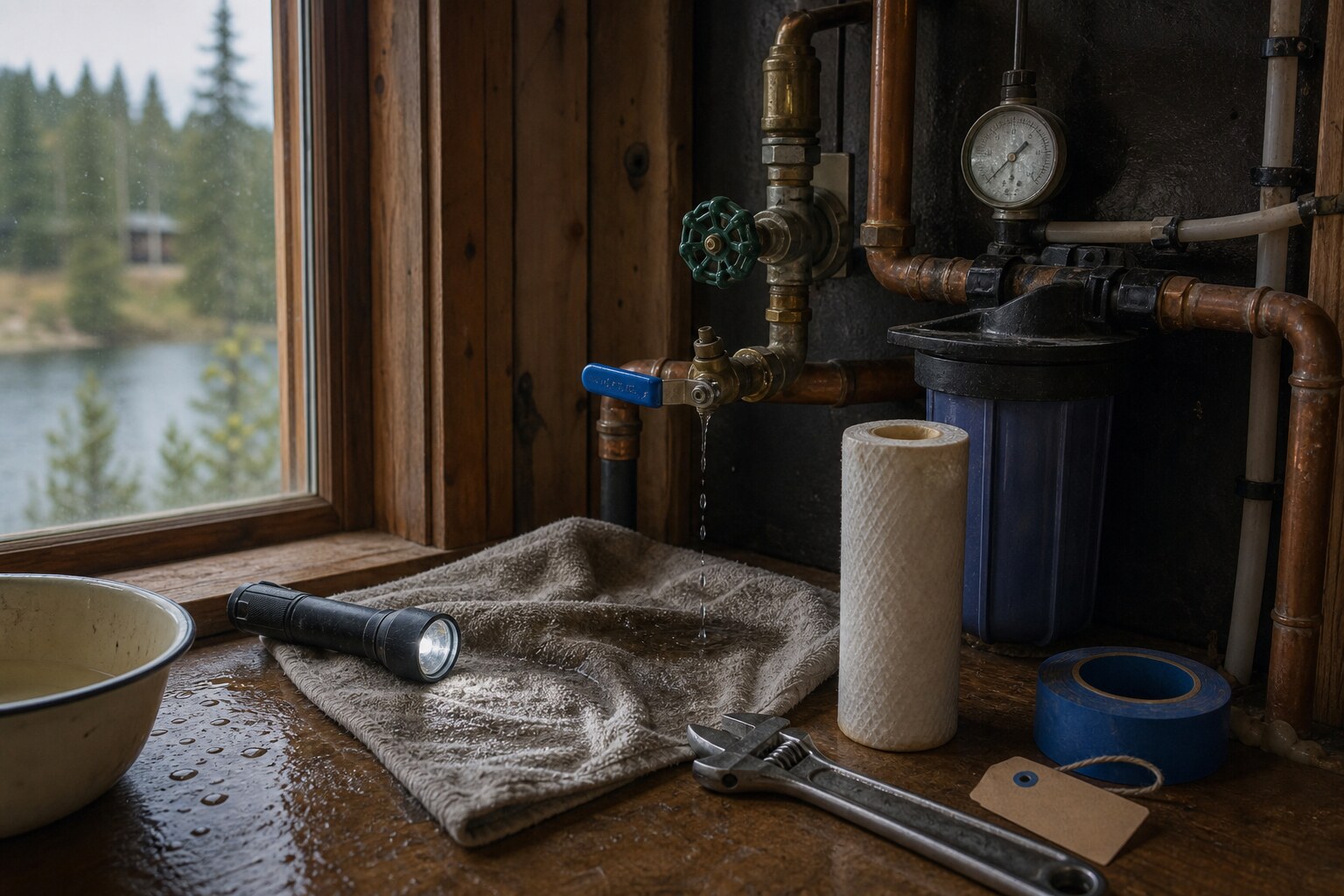
Getting the water out in the fall is a careful job. Getting it back in in the spring is a nervous one, because this is the moment the cottage tells you whether the fall job worked. If a trap cracked, or a line kept a spoonful of water it shouldn’t have, you find out now — ideally as a hiss, not as a flood.
So you go slow, and you listen.
Close what you opened
Before you prime anything, walk the system and close every drain you opened last fall: the main drain, the water-heater drain, the toilet supply valves, the outdoor hose bibs. It sounds obvious. It’s the step people skip, and an open drain valve you forgot about will pour your newly pressurized water straight onto the floor.
Replace the pump filter while you’re at it — a season-old filter is half-clogged before you start.
Prime, then pressurize slowly
Prime the pump, then bring the system up slowly, opening valves and taps a little at a time. This is not the moment for speed. Speed is how a hairline freeze-split stays hidden until it’s a running leak.
Walk the whole place while the pressure comes up, and listen. A hiss. A drip. The particular sound of water moving when every tap is closed. Look under every sink, around the base of every toilet, and through the crawlspace or basement. A white or green mineral crust on a fitting is a slow leak that’s been weeping — a sign, not an accident.
The reason for all this caution fits in one number: a hairline crack in a copper line lets go five to ten litres a minute. Found as a hiss on opening day, it’s a fitting and an afternoon. Found in June, it’s a floor.
Flush the antifreeze out
The pink plumbing antifreeze you put in the traps last fall has to come out of the lines before you drink from them. Run every faucet, hot and cold, two or three minutes each, working from the tap nearest the supply outward. Flush every toilet at least twice. Keep going until the water runs clear and has no taste or smell of the antifreeze.
Only then does the water heater come on — after you’ve confirmed the tank is full by running a hot tap until it gives a steady, air-free stream. An electric tank comes up to temperature in half an hour to an hour.
The well: shock it, but understand it
If you’re on a well that sat all winter — and especially through breakup — plan to shock-chlorinate before you trust the water, because spring melt is exactly when surface contamination finds its way down.
The Yukon’s own handout keeps it refreshingly simple for a normal residential well: turn the pump off at the breaker and tape it off so nobody energizes a well you’re standing over; bypass the water softener; pour in one four-litre bottle of unscented household bleach, coating the casing; run the pump and open every tap until you smell bleach at each one, then shut them; let it sit at least six hours, or overnight; then purge outside through a garden hose until the smell is nearly gone before you flush the indoor taps. Keep the chlorinated water away from people, animals, and any fish-bearing water — it’s deadly to fish. Retest for bacteria after a week.
Two things the simple version doesn’t say, worth knowing. First, what actually matters is concentration and contact time — the target is roughly fifty milligrams per litre held for somewhere between eight and forty-eight hours, and more bleach is not better; past a couple hundred milligrams per litre it gets less effective and starts corroding your equipment. Second, and this is the one people don’t want to hear: shock chlorination is temporary. If something is getting into the well — a cracked cap, surface water after breakup — the bacteria come back in a month or two. The shock buys you a clean test and a season; it doesn’t fix a source. If you’re failing tests every spring, the well needs looking at, not just more bleach.
Water is the first thing a cottage asks about in spring and the most expensive thing to get wrong. Bring it up slow, listen the whole time, and don’t drink from a well you haven’t tested. Everything else in the place can wait a day. This can’t.