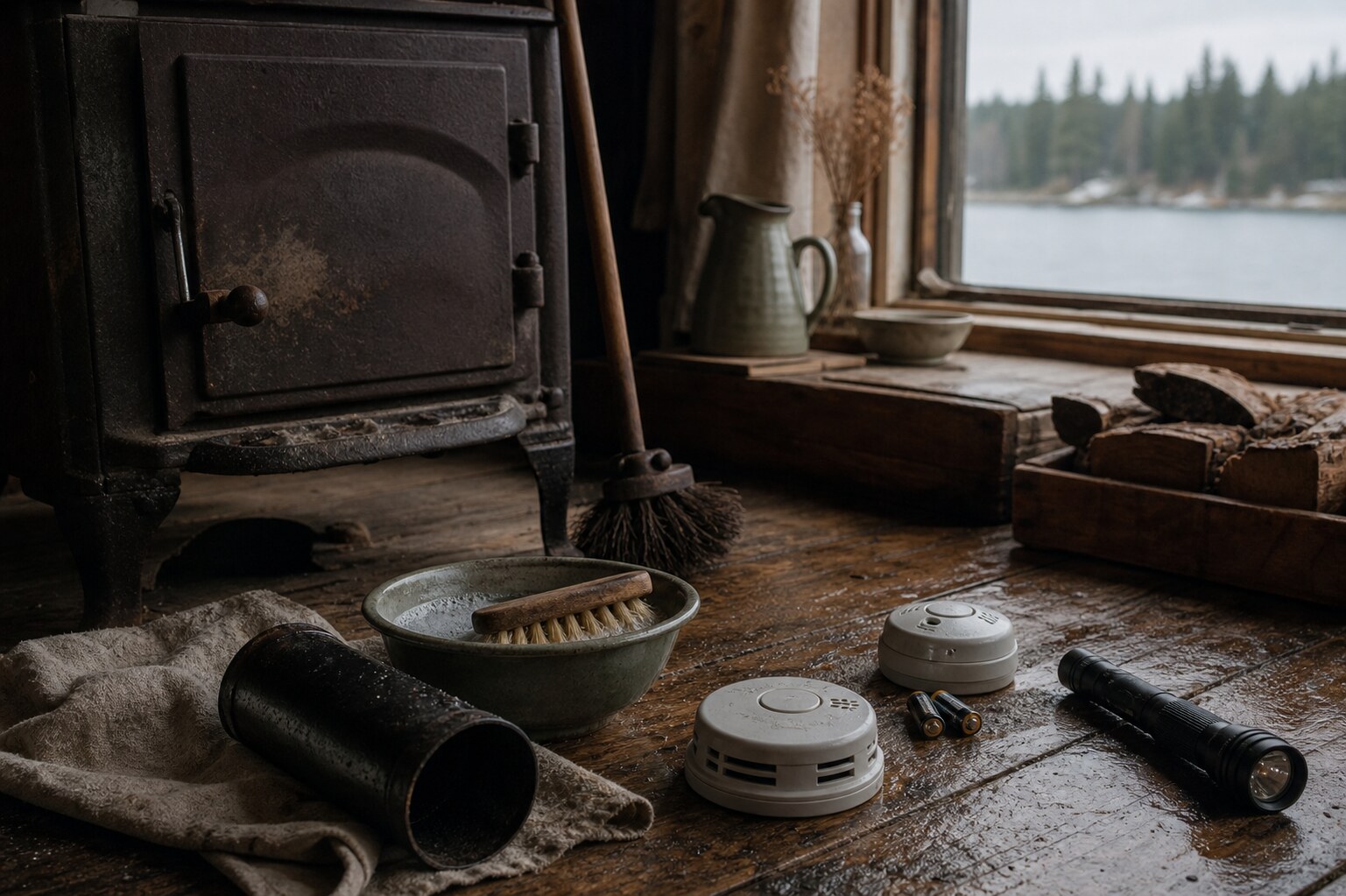
Most of opening a cottage is inconvenience — cold water, dead batteries, mouse mess. Three parts of it are not inconvenience. Three parts can hurt you, and they all come due before the first fire and the first night. Do them deliberately, before you get comfortable.
The propane leak test
A winter of freeze and thaw works fittings loose. And any time the gas has been shut off — a closed tank valve all winter counts — a leak test is required before you light a single thing. This isn’t caution. It’s the rule.
Here’s the test. Brush a leak-detector solution, or just thick soapy water, onto the tank valve, the regulator, and every fitting you can reach. Don’t use a soap with chlorine or ammonia in it — those corrode brass and copper. Then open the tank valve slowly and watch. Bubbles growing anywhere means gas escaping there. If you find bubbles, close the valve, tighten the fitting — snug, not gorilla-tight — and test again. If they keep coming, shut it off and call a technician; you’re done for the day on that appliance.
And the line that should be tattooed somewhere: never look for a gas leak with a flame. Not a lighter, not a match, not “just to check.” Soapy water and your eyes are the entire tool kit.
While you’re there: open that tank valve slowly for the working reason too, not just the test. Snap it open fast and the excess-flow safety reads it as a rupture and shuts you out, and you’ll stand there baffled. Slow every time.
The chimney, before the first fire
If there’s a wood stove, it gets looked at before it gets lit.
You’re checking the things a season of cold and a possible animal tenant leave behind: clearances to anything combustible, the chimney height and cap, cracked mortar or flue tiles, a damper that still moves, and creosote. The threshold that matters is about an eighth of an inch of buildup — at that point it’s cleaned before you burn, and any hard, glassy, tar-like creosote gets dealt with by someone with the right tools, because that kind doesn’t brush off and it’s what chimney fires are made of.
Check the vents too — dryer, stove, furnace, chimney — for the nest something built in them over the winter, before you run any appliance that breathes through them.
The detectors
A cottage that sat cold for five months almost always has dead detector batteries, and sometimes a detector that’s simply aged out.
Test every smoke and carbon-monoxide alarm and change the batteries. Then check the printed date on each unit: smoke alarms are done at about ten years, CO alarms at around seven to ten. A detector past its date isn’t a detector; it’s a plastic box that beeps when you press the button and does nothing at three in the morning. You’re about to relight propane appliances and burn wood in a building you’ll sleep in. This is the night the CO detector earns its whole existence.
None of these three take long. They take attention, which is the thing in shortest supply on a busy opening day when you’d rather be on the dock. Do them first, cold and sober and before the fun, and the cottage becomes a place you can safely be tired in.