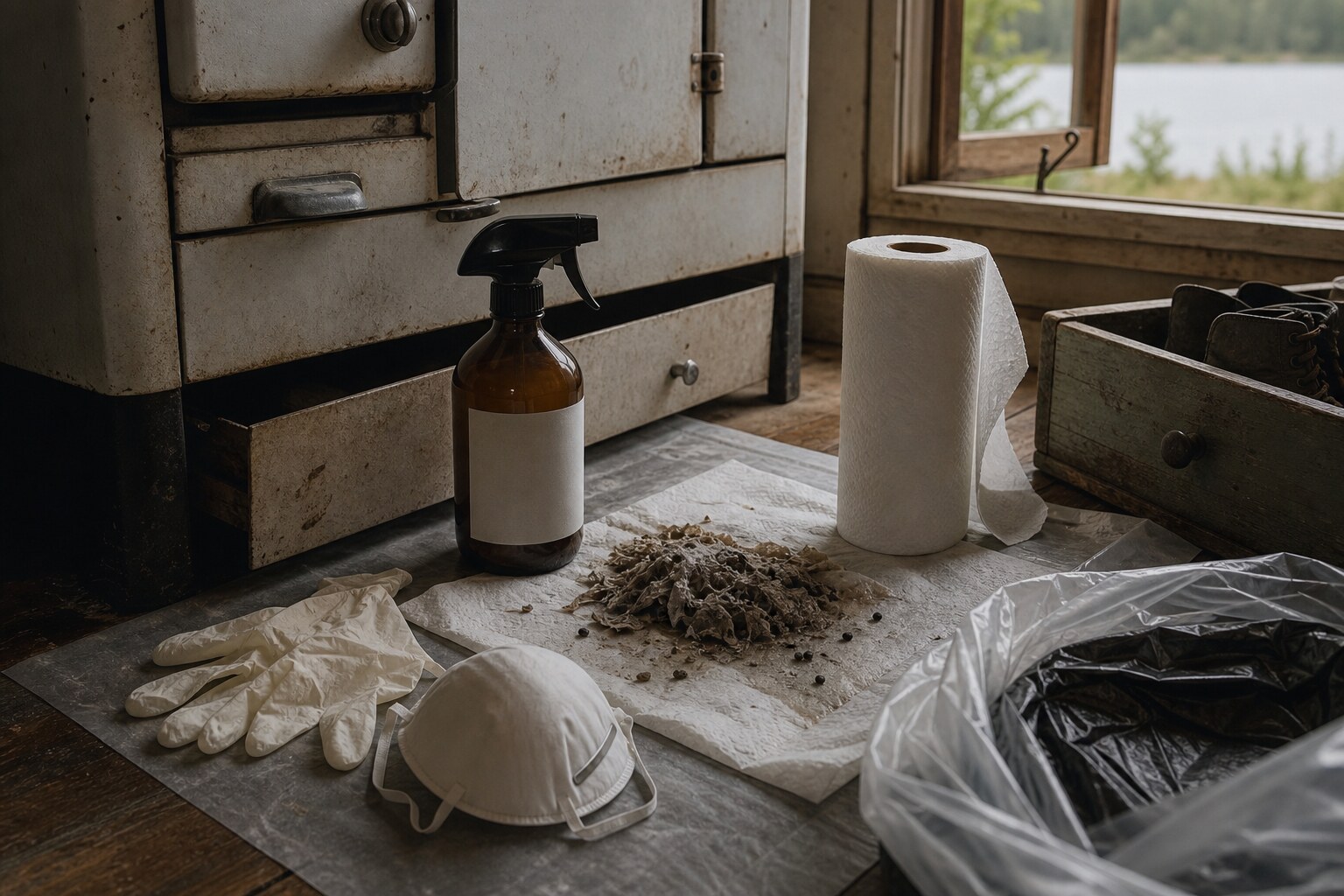
You’ll find it in the same places every year. In the back of a drawer. In the insulation you can see through a gap. In the dead space behind the stove, in a boot, in the silverware tray. Little dark grains and a nest made of something they shredded — a dish towel, the corner of a paperback, pink insulation pulled out in tufts.
The mice had the run of the place since October. This is what they left.
And here is the thing nobody tells you until they’ve told you: the broom is the wrong move.
Sweeping it stirs it into the air. So does a vacuum, worse. Dried mouse droppings and urine can carry hantavirus, and hantavirus is a breathing-in disease — it rides on the dust you’d raise cleaning the fast way. In the North this is a spring problem specifically, because the rodents nested indoors all winter and left months of it waiting for exactly the person who arrives, opens the cabin, and reaches for a broom on instinct.
So you don’t.
You open the windows and the doors first, and you leave the building for half an hour. Let the air move through before you go back in to work. It feels like wasted time. It is the opposite of wasted time.
You put on gloves. You put on a proper fitted N95 — the dust mask from the junk drawer isn’t it. You mix one part household bleach into nine parts water, fresh, in a spray bottle.
Then you wet it. Really wet it — spray the droppings, the nest, the whole area, until it’s soaked and nothing can lift off it into the air. And you wait. Five minutes at the least; ten is the number I use, because there’s no prize for the shorter one. The wetness is the whole strategy. Wet mess can’t fly.
You wipe it up with paper towel, not a rag you’ll reuse. Into a plastic bag, then that bag into a second bag, sealed. You spray and wipe the surface again. You disinfect your gloved hands before you take the gloves off, and then you wash your hands with soap and warm water like you mean it.
It is a slow, deliberate, faintly ridiculous-feeling procedure, done in a mask, in a cold cabin, on your knees behind a stove. Every part of you that grew up cleaning fast wants to just sweep it and be done.
That instinct is the only real danger in the room.
I think about this one differently than the frozen pipes and the propane and the rest. Those cost money. This one is the single job at a spring opening where doing it the quick, obvious, satisfying way is the way that can actually make you sick. So I’ve made it a rule with no exceptions, the kind you don’t get to be tired past: never the broom. Wet it, wait, bag it. Then you can open the windows the rest of the way and let the summer start.