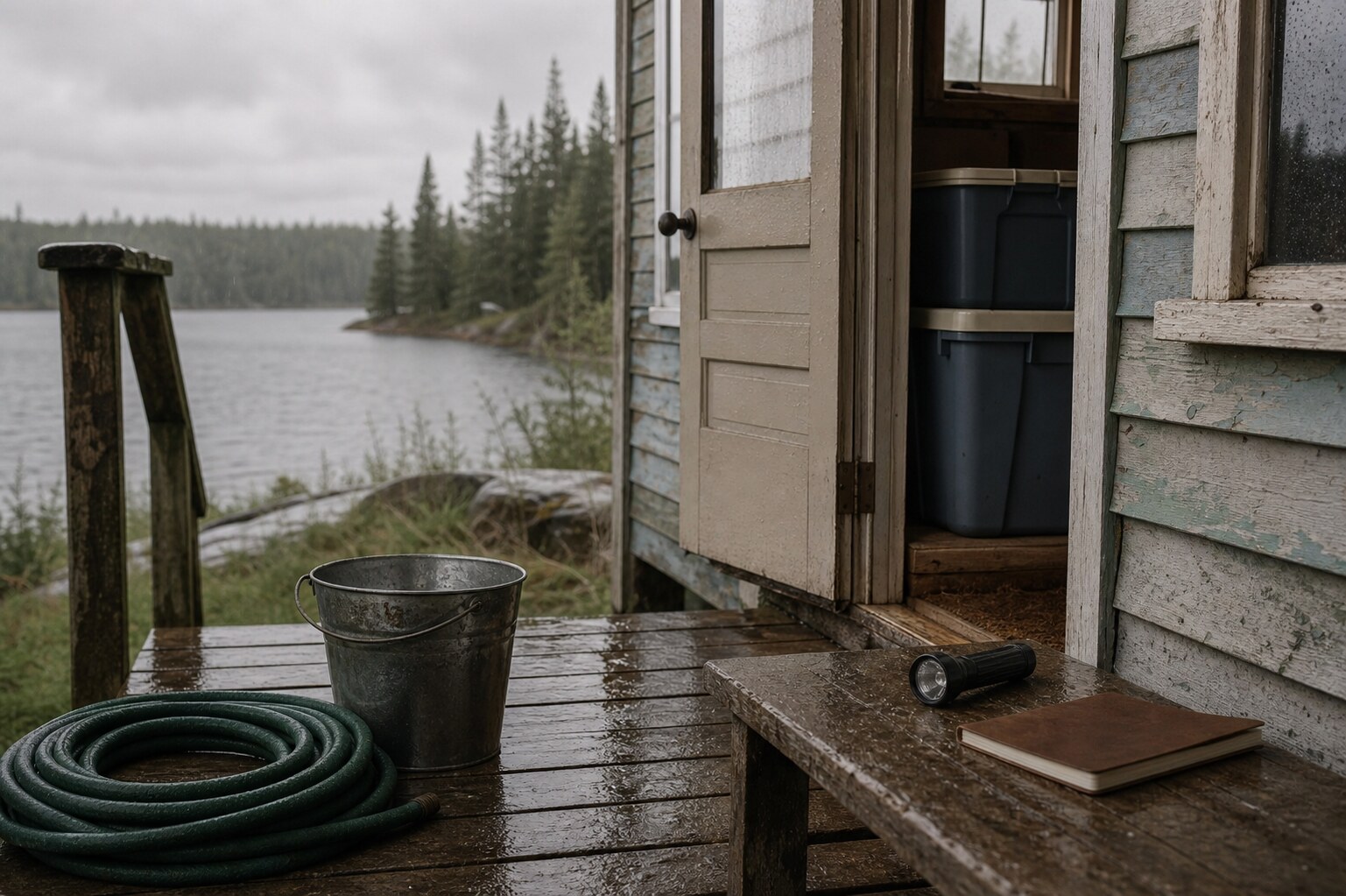
Most of what goes wrong at a cottage over the winter goes wrong because water was left somewhere it shouldn’t have been, or because something with a heartbeat moved in while you weren’t looking. Close for both and you’ve done the real work. The rest is putting things away.
I close in the Yukon, which changes the math. Down south a cottage might see a cold snap. Here, minus forty is an ordinary week, and minus forty is the same number in both Celsius and Fahrenheit — the scales meet there. The coldest morning ever recorded on this continent was at Snag, an hour or so from where some of you are reading this, and it was minus sixty-three. So I don’t trust anything to “hold” a temperature. I get the water out.
Everything you do in the fall is a guess about spring. If you want the other half of the year, opening a cottage after winter is where the guesses get answered.
What do you do about the water?
You get it out. All of it. That’s its own long story and I’ve told it here, because it’s the part that floods cottages and it deserves the space. The short version: shut off the pump, drain the tank and the water heater, blow the lines out with air, and put antifreeze in every drain trap and every toilet. Not to keep the water from freezing — to replace the water that would.
If you leave this until you’re tired and losing light, you’ll skip a trap. The trap you skip is the one that cracks.
What food can stay?
Less than you’d think.
Canned goods are the surprise. Freezing doesn’t automatically ruin a can — the thing that matters is the seal. A can that froze solid but kept its seams and didn’t bulge is fine when it thaws, even if the texture went a little sad. A can with a split seam or a bulging lid is a different story: if it thawed to room temperature, it goes in the garbage. Don’t taste it to check. Botulism doesn’t announce itself, and no soup is worth the argument.
But here’s the northern reality: in an unheated cabin, everything with water in it freezes solid, and I can’t keep the pantry above freezing to protect the seals. So the jars come home. Home-canned goods, wine, beer, anything in glass — it bursts. I’ve cleaned frozen tomato sauce off a shelf exactly once. Now the glass rides back to town with me.
Everything a mouse would want comes out too. Flour, sugar, pasta, grains, the bag of birdseed, the dog’s kibble. Sealed metal tins if it stays, the truck if it doesn’t. An open bag of anything is an invitation with your name on it.
Then unplug the fridge and the freezer, wipe them dry, and prop both doors open with a block of wood. A closed, unpowered fridge grows a science experiment by May. An open one just smells like nothing, especially with a box of baking soda inside.
How do you keep the mice out?
You keep them out. You don’t repel them.
I’ll say this plainly because a lot of otherwise good advice gets it wrong, including a tip sheet from a cottage association I otherwise respect: mothballs don’t work. Neither do dryer sheets, and neither does peppermint oil. Mice walk right past all of it. Mothballs are also a pesticide, and using them scattered around a cabin is both illegal and a bad idea for your own lungs.
What works is boring. You find the gaps — a mouse gets through a hole the width of a pencil — and you stuff them with copper mesh or cover them with hardware cloth, because a mouse can chew through steel wool and foam but not woven copper. You seal where the pipes and wires come through the wall. It’s an afternoon on your knees with a flashlight, and it’s the only thing that actually keeps them out.
What about the linens and the books?
The enemy isn’t cold. It’s damp and it’s mice, and the two arrive together.
Everything goes into storage bone dry — a damp towel folded away in October is a mildewed towel in May. Use hard-sided plastic totes with tight lids, not cardboard: cardboard wicks moisture and mice chew it like it’s there for them. Lift the totes off the concrete floor, because concrete pulls moisture up into whatever sits on it. A few silica packs inside each bin earn their keep.
Books get their own rule: never store them in cedar. Cedar keeps moths out of your wool, but its oils migrate into paper and stain it for good. Cedar for the linens, acid-free boxes for the books.
Mattresses and cushions are prime nesting material, so stand them on edge, wrap them in something breathable, and get them off the floor.
What about the propane?
Turn the burner valves off, set the water heater and furnace to pilot or off, then close the main valve at the tank. Closing the tank valve over a long winter also keeps it from seizing. Small barbecue and portable cylinders come home.
In spring, open that tank valve slowly. Fast, and the safety valve reads it as a leak and shuts you out, and you’ll stand there confused for twenty minutes like I did the first time.
What gets forgotten?
The traps under sinks nobody uses. The outdoor tap. The water in the washing machine’s hose. The one window left cracked. The banana on the counter.
Make the last thing you do a slow walk through every room with nothing in your hands, looking. Not carrying, not fixing. Just looking. That’s when you see the tap you left half-drained and the window you meant to latch.
Then lock the door. But locking the door isn’t closing the cottage. Closing the cottage is everything you did in the four hours before the door — the water gone, the glass in the truck, the copper in the gaps, the freezer breathing with its mouth open in the dark. The lock is just the last thing your hands touch on the way out.