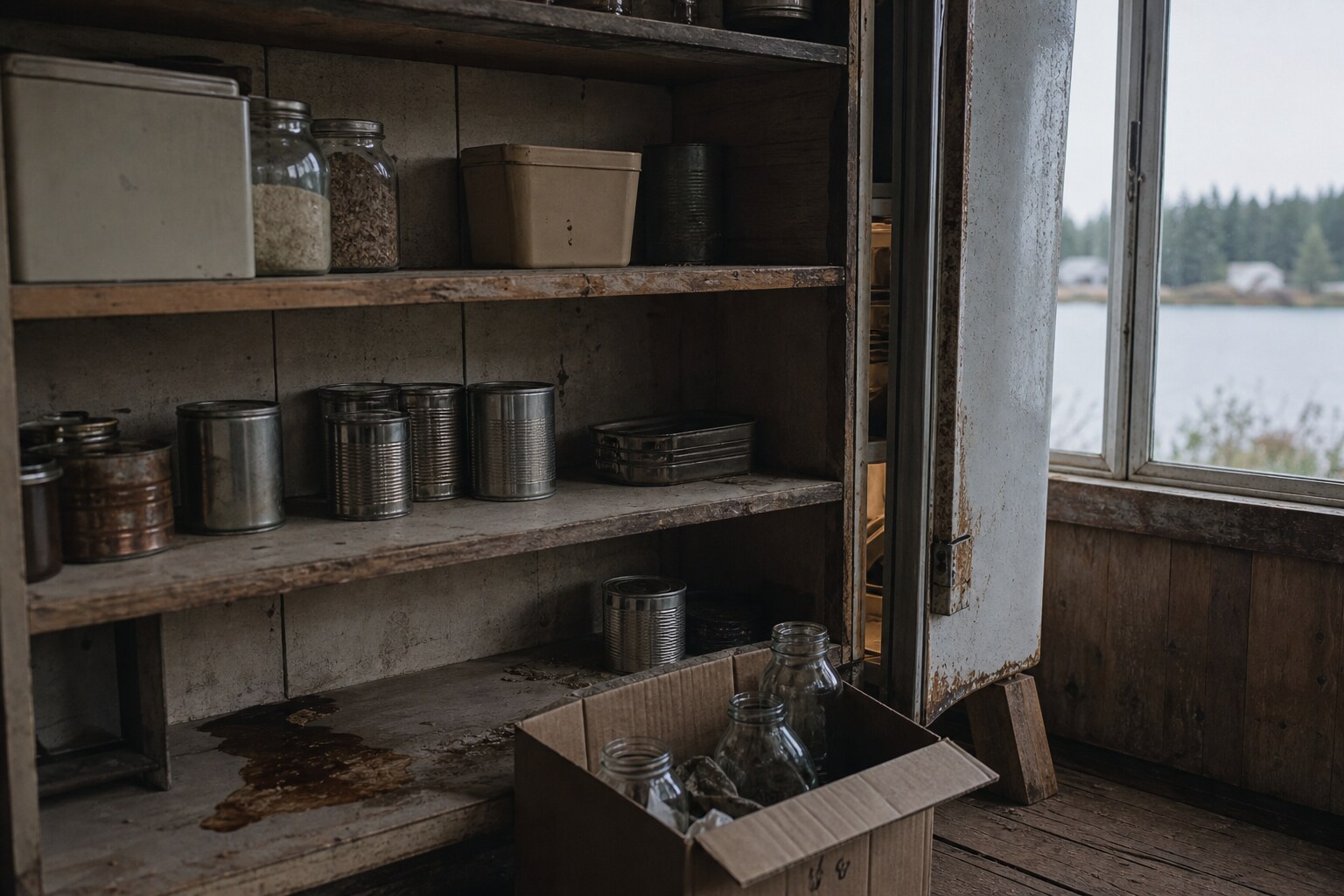
The pantry is the part people wave off. They pull the perishables, glance at the shelves, and figure cans are cans. Then in spring they meet a burst jar of tomato sauce that spent four months redecorating the shelf below it, and they revise their thinking.
In an unheated cabin the governing fact is simple: everything with water in it freezes solid. Not “gets cold.” Freezes, expands, and pushes on whatever’s holding it. So the pantry question isn’t what will spoil — it’s what will survive being frozen and thawed, and what will burst while it’s at it.
What can actually stay?
Metal cans, mostly — with a catch I’ll get to. Dry goods in sealed containers. Honey, salt, sugar, which don’t really care about anything. Vinegar. Oil will cloud and solidify and come back fine, if it’s in something that won’t crack.
Which brings us to the catch.
The truth about canned goods and freezing
Freezing does not automatically ruin a can. I know that runs against instinct. What matters is the seal, not the ice.
A can that froze solid but kept its seams intact and didn’t bulge is safe when it thaws. The texture might go a little soft or watery — freezing ruptures things at a level you can taste — but it won’t hurt you.
A can with a split seam or a bulging lid is the one to respect. If it thawed back to room temperature, throw it out. You can only salvage it if it’s still at fridge temperature — about 40°F — in which case move the contents to another container and refrigerate or refreeze right away.
And the rule under all the other rules: when in doubt, throw it out, and never taste a suspect can to decide. Botulism gives no warning taste. There is no can worth that.
Why the jars come home anyway
Here’s where the northern reality overrides the tidy version. To protect those seals you’d need to keep the pantry above freezing — above about 34°F — and I can’t do that in a cabin I’m walking away from until May. So I stop trusting the seals to survive and I just take the vulnerable things home.
Anything in glass rides back to town: home-canned goods, wine, beer, pop, bottled condiments, oil in glass. Glass and freezing water are not friends. I learned this with a shelf of sauce exactly once.
What has to leave no matter what
Everything a mouse would cross a field for. Flour, sugar, pasta, rice, oats, the crackers, the bag of birdseed, the dog’s kibble. If it stays, it stays in sealed metal or hard-lidded containers a mouse can’t chew — not the bag, not cardboard, not a plastic tub. Otherwise it comes with me. An open bag of anything is a printed invitation.
The alcohol comes home too. It freezes and bursts like everything else, and a visible bottle through a window is its own kind of temptation for whoever wanders by.
The fridge and freezer
Unplug both. Wipe them dry. Then prop each door open with a block of wood or a wedged chopstick.
A sealed, unpowered fridge is a terrarium by spring — it grows things you have to meet with a bucket. An open one just smells like nothing, especially with an open box of baking soda sitting on a shelf inside.
That propped door looks wrong every time. It’s the most reliably right thing in the whole kitchen.
The real test
The pantry is done when nothing left on the shelf can burst, feed a mouse, or grow a colony. Walk it with that question, shelf by shelf, and you’ll pull three more things than your first pass said you would.
Then it’s just cans and quiet, waiting for a cook who won’t be back for a while.