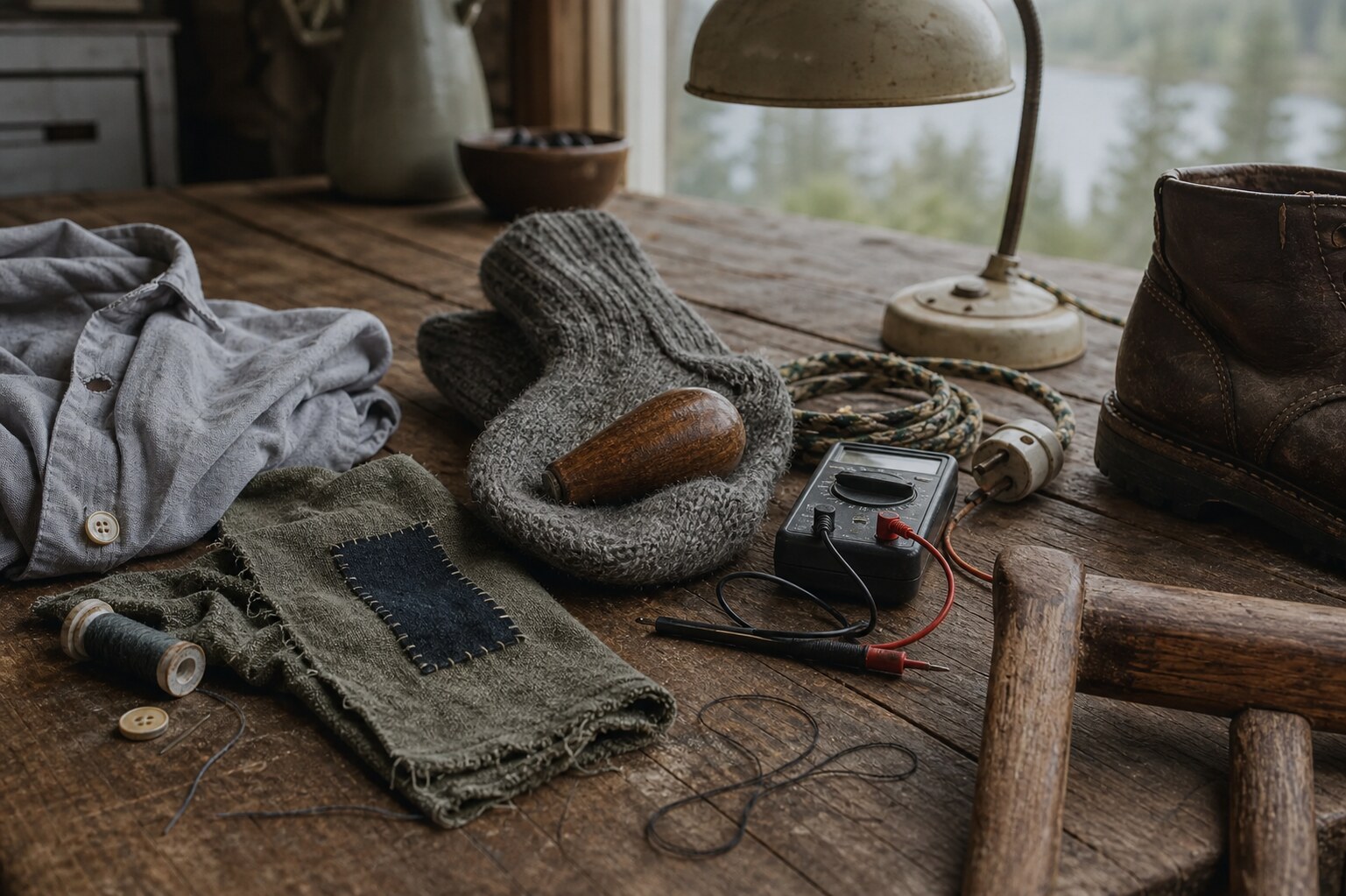
Most people who want to fix their own things start in the wrong place — usually with something electronic that died, which is the single hardest category to win at. Then it doesn’t work, and they conclude they’re not handy. They’re not un-handy. They just picked a fight they were likely to lose.
There’s good data on this, from the Repair Café movement — thousands of volunteer-run repair events, started in Amsterdam in 2009, now more than three and a half thousand of them worldwide, and they log what comes in and whether it got fixed. The pattern is clear and useful: non-electrical things — textiles, mechanical items, furniture — get successfully repaired around 85% of the time, while electrical and electronic items succeed closer to 56%. So the beginner’s path isn’t a mystery. Start where the odds are with you, build the confidence and the hands, and work toward the hard stuff later.
Here are the five I’d learn, in order.
1. Sew a button back on
The most useful repair there is, and nearly free to learn. A needle, thread, a few minutes. It’s on every “how did I not know this” list because a shirt with a missing button is otherwise a shirt in the giveaway pile over ten cents of thread. Learn the knot, the running stitch, the backstitch. Everything else in mending is a variation on these.
2. Patch a hole or a torn seam
The next step up, same tools. A blown seam is just re-sewing a line someone already sewed. A hole is a patch — a scrap of fabric bridged across the gap. Once you can do this, a huge share of “ruined” clothes turn out to be twenty minutes from fine. And you can do it so it shows, on purpose — more on that here.
3. Darn a sock or a worn knit
Now you’re weaving, not just stitching, and it feels like a real skill because it is one. A woven darn rebuilds a small patch of cloth across a hole. Twenty minutes to an hour for a sock, and suddenly good wool socks last years instead of a season. This is the repair that changed how I think about wearing something out.
4. Learn to triage an appliance before you open it
Not fix — triage. Before you decide a lamp or a kettle or a small motor is dead, learn to check the easy failures: the cord, the plug, the switch, the fuse. A cheap multimeter and the willingness to look tells you whether the thing has a simple, fixable fault or a dead brain. Half the “broken” small appliances in the world have a broken cord and nothing else. Knowing whether to bother is its own skill.
5. Judge repairability before you buy
The last one isn’t a repair. It’s the judgment that makes all the others possible, and it happens at the store, not the workbench: learning to see whether a thing is even built to be fixed. Boots with a stitched welt can be resoled for years; boots with a glued sole cannot, no matter how much you paid. A solid wood frame can be repaired for generations; a particleboard one is disposable by design. Once you can see this, you stop buying things that were built to be thrown away — which is the whole worth-repairing question.
Notice the shape of the list: it starts with cloth and a needle, where beginners almost always succeed, and it ends not at the hardest repair but at the wisest purchase. That’s the honest path into fixing your own things. Not talent. Just starting where the odds are good, and letting each small success buy the confidence for the next.