“Is it worth fixing?” is the question everyone asks when something breaks, and it’s almost always asked too late. Because the honest answer was decided long before — on the day the thing was built, and again on the day you bought it. By the time it’s broken on your bench, the verdict is mostly already in.
Let me give you the two things that actually decide it.
The 50% rule, and how it’s used against you
There’s a well-documented pattern in the repair world: a repair tends to get priced right around half the cost of a new one. Not because that’s what the fix costs, but because half is roughly the point where most people give up and buy new. It’s a behavioral number, and once you know it, you can see it working.
So when a repair quote comes in at “well, it’s about half what a new one costs,” that’s not a coincidence and it’s not necessarily the true cost of the labor. It’s the number calculated to tip you toward replacing. Knowing the rule lets you push back on it — to ask what the repair actually involves, and whether “half” is the real price or the persuasive one.
Construction decides everything, and you can see it
The deeper answer is that repairability is a physical fact built into an object, and you can learn to read it before you buy.
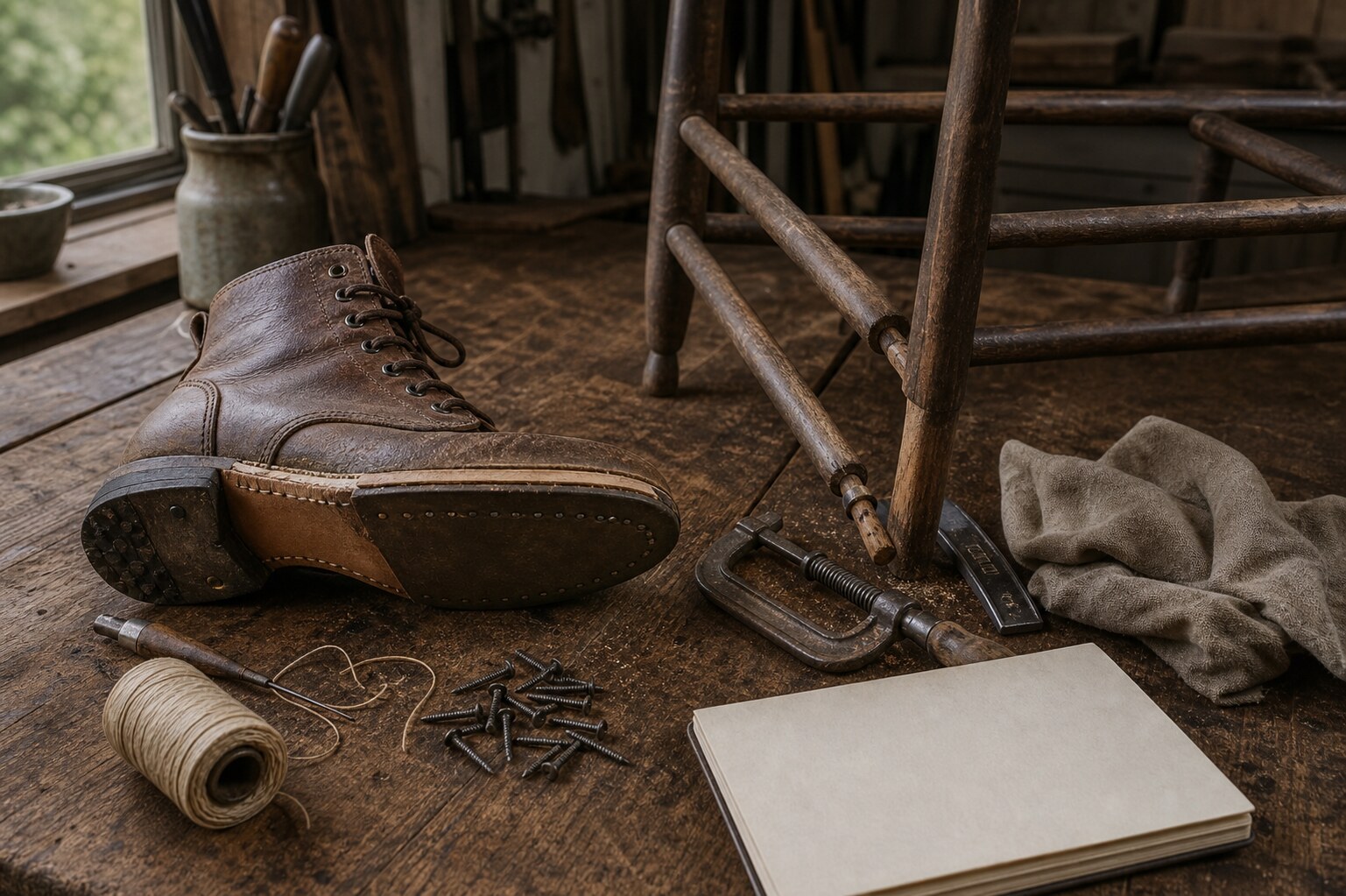
Footwear is the clearest example. A boot with a stitched welt — the sole sewn to the upper — can be resoled again and again, for a total that runs roughly seventy-five to two hundred dollars a time, and a good pair outlives a dozen cheap ones. A boot with a glued sole cannot be properly resoled at all; when the glue lets go it takes the shoe with it. Two boots can look identical in the box. One is built for decades and one is built for a season, and the difference is visible at the seam if you know to look.
Furniture is the same story. A solid hardwood frame can be reupholstered — five hundred to a couple of thousand dollars, yes, but it comes out lasting another fifteen years and often costs less than equivalent-quality new. A particleboard frame can’t really be repaired; it’s disposable by design, and the cheap new sofa it becomes may itself be gone in three years. The reupholstery only “isn’t worth it” if you compare it to the disposable thing, not to its actual peer.
The part that isn’t about money
There’s a number I keep coming back to, from the people who study clothing and waste: keeping a garment in use just nine months longer cuts its carbon, water, and waste footprint by something like twenty to thirty percent. Mending a sweater instead of replacing it isn’t a sentimental gesture. It’s one of the larger everyday levers a person actually has.
So “worth repairing” has a wider answer than the quote in front of you. The dollars might say replace. The nine months, and the landfill, and the fact that the replacement is often worse, say otherwise.
What this changes
Once you can read construction, the question moves. You stop asking “is this worth fixing?” at the moment of the break, and start asking “is this built to be fixed?” at the moment of the purchase — which is the fifth repair skill, the one that isn’t a repair at all. Buy fewer things that were designed to last, and the whole worth-repairing question mostly answers itself, cheaply, for years.