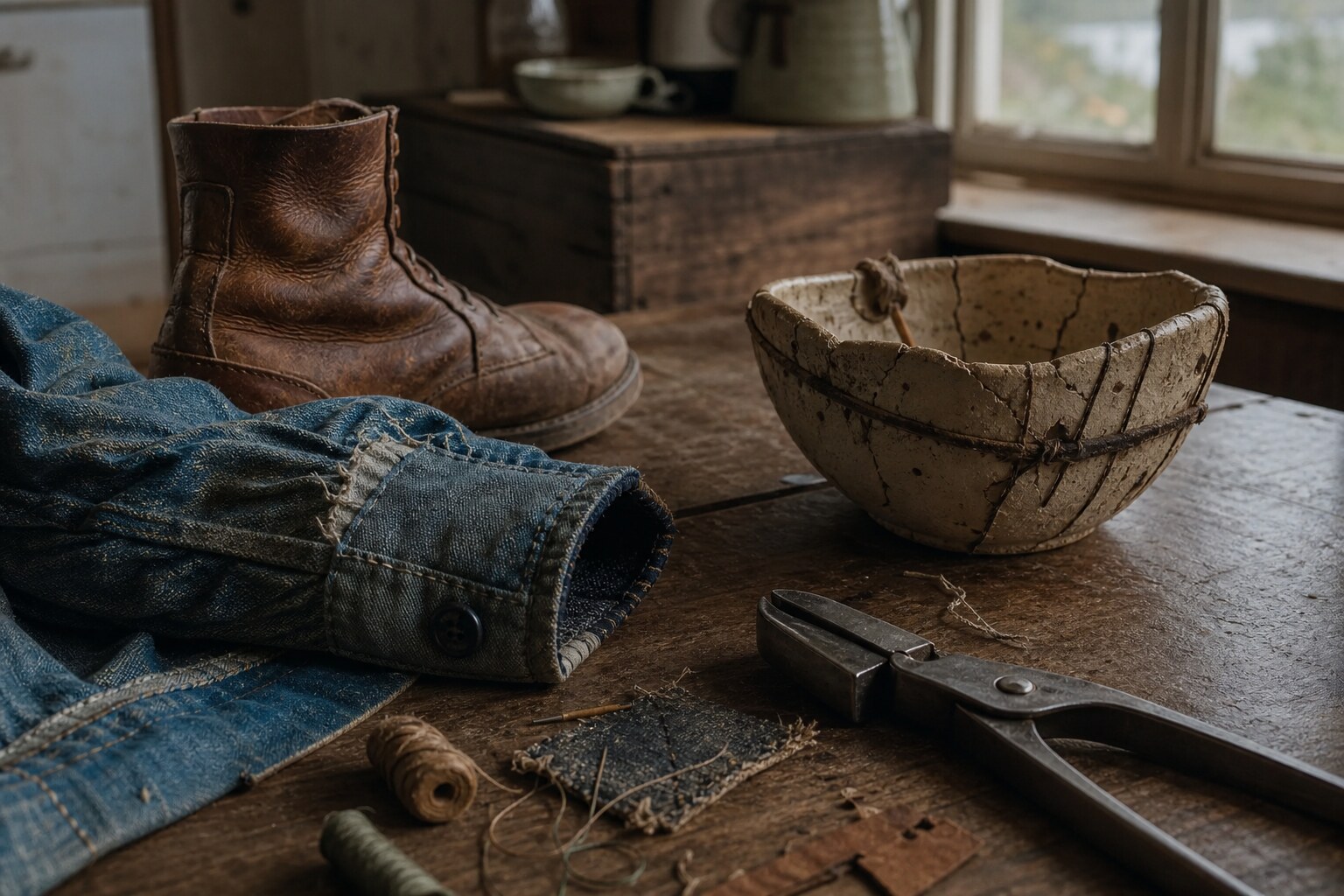
I make and mend a lot of things, and I want to say something that cuts against my own grain: the fact that something is handmade does not, by itself, make it good. Not morally, not practically, not even usually. “Handmade” is a method, not a merit, and we’ve let it accumulate a halo it hasn’t earned.
You can feel the halo working everywhere. “Artisanal” and “handcrafted” and “small-batch” are printed on things to transfer a sense of virtue onto them — sometimes onto goods that are barely handmade at all, sometimes onto industrial products borrowing the language wholesale. The words do real commercial work precisely because we’ve agreed that made-by-hand means made-with-care means somehow better. Scholars who study this call it the moral capital of craft, and they note how neatly the “labor of love” story can paper over the reality — the thirteen-hour days, the underpaid hands, the same old inequalities dressed in nicer language. The romance of craft can hide as much as it reveals.
The person who saw this most clearly saw it from the inside, and it broke his heart a little. William Morris founded the Arts and Crafts movement in the nineteenth century on a genuinely beautiful idea: that ordinary people should be surrounded by things both useful and beautiful, made well by hand rather than churned out shoddily by machine. He meant it as a democratic vision. But the handwork made his goods so expensive that only the wealthy could afford them, and he knew it, and it tormented him — he’s the one who said he spent his life “ministering to the swinish luxury of the rich.” A socialist who wanted good things for everyone, delivering exquisite handmade goods to the few, because he wouldn’t use the machines that might have put them in reach of the many. He never resolved it. The whole cautionary tale is right there in one man’s life: handmade can be exclusionary, self-deceiving, and a luxury pretending to be a virtue.
So if it isn’t the handmade-ness, where’s the virtue — because I do think making and mending are worth defending. The virtue, when it’s real, lives in things the hand and the machine can both possess or lack:
Usefulness. Does the thing actually serve, or does it mostly signal that you made it? A useful handmade object and a useful machine-made one are both good; a useless handmade one is just craft cosplay.
Durability. Was it made to last and to be repaired, or made to be admired and replaced? A boot built to be resoled for twenty years is virtuous whether a hand or a machine welted it. This is the whole worth-repairing question, and handmade-ness doesn’t answer it.
Honesty. Does it tell the truth about what it is and how it was made — including its flaws — or does it perform an authenticity it doesn’t have? A repair that shows is more honest than a flawless-looking thing hiding shoddy work underneath.
Care. Was real attention paid, to the material and to the person it’s for? This is the one thing machines genuinely can’t fake, and it’s also entirely possible to make something by hand carelessly. Care is the virtue. Handmade is just one of the places it sometimes lives.
Keep the making. Keep the mending. I’m not talking myself out of any of it. I’m only refusing the shortcut where the label does the moral work — where “I made it by hand” is offered as though it settles the question of whether the thing is any good. It doesn’t. Make useful things, built to last, honestly, with care. If they happen to be handmade, lovely. But it’s the other four words, not that one, that do the work.