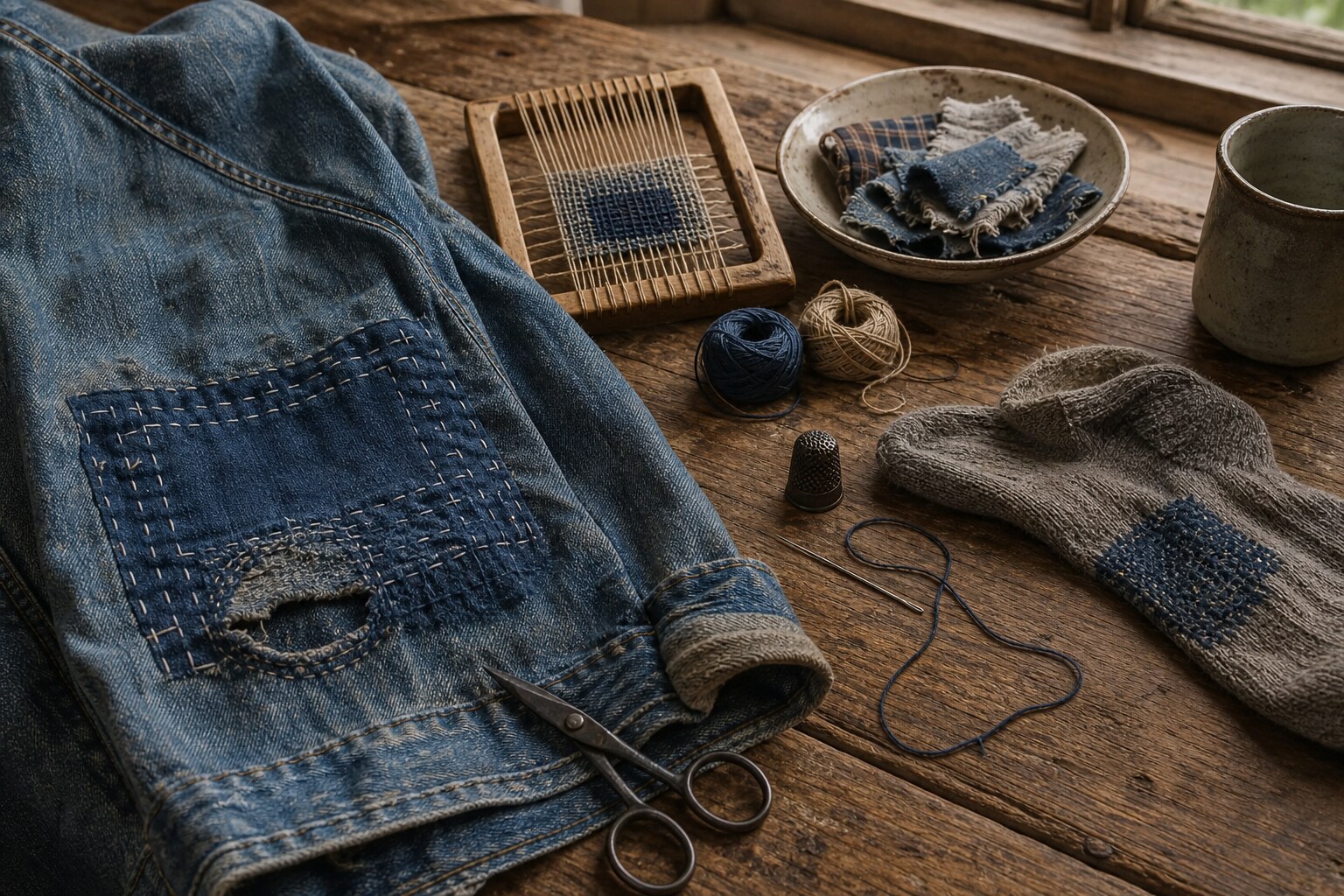
There are two honest ways to mend, and a dishonest middle. You can repair something so well it disappears — real skill, and sometimes the right call. Or you can let the repair show, deliberately, as part of the object’s life. The middle way, the botched half-hidden fix that fools no one, is the only one worth avoiding.
I’ve come to prefer the visible mend, and not only because it’s easier. A repair you can see says something an invisible one can’t: this was worth saving. But if you’re going to make the repair part of the design, it’s worth knowing the traditions you’re borrowing from, and getting their names right — because most of what’s online garbles them, and the names carry the technique.
Sashiko and boro are not the same word
These two get used interchangeably and they shouldn’t be.
Sashiko — “little stabs” — is the technique: rows of small, even running stitches used to reinforce and layer cloth. It grew up among farming and fishing families in Edo-period Japan, stitching to make work clothes warmer and stronger.
Boro — from a word meaning “tattered” — is the result: textiles built up over years from patched scraps, mended again and again until the cloth is a history of its own repairs. So sashiko is the stitching; boro is the accumulated, much-patched cloth. You do sashiko. You end up with boro. Getting this right is the difference between knowing the craft and having read one caption about it.
Darning is weaving, and there’s more than one kind
Darning isn’t stitching a hole shut — it’s weaving a new little patch of cloth across the gap.
A woven darn (or stocking darn) lays a set of parallel threads across the hole in one direction — the warp — then weaves a second set over and under them at right angles — the weft. You’re building a tiny woven fabric in the wound. This is what fills an actual hole in a sock.
Swiss darning, also called duplicate stitch, is a different animal: it traces the path of the existing knitted stitches on top of thinning knitwear, reinforcing it and keeping the stretch. It’s nearly invisible and lovely for a worn patch — but it isn’t a hole-filler, because it needs stitches still there to follow. Woven darn for a hole; Swiss darn to shore up a thin spot before it becomes one.
If weaving by hand sounds fiddly, there’s an old tool for it — a small darning loom (the “speedweve” style, from the 1940s) that holds the warp threads under tension so you only weave the weft. It mechanizes exactly the tedious half.
Patch it loud, if you like
Simplest of all: a patch is a piece of fabric laid over the damage. Make it match and it vanishes; make it contrasting, with bold visible stitching, and the repair becomes the best-looking part of the garment. That’s the whole visible-mending idea — the mend as ornament, not apology.
The idea has a name in broken pottery, too
The philosophical home of all this is a Japanese repair you’ve probably seen: kintsugi, “golden joinery” — mending broken ceramics and drawing gold along the seams so the breaks are illuminated rather than disguised.
It’s worth being honest about kintsugi, because it’s romanticized past recognition online. Real kintsugi is a slow, weeks-long process using urushi, natural lacquer, dusted with actual gold — not the epoxy-and-gold-glitter kits sold as kintsugi, which are a modern shortcut. Its exact origins are genuinely unknown; the popular tale of a shogun and a broken tea bowl is a legend, not documented history. What’s real is the idea it came to carry — kin to wabi-sabi, the finding of beauty in wear and imperfection: the repair is highlighted, and the break becomes part of the object’s worth rather than a flaw to hide.
That’s the whole spirit of a visible mend, whether it’s gold on a bowl or bright thread on a sleeve. The thing broke. You kept it. You didn’t pretend otherwise. If you’re just starting to fix your own things, the mending skills here are numbers two and three on the list of five.