Almost every flooded cottage I’ve heard about flooded because a little water was left in a pipe, a trap, or a tank, and that little water froze, and freezing water is a slow, patient wedge. It doesn’t matter how small the amount is. A tablespoon in the wrong elbow will split a copper line, and a split copper line in April can move five or ten litres a minute onto a floor nobody will see for weeks.
So the job isn’t to protect the water. The job is to remove it.
Turn it off first
Shut off the well pump at the breaker, or close the main supply valve. Tape a note over the breaker so nobody flips it back on out of habit. Everything after this depends on no new water arriving.
Drain it, high to low
Open the lowest drain valve in the system. Then open every faucet in the place, hot and cold, working from the top floor down. You’re not just letting water out — you’re breaking the vacuum so the lines can gravity-drain instead of holding their contents like a straw with your thumb over the end.
Drain the pressure tank all the way. Drain the water heater — but read the next line before you touch it.
If the water heater is electric, flip its breaker off first. An element that fires up in an empty tank burns out in seconds. If it’s gas or propane, set it to pilot or off first. Then put a hose on the tank drain and empty it, and leave the drain open for the winter.
Blow the lines out
Gravity gets most of it. Air gets the rest, and the rest is what cracks pipes.
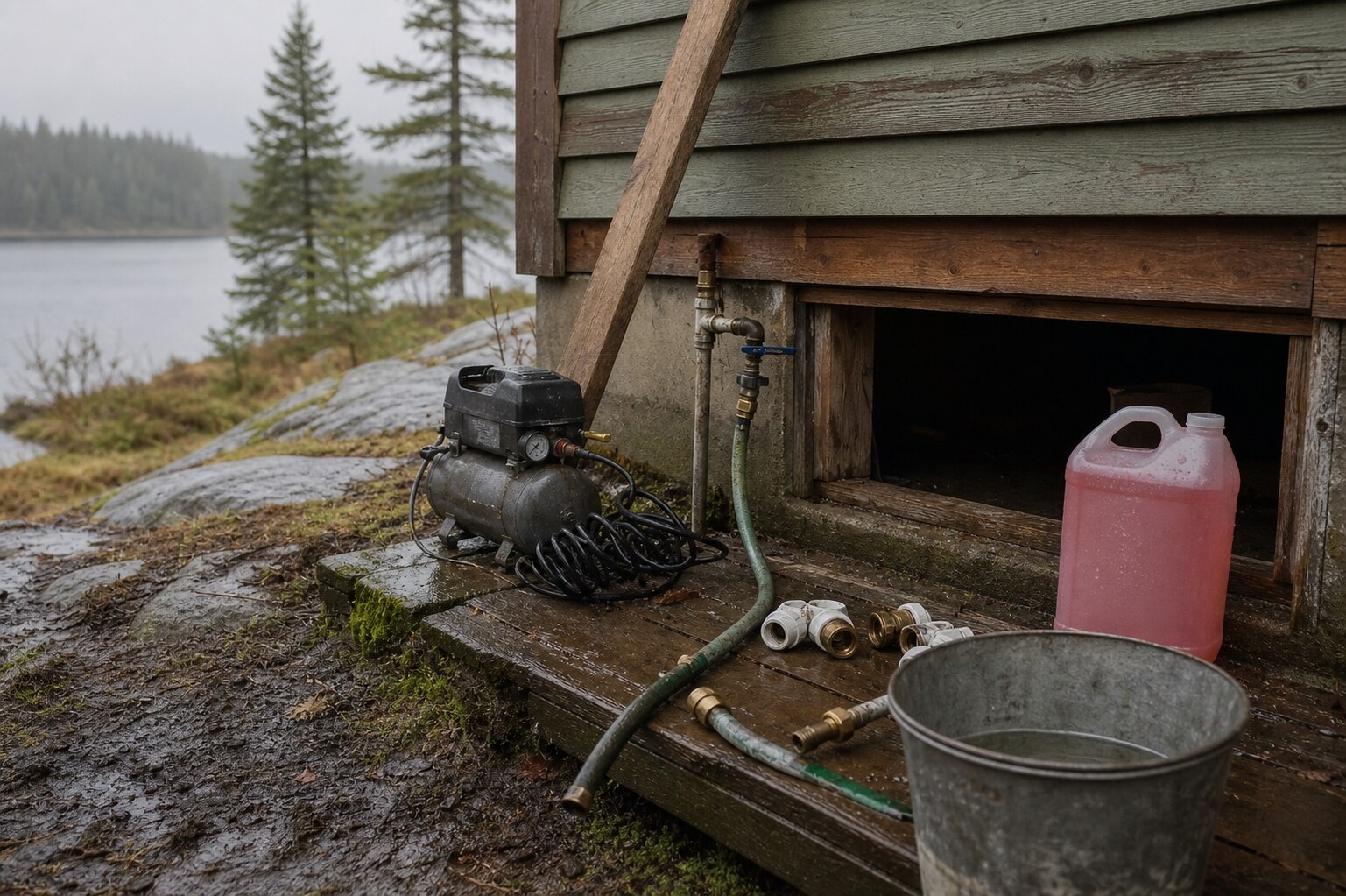
Put a small compressor on the system and push the standing water out of the lines, one fixture at a time, until you get vapour and then nothing. Keep the pressure low — thirty to fifty psi is plenty. Do not go past about ninety. Plastic fittings and the pump itself will crack under too much air, and then you’ve caused in September the exact problem you came to prevent.
This is the step people skip because gravity looked like it did the job. In a mild climate you might get away with it. Here you won’t.
The traps and the toilets
Every drain has a trap — a U-bend holding a little standing water to block sewer gas. That standing water freezes and splits the trap. So into each one goes non-toxic plumbing antifreeze: a cup or two per sink trap, about two cups for a shower drain, and roughly half a gallon down each toilet after you’ve flushed it empty and sponged out both the tank and the bowl.
Don’t forget the ones you can’t see: the dishwasher, the washing machine’s pump and hoses, a water softener, filter housings, any hydronic heating loop, and the outdoor taps.
Now, the antifreeze itself
This is where I get particular, because the label lies to you by telling the truth in small print.
Use RV or marine “plumbing” antifreeze, which is propylene glycol. It’s non-toxic — the same glycol is a food additive — and it won’t poison a water line you’ll drink from in spring. Never use automotive antifreeze. That’s ethylene glycol, it’s sweet, it’s poison, and it has no business anywhere near a potable system.
Now the part almost nobody reads. Freeze point and burst point are not the same number. RV antifreeze is sold as burst protection. A jug labelled “−50°F” does not stay liquid to minus fifty. It turns to slush at about plus twelve degrees Fahrenheit — it just slushes gracefully instead of expanding hard enough to crack the pipe, all the way down to minus fifty. That’s the promise: not “stays liquid,” but “won’t split the pipe.”
For a Yukon winter, minus fifty of burst protection can be the ordinary week, not the worst case. They make higher grades — a “−100°F” product that actually freezes around minus sixty. If your traps could see colder than the jug protects, buy the colder jug.
And do not dilute it. It comes pre-mixed from the factory to hit its rated number. Add water “to stretch it” and you raise both the freeze point and the burst point, and you’ve quietly undone the whole thing.
Why I don’t leave the heat on instead
Some people keep a cottage just warm enough — ten or twelve degrees — and have someone check it every other day. Insurers will accept that, and they’ll accept a full drain-down. What they won’t accept is an unheated place left full of water with no precautions; that’s the claim they deny.
Here, “just leave the heat on” means betting a whole winter, at minus forty, on a furnace and a power line that both have to survive until May. I don’t make that bet. I get the water out, and then there’s nothing left to freeze.