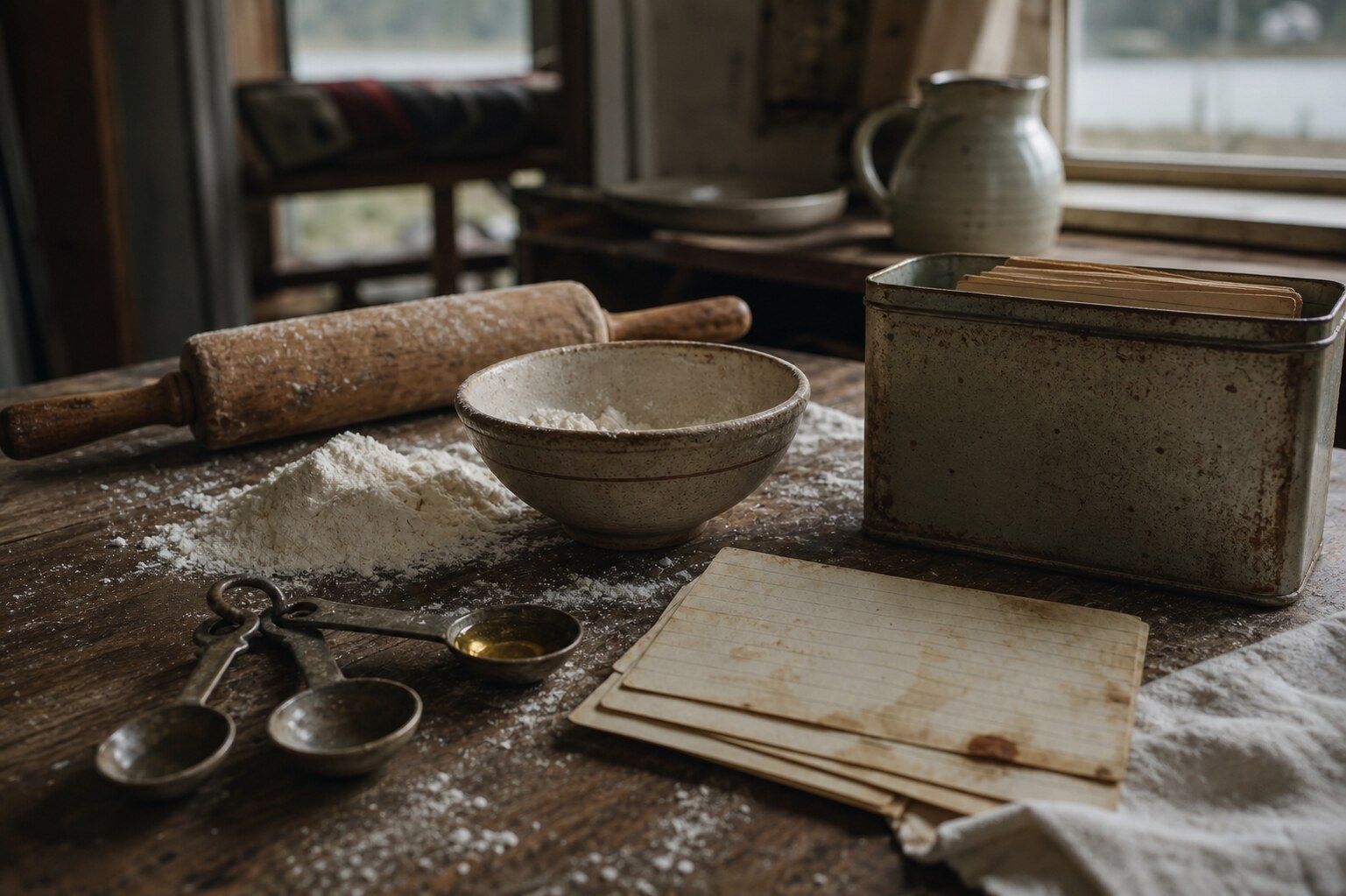
Every family has one: the recipe that isn’t a recipe. A card in a slanting hand, or no card at all, that says a handful of this, a good glug of that, flour until it feels right, bake until it looks done. You ask your mother how much and she says “you know, enough,” and she isn’t being cagey. She genuinely doesn’t have a number, because she never used one.
People treat this as a failing — as if grandmother was just careless, and if she’d been more rigorous we’d have the real recipe. I’ve come to think it’s the opposite. The imprecision isn’t a flaw in the recipe. It’s a clue about how the recipe was meant to travel.
There are two completely different ways to hand a dish to someone else, and they pull in opposite directions.
One is to write it down for a stranger — someone who has never seen the dish, isn’t standing in your kitchen, and can’t ask. For that, you need everything pinned. This is what professional baking does, and it’s ruthless about it: flour is 100%, and every other ingredient is a percentage of the flour’s weight, so the formula can be scaled to any size and reproduced exactly by someone who’s never met you, in a kitchen you’ll never see. It’s a marvel of precision. It has to be, because it’s built to survive the absence of the person who knows.
The other way is to remind someone who was already there. A family recipe was never written to travel to strangers. It was learned by standing next to someone — watching the hands, smelling when the onions were right, being told “here, feel this” as the dough came together. “A handful” and “until it feels like an earlobe” and “bake until it smells done” aren’t instructions. They’re memory aids for a person who already carries the dish in their hands and just needs the sequence jogged. The precise version would actually be worse for them — a stranger’s document for something they know in their body.
This is old, by the way. It isn’t a modern lapse. Recipes for most of history assumed the reader already knew how to cook — how fine “chopped” was, how much “a handful” held, how hot the fire — because the alternative, spelling out every motion, would have been absurd to a reader who’d cooked their whole life. The recipe was a reminder among people who shared a kitchen’s worth of common knowledge.
What that kind of recipe carries, that a precise one can’t, is judgment. Learn a dish by number and you can reproduce it. Learn it by standing beside someone and you learn to read it — you learn that it’s done when it looks and smells and feels a certain way, not when the timer goes, and you learn why, so you can save it when the pan runs hot or the flour is damp. The vague recipe transmits the one thing the exact recipe leaves out: how to tell.
It does have a cost, and it’s worth being honest about it. What travels by presence can be lost, or bent a little each generation, the way a story changes down a line of people. Get the number and you have it forever, flat and safe. Get “a handful” and you have to actually learn the dish, or it’s gone with the hands that knew it.
So I’ve stopped apologizing for the imprecise cards. When I write a recipe down for a stranger, I weigh things and give real cues, because that’s the honest way to hand a dish to someone who can’t ask me. But the ones in my own kitchen stay vague on purpose. “A handful” is what you write when you were counting on being in the room. It’s a bet that someone will stand next to you and learn it with their hands, the way you did — and it only pays off if they do.