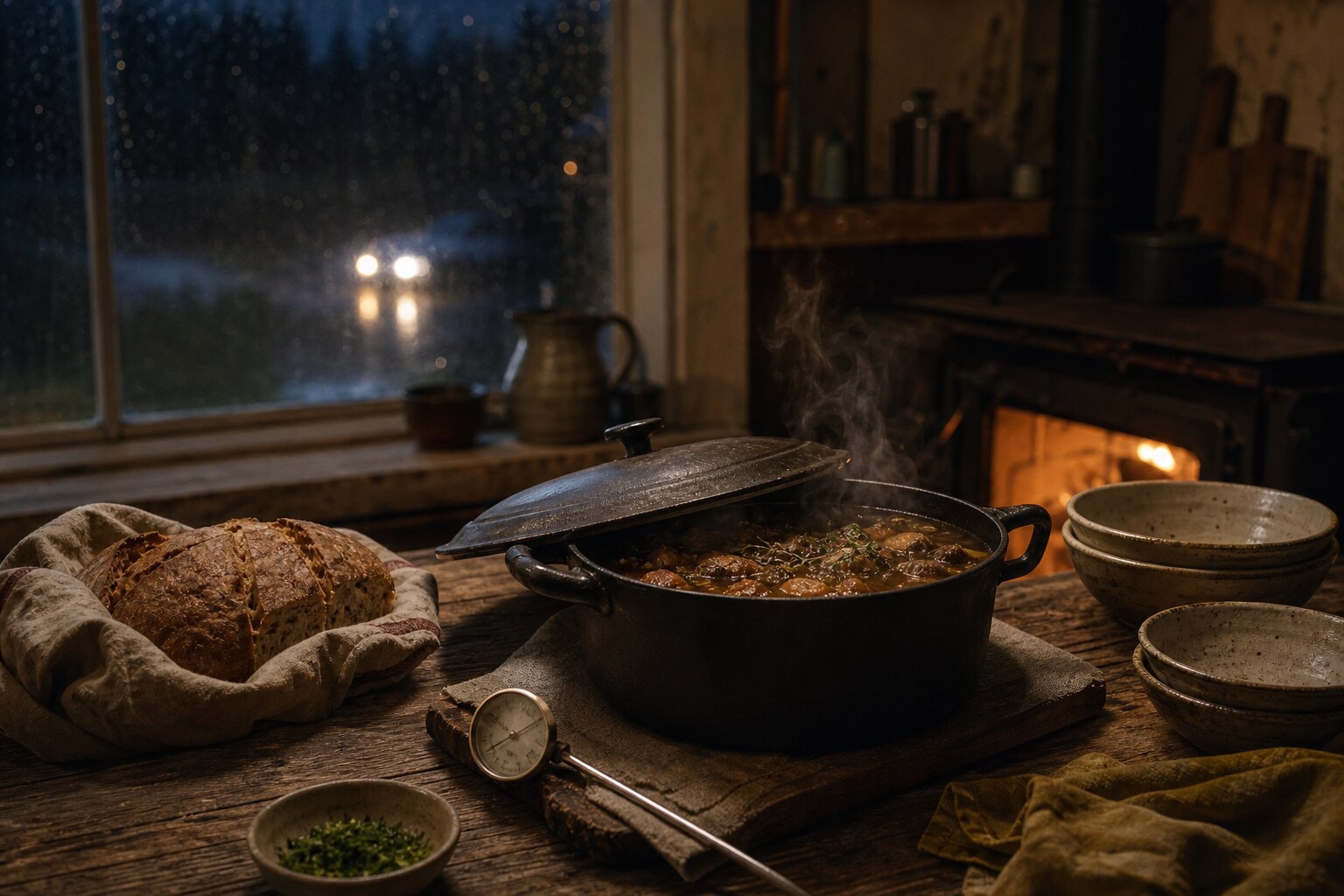
Guests are late. Roads are long here, and ferries and weather and a dog that needed one more thing all conspire, and “we’ll be there by seven” becomes a set of headlights at half past eight. A supper that can wait for that is not a lucky supper. It’s a chosen one.
The mistake is trying to hold the wrong dinner — keeping something alive that wanted to be eaten the moment it was done, hovering, re-warming, watching it dry out and dull. The move is to cook something that improves in the waiting, so that lateness works for you instead of against you.
Choose a dish that’s still cooking when it’s “done”
The suppers that wait well are the slow, wet, forgiving ones: braises, stews, tagines, big pots of beans, a shoulder cooked until it gives. They wait well because they were never really finished — they keep getting better sitting there, and here’s why, since the why is what lets you trust it.
Tough cuts are full of collagen, and collagen slowly turns to gelatin as it cooks, which is what makes a braise silky instead of stringy — and that conversion keeps happening as the pot sits. The seasoning, given an extra hour, stops sitting in layers and spreads evenly through everything. The fat rises and traps the aromas that would otherwise drift off. Even the starches settle and thicken the whole thing into itself. A stew at half past eight is a genuinely better stew than the same pot at seven. Nobody’s compromising. The lateness improved dinner.
My pot of beans and sausage is exactly this dish. So is almost anything you’d happily eat as leftovers — which is the honest test. If a dish is better the next day, it’s better in two hours too.
Hold it hot, not warm, and not on the counter
Here’s the part that’s a safety rule and not a preference, so I’ll be plain about it.
A supper only “waits” safely if you keep it genuinely hot — at or above 140°F — in a low oven, a slow cooker on its warm setting, or a heavy pot over your lowest flame with the lid on. What you cannot do is cook it, turn the stove off, and leave it covered on the counter to “stay warm.” Between about 40°F and 140°F is where bacteria are happy, and cooked food left sitting in that range shouldn’t rack up more than two hours total before it’s a problem — and that clock includes the time it’s already spent cooling on the counter while you waited.
So: keep the braise on low heat or in a warm oven, lid on. It sits there perfectly happy for the extra hour, above the range where anything can go wrong, quietly improving. That’s the difference between a supper that waited and a supper that merely sat.
Add the fragile things at the last minute
Some things don’t wait, and the trick is to keep them out of the waiting entirely.
Anything that was crisp goes soft. Bright green vegetables go grey and sad and overcooked if they sit hot. Cream sauces and anything emulsified — a carbonara, an Alfredo — break and turn oily when held. So you build the supper so none of those are in the pot that waits. The braise waits; the greens get stirred in when the headlights finally appear. The crust of bread gets warmed at the last minute. The fresh, sharp, crunchy thing on top is assembled while everyone’s taking off their coats.
The shape of it
A dish that improves as it sits, held properly hot, with the fragile parts added at the end. Get that shape right and you can tell your guests, honestly, to take their time — the roads are bad and the dinner is only getting better.
Lateness stops being a problem to manage. It becomes, of all things, a seasoning.