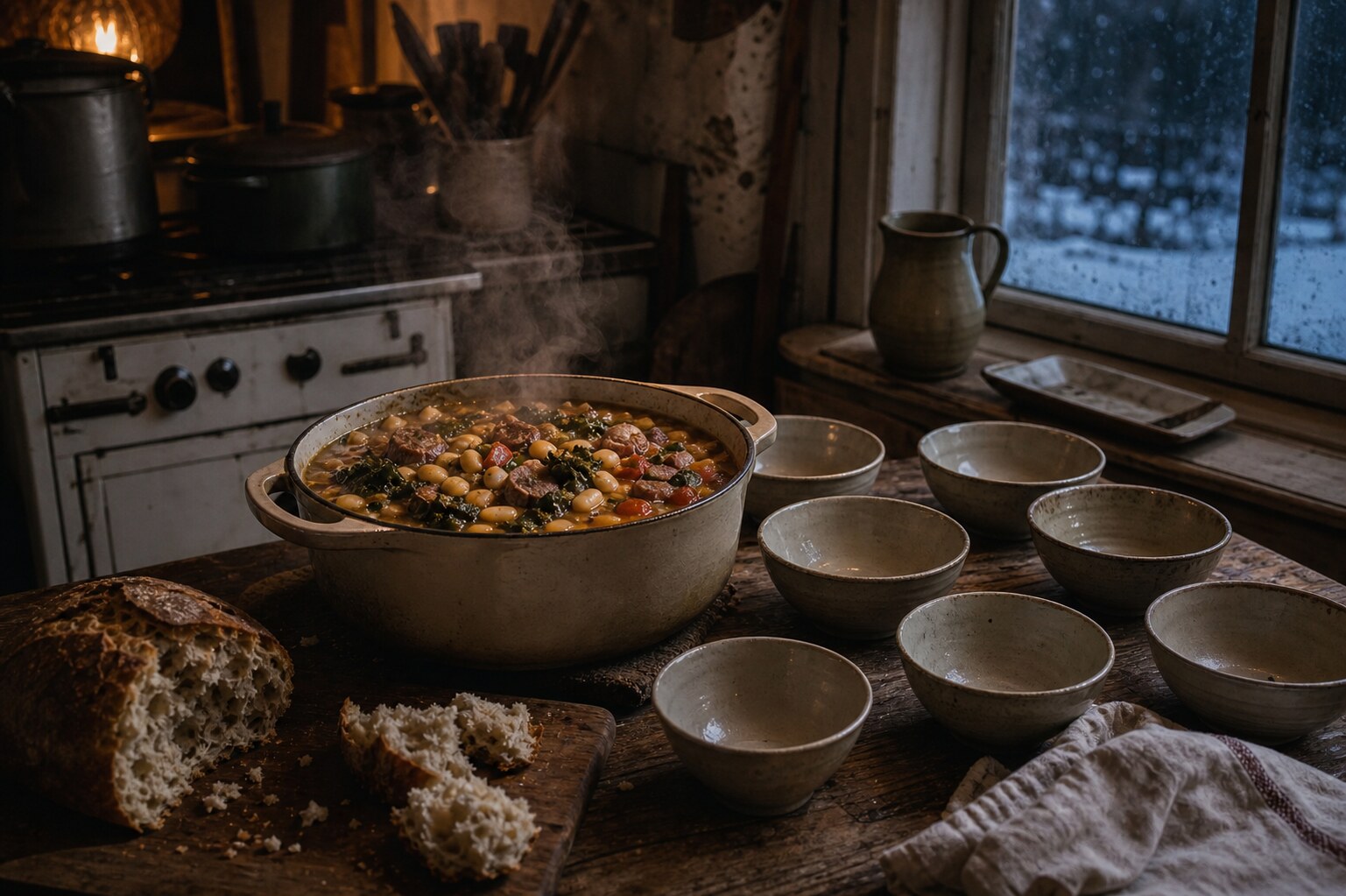
People arrive cold in the North more than most places. Off the lake, off the trail, out of a truck that took the whole drive to warm up. They come through the door with the weather still on them, hands not quite working, that particular quiet of being chilled through.
I’ll be honest about what a hot dinner does and doesn’t do here, because the internet will tell you cold weather makes you ravenous and your body demands a bigger stew, and that’s mostly a story. What’s true is smaller: your body does burn a little extra holding its heat, and a hot meal genuinely does warm you a touch as you digest it. What’s not true is that cold reliably makes you hungrier — sit someone in a cool room and they eat about the same as anyone else. So I don’t cook a cold-weather supper because science says their body is screaming for it. I cook it because a hot pot and a lit, steamy kitchen are what “come in, you’re safe, sit down” tastes like. The warmth that matters is at least half the room and the ritual, not the metabolism. That’s not a lesser reason. It might be the whole reason people cook for each other at all.
So the dish has to do three things. Be hot and abundant. Not need me hovering when the door opens and everyone’s talking at once. And be better for having sat on the stove an hour longer than planned, because people arriving cold are rarely people arriving on time.
Beans and sausage do all three.
A Pot of Beans and Sausage
Makes 6 generous bowls Time: 30 minutes active, plus a slow hour and a half — and it’s happier at two
Ingredients
500 g (about 1 lb) dried white beans — cannellini or navy — soaked overnight 500 g (about 1 lb) good coarse sausage, the garlicky kind 1 large onion, diced 2 carrots, diced 3 cloves garlic, sliced 2 tablespoons tomato paste 1 tin (about 400 g) chopped tomatoes 2 bay leaves A parmesan rind if you have one Olive oil, salt, pepper Something green and bitter to finish — kale, chard, whatever’s holding on
How it goes
Drain the soaked beans. This is the one place the ratio matters, so measure the beans by weight if you can — dried beans roughly double, and 500 g dry is the right amount of dinner for six with leftovers you’ll be glad of tomorrow.
Brown the sausage first, in the pot you’ll braise in, in a little oil. Don’t rush this — you want real color on it, dark in patches, because that browning is where the deep flavor of the whole pot is actually made. Take the sausage out and leave the fat.
Into that fat go the onion and carrots. Cook until soft and starting to catch, then the garlic for a minute, then the tomato paste — cook the paste a couple of minutes until it darkens and smells less sharp. Add the tin of tomatoes and scrape up everything stuck to the bottom.
Beans back in, sausage back in, bay leaves, the parmesan rind, and water to cover by a couple of fingers. Bring it up, then drop it to the quietest simmer your burner will give and put the lid mostly on.
Now leave it. It’s done not by the clock but by the beans: when they’re completely tender and creamy inside, not chalky, with no bite left at the center — usually an hour and a half, sometimes two. Taste one to know; the clock can’t tell you. If it’s ready before your people are, all the better. Turn it to its lowest setting and let it wait. It will only get rounder and better while it does, the beans drinking up the sausage and the tomato going soft and sweet.
Stir the greens through right at the end, just until they wilt, so they stay green instead of going grey. Salt until it tastes like something you’d want after a cold day. A hard grind of pepper. Bowls, bread, done.
When the door opens and the cold comes in wearing four people, you don’t want to be timing anything. You want a pot that’s been quietly getting better without you, a kitchen full of steam, and six bowls already warming.
The stew is not much to look at. Beige, mostly. Nobody’s photographing it. They’re too busy getting warm, which is the entire point.