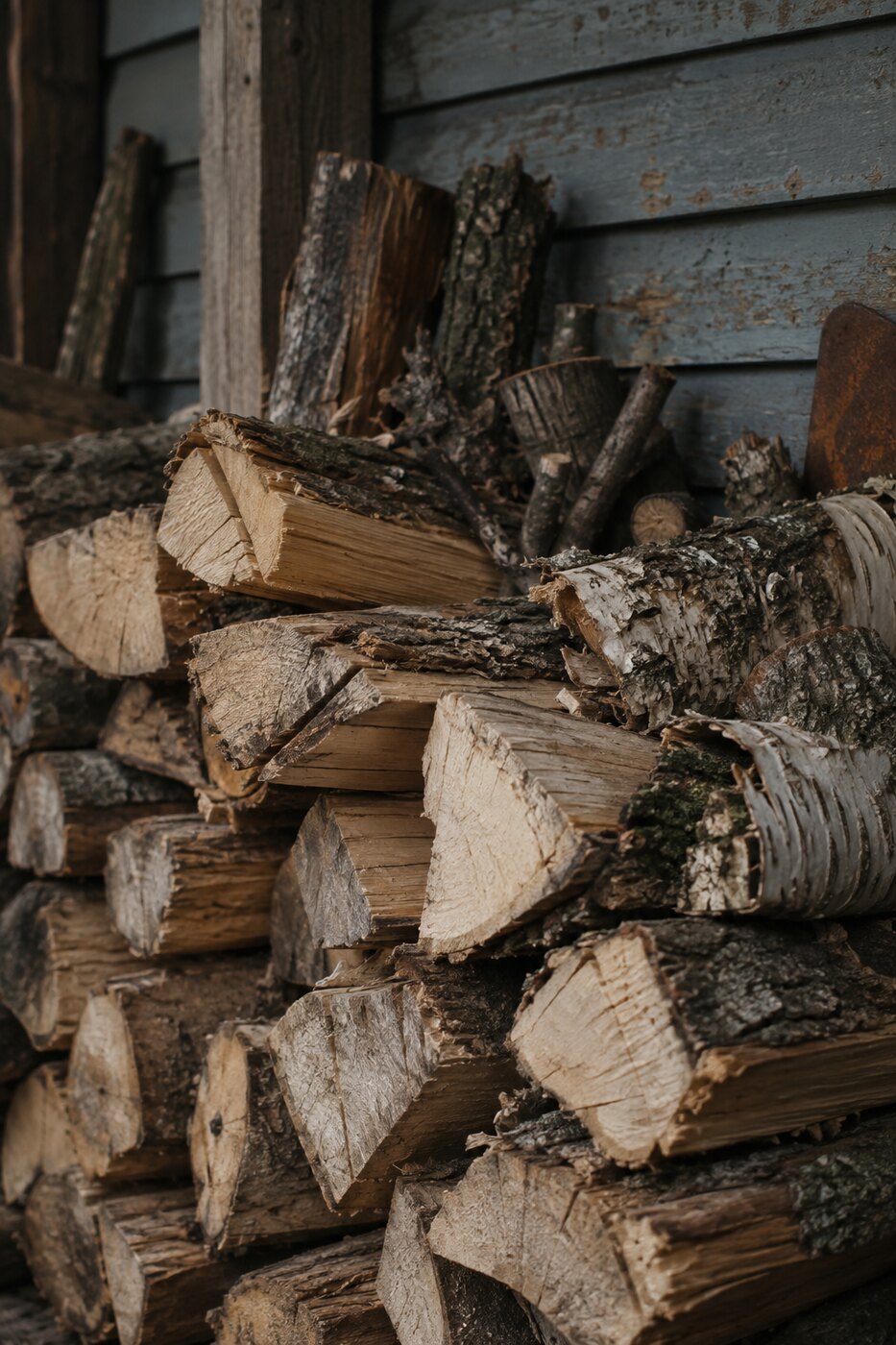
I folded the birch bark twice and pushed it under the short end. The split rocked once, then held. Damp sawdust clung to the cut face. Bark grit worked into the leather of my right glove. I pressed down. The wood held.
From the yard, the row had standards. Pale ends sat nearly flush. I put the good splits forward, face out. The line looked measured.
The mittens were too thick to judge the gap. I pulled one off and slid my bare fingers between the stack and the aluminum siding. Cold air moved through. The hidden side was cold and loose with splinters, curls of bark, one round still damp from October. I pressed the back row inward. A hollow clack answered, then a low wooden tick as the weight shifted. I tested the back by pressure and by whether the row stopped moving.
A slanted chainsaw cut leaned into a punky round. Bark slabs and cedar offcuts worked as shims. The maul had bounced off a Y-joint twice. I gave it a place near the wall. Odd lengths crossed at bad angles. Bark had employment there. I wedged a damp slab into a low gap. The friction held.
The long ends touched the siding. The aluminum gave a small creak under the load. Three old dents stayed where the maul had missed years ago. Spiders bridged the two-inch gaps with silk that caught sawdust and held it. The wall received the long ends and kept their pale scrapes.
I brought my heel to the front row and leaned. The line settled half an inch. The folded bark compressed but did not slip. One dark edge remained visible, still under the birch, taking the weight.