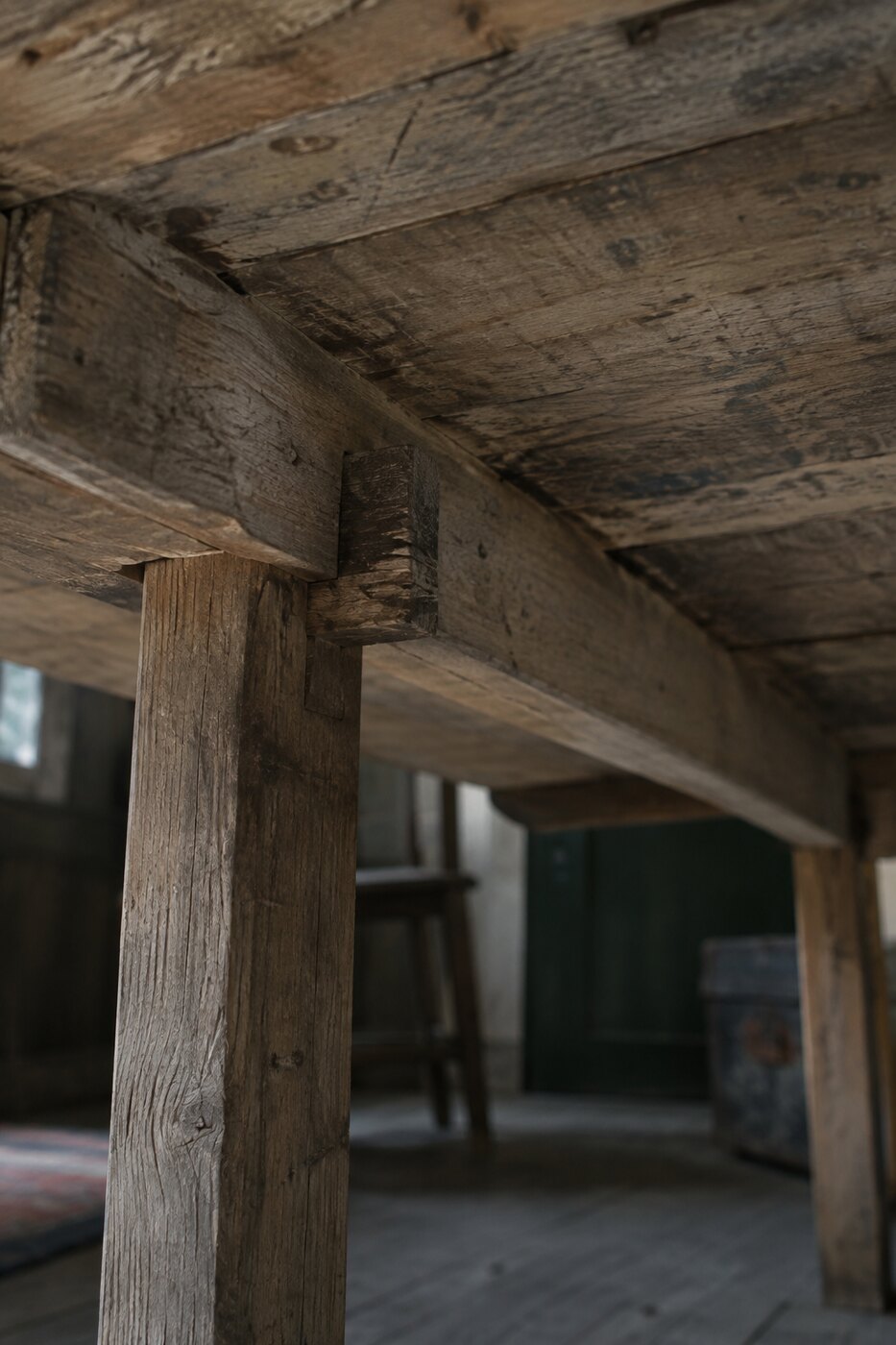
I went under the table with a screwdriver and one knee that no longer folded quietly.
The work was at the back corner, where a brace had loosened enough to let the whole surface pitch when someone leaned into a plate. Dust close to the nose, the smell of old pine and floor wax. My shoulder pressed the chair leg. The screw waited.
Finished oak met me at eye level, but only on the outer two inches. The finish gave out where the hand stopped. Past that, the wood went raw. The sanding ended mid-grain, as if anything past a polite reach didn’t count. A ridge caught my thumb. A loose fiber held.
Then the marks. Someone crossed out 29¾ with a carpenter’s pencil, hard lines not quite parallel. Below it, 30? — the question mark heavy enough to dent. Behind the apron board, where the light barely got in, a partial scrawl. It might have read LEO. It might have been LEAVE. I didn’t touch it. A bead of glue, yellow as weak tea, had hardened alongside, holding the shallow print of a wiped thumb. The screw I came for had a chewed head, the slot already gone soft.
I tightened it. Not gently. I scraped one glue bead with a thumbnail, exposing a paler interior, then stopped before taking the rest. Back out from under, I pressed the tabletop. It still rocked.
The floor had the real opinion. A hollow under the back right foot. The screwdriver had done its small thing; the wobble stayed.
Standing, the table looked unchanged. Coffee rings, a folded napkin, the usual surface. By the window, I turned my hand over and found a splinter in the side of the index finger, just visible, too short to grip. The tweezers would not find it.