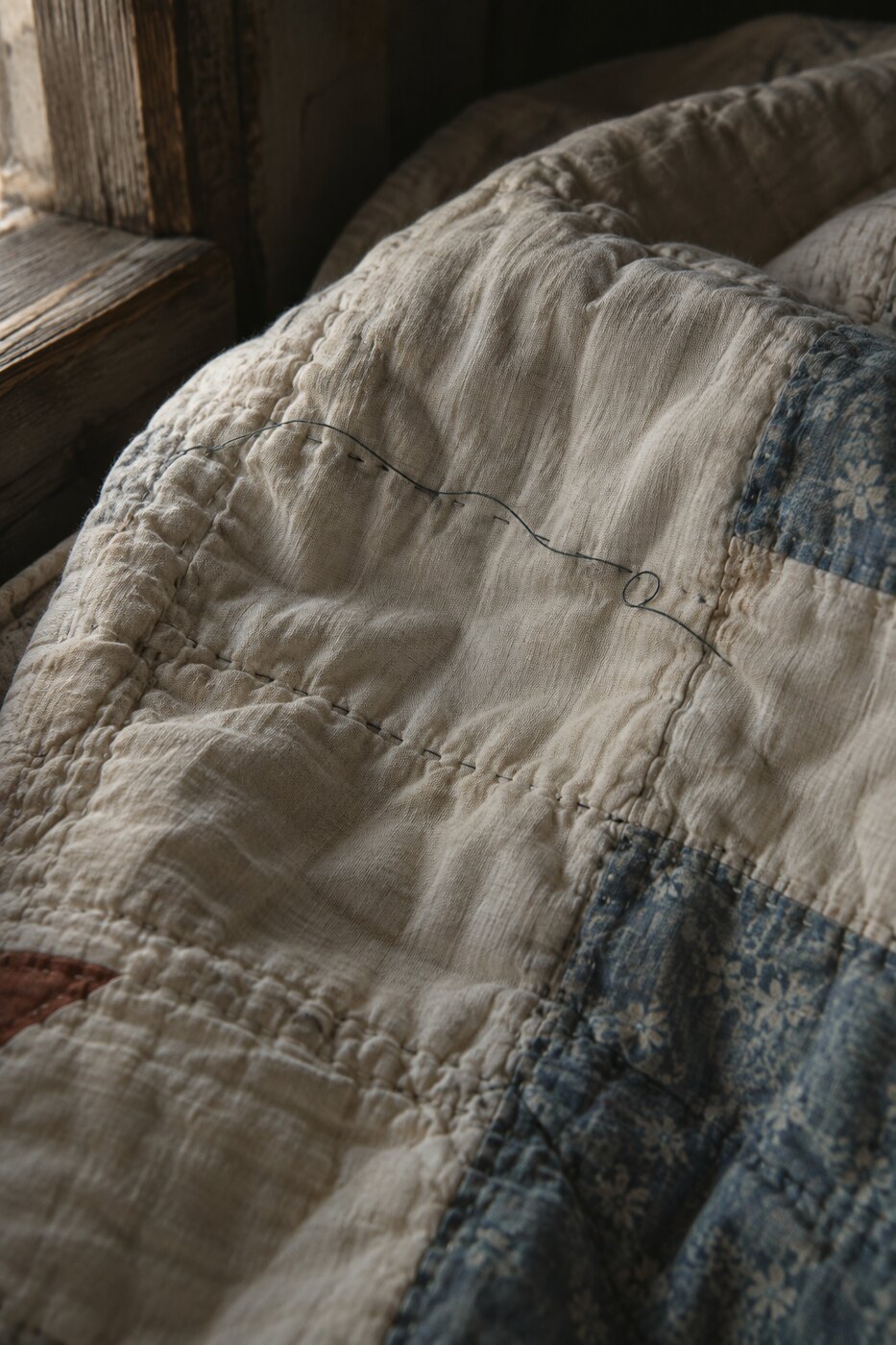
I spread the finished quilt face down across the table. The wood was too short. Two corners hung toward the linoleum. The backing was cool under my palm, then warm.
A loose thread caught on the side of my hand. Not a tear. Just a place where the needle lifted too soon and moved on. I mapped the other flaws without meaning to. A hard knot near the center, small as a rice grain. A pressed ridge where two seams overlapped and the iron had its own opinion. One needle hole where gray batting showed through like insulation behind drywall. The patterned top stayed turned away.
Then I found the seam that wandered.
Halfway down the right panel, the stitches drifted left. Not by much. Maybe three-eighths of an inch over six inches of travel. Then they corrected, straightened, continued to the border as if nothing had happened. I followed the line with my fingernail. The thread held.
The seam had made an independent decision. The back burner had boiled over that afternoon, and I let it hiss. The stitches on either side of the drift pulled tighter. My hand remembered before I did.
The back kept the route my hands took.
I held the quilt to the window. Light came through the pale cotton and found a dark thread carried inside, a length of navy traveling where it was never meant to show. The batting made a soft shadow around it, faint as a watermark.
I threaded a needle and secured the one loose end I could reach without opening anything. A quick stitch. Tug and bury.
The carried thread I left alone. It stayed in there, running parallel to the seam, visible only when the light was right and someone stood close enough to wonder how it got from one side of a straight line to the other.