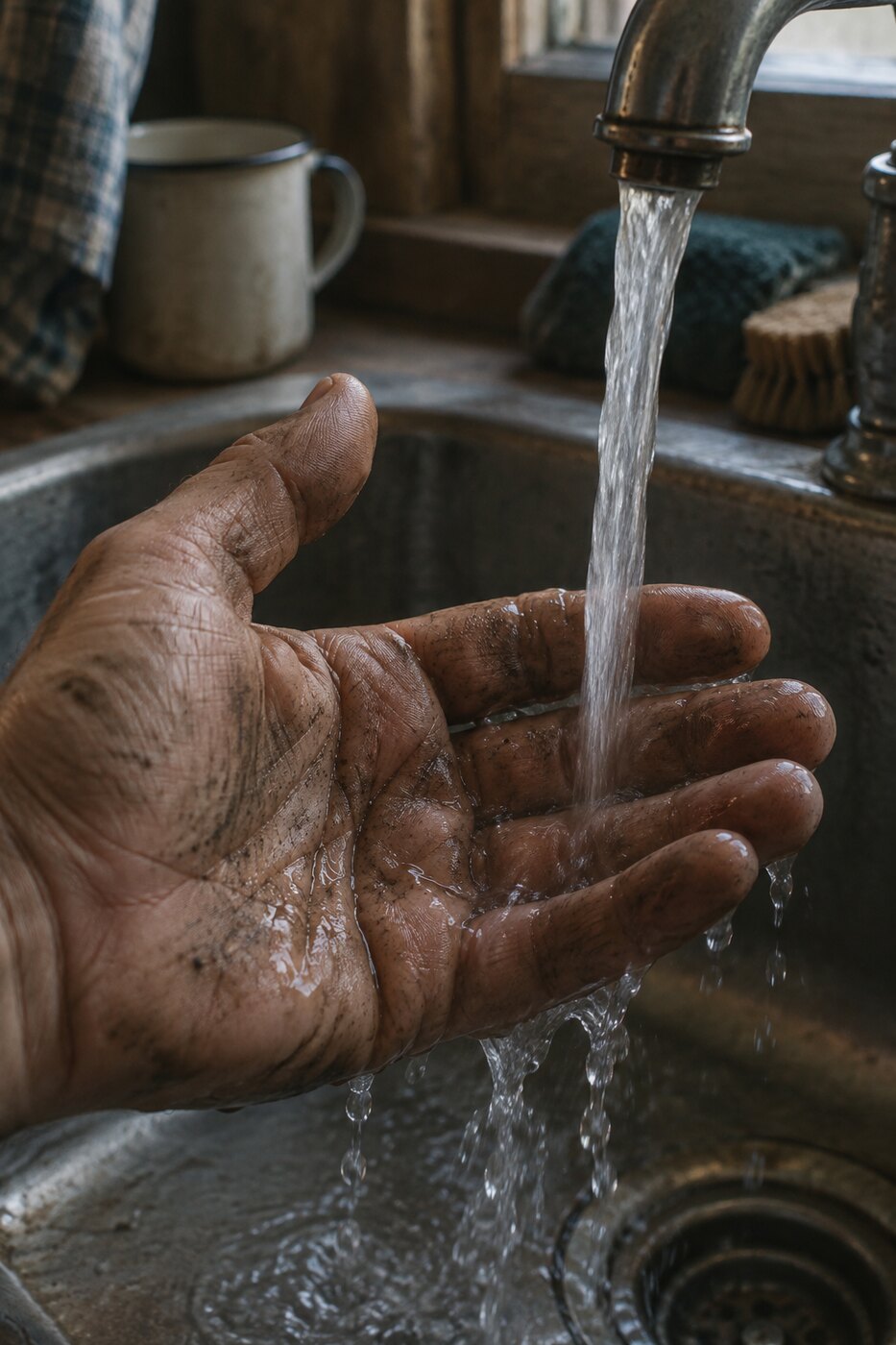
I rested one hand on the edge of the sink, back facing up, and turned the cold tap on.
The dirt had settled into the folds over my knuckles. Fine gray-brown silt, packed into the creases like grout. Under each nail, a black crescent. A scatter of grit clung to the damp skin near the thumb, held by nothing but moisture. One narrow scratch ran from the base of the index finger toward the wrist, still dry, still just a line.
Cold water found the scratch. It turned pink. Not deep. Not needing a bandage. I couldn’t remember what made it—raspberry cane, tomato cage, the stem of something that had already died standing up. The afternoon did not keep minutes. I let it stay unknown.
I turned my hand over. The palm came clean first. A few passes under the water and it looked like a hand that hadn’t done anything. It had done most of the gripping. It kept no record.
Back to the knuckles. Soap pulled together near the drain, brown and thinning. The surface dirt washed away in a single pass, but the creases held their lines. The nails required separate negotiations. A stiff brush sat on the windowsill. The bristles were caked with old paint. I left it where it was. Scraping too soon just tears the skin. One finger still smelled like green tomatoes, sharp and almost sticky, even after the soap.
The skin tightened as the water dripped off. I dried my hands on the front of my shirt—the old one, already stained—and looked at the back once more. The scratch had stopped complaining. The knuckle creases kept a pale gray memory of where the soil had been.
Gloves hung folded beside the back door. Clean, dry, exactly where I’d left them in April.