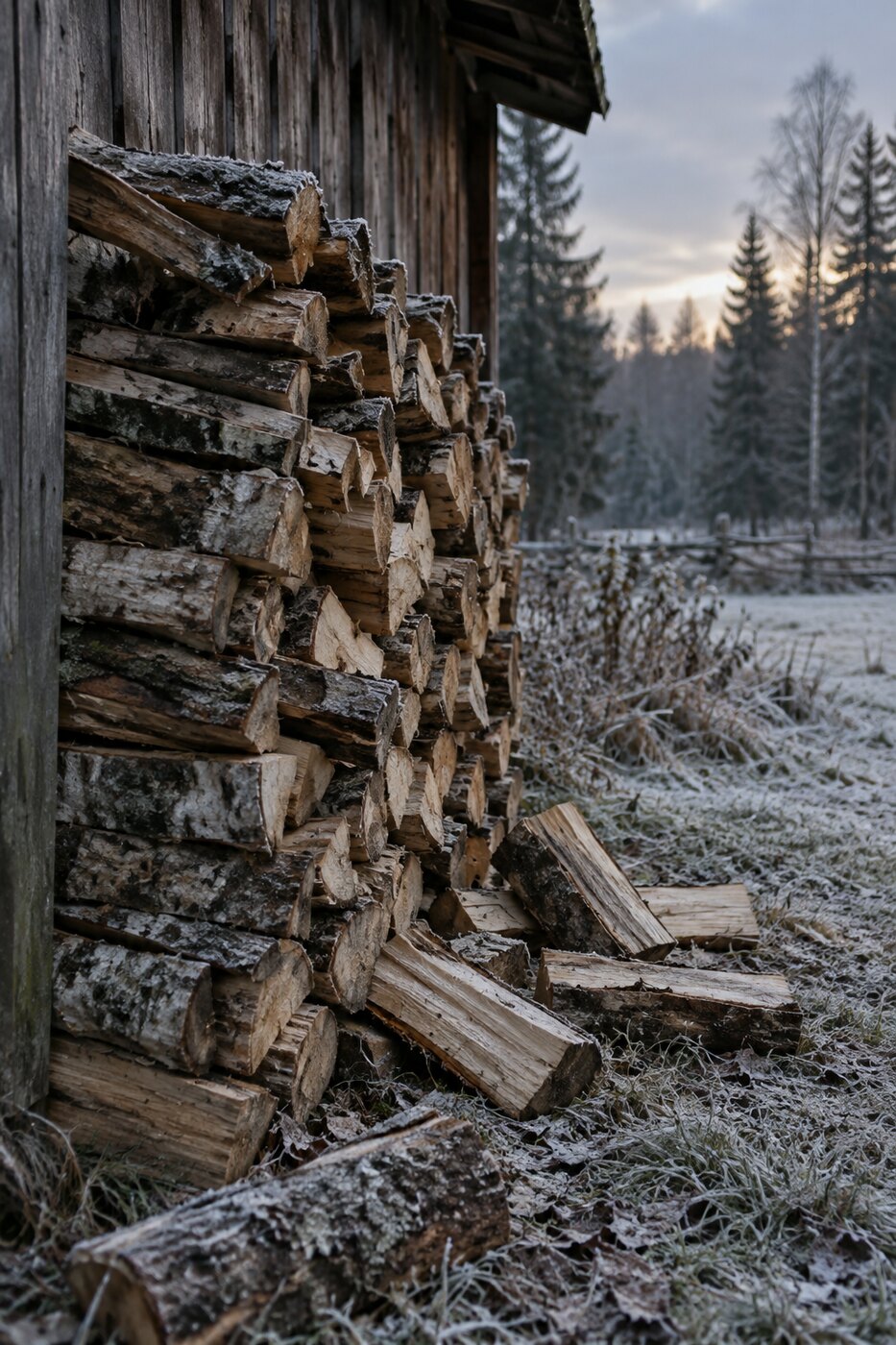
I built the pile in October and I was proud of it, which I will admit is not a useful thing to be about firewood. It stood against the south wall of the shed, two rows deep, as high as my chest. I had squared the ends by hand, laying the splits in crossed pairs at each end like a bricklayer’s corner so the stack would tie itself together and stand without a crib. The face was flat. You could have laid a level along the top and not been embarrassed. Every split on the outer row I had turned bark-out and roughly matched for length, so the whole face read as one clean plane, and I stepped back from it the way you step back from a thing you have made on purpose. It was a woodpile stacked for the eye. It looked finished.
Last night it froze hard after a week of days above and nights below, and this morning the pile had leaned.
I saw it from the yard before I was close enough to see the reasons. The clean flat face was not flat anymore. It bowed. The top course had swung out toward me and the bottom had stayed put, so the whole two feet of height near the middle had gone from vertical to a slouch, a lean of maybe a hand’s width out of true — not fallen, not scattered, just canted, like a man settling his weight onto one hip. Three splits had let go off the top and lay on the frozen ground in front of the pile, thrown clear, one of them landed on end and standing there like it had been placed.
Up close, the ground told on itself. The frost had done it. A week of thaw had put water into the dirt under the pile, and last night’s hard freeze had turned that water to ice, and ice takes up more room than water does — it had to go somewhere, and where it went was up. The ground under the front edge of the pile had heaved. I could see it: a low ridge of risen dirt along the base, the soil crumbed and lifted, glittering with frost in the morning light, and along that ridge the bottom course of splits had been shoved and tilted, each one rocked a few degrees off the seat I had given it in October. Multiply a few degrees at the bottom by two feet of height and you get a hand’s width of lean at the top. The pile had not failed. The floor under it had moved, and the pile had done the only honest thing it could, which was to move with it.
Where the stack met the shed wall it had pulled away. In October the back row leaned lightly against the boards, borrowing a little support, and I had let it, because it looked neat and it held. Now there was a gap between the wood and the wall, a dark inch of daylight running the length of the pile at the top, where the heave had walked the whole stack forward and away from the thing it had been quietly leaning on. The crossed ends I was so proud of had held — those still stood square, tied to themselves — but between them the face had bellied out, because a flat face has nothing holding its middle but the friendship of one split for the next, and freeze-thaw does not care about friendship.
I stood and looked at it and I was not proud anymore, just interested.
Freeze-thaw is an editor with no manners. It does not care that the face was flat. It does not care that I squared the ends by hand or turned the bark out or matched the lengths. It read the whole neat argument of the pile overnight and it rewrote the part it disagreed with, which was all the parts I had done for looks. What it left standing was the honest structure — the tied ends, the splits that happened to seat deep — and what it shoved out of true was everything I had added on top of that for the eye. The ground has opinions about architecture, and it expresses them slowly, and then all at once in a single hard night, and it is always right in the narrow sense that it wins.
So I will restack it, and I will stack it differently this time.
I will take it down to the frost-heaved base and I will not build for the eye. I will crib the ends properly instead of trusting the crossed corners to tie a face that wants to belly. I will lean it back into the wall on purpose and let the wall carry its share, since the pile is going to seek the wall or leave it regardless of what I want. I will let the outer row go rough — splits turned every way, long against short, bark in and bark out, whatever seats deepest and locks its neighbors — and the face will not be flat and I will not be able to lay a level on it. It will be an uglier pile. It will also still be standing in March, which the pretty one was not going to be, and the wood inside it will be dry, which is the entire and only point of stacking wood.
I picked up the three splits off the ground before I went in. They were furred white with frost on the down side, the side that had lain on the heaved dirt all night, and where I lifted the standing one it left a clean dark oval of unfrozen ground under it, already going gray at the edges as the cold got into the bare spot it had been keeping warm.