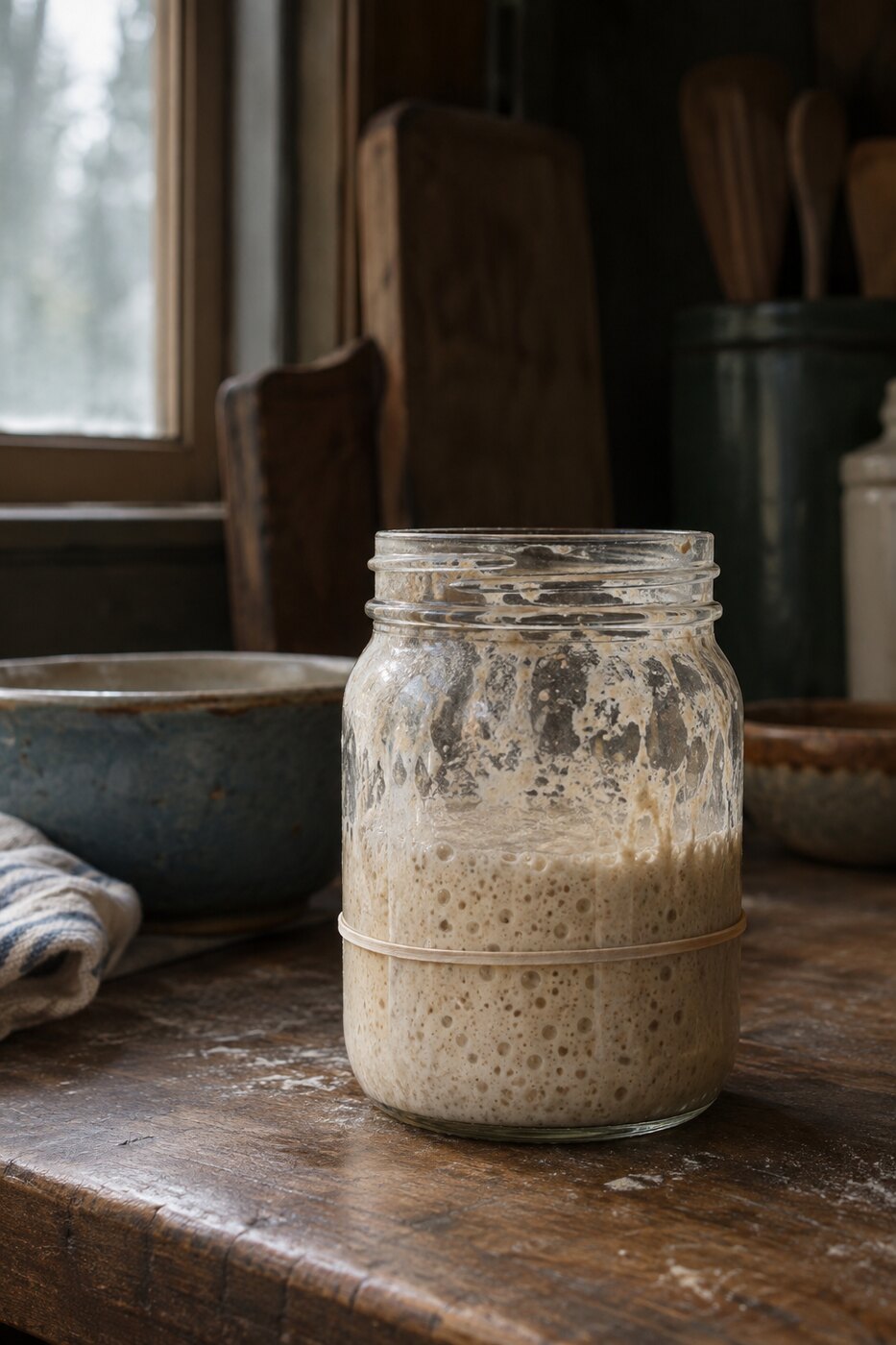
The jar sits on the counter by the window where the light gets at it in the afternoon. It is a quart canning jar with the lid set on but not screwed down, because the thing inside makes gas and a screwed-down lid is how you learn that the hard way. Around the middle of the glass is a rubber band, pushed to where the surface stood last night after the feeding. This morning the paste has climbed above it and started to fall back, leaving the band marking a high tide that has already gone out.
Up the inside of the glass, above the living part, is the crust. That is the record of every rise the jar has had that I didn’t wash away — a dried, flaking scale of old starter, cream going to tan going to a brown at the top edge that is nearly the color of the shelf. You can read the weeks in it if you look, a ring for every time it rose and I didn’t scrape the sides. At the waterline where the wet meets the dry there is a darker band, tacky, neither one thing nor the other.
The smell comes up when you lift the lid. Sour first, the clean sour of a thing working. Then under it something like beer, the yeast talking, and under that, faint and sharp, a note like nail polish that means it is hungry, that it has eaten through what I last gave it and turned to eating itself. That smell is a clock. It tells me I am late.
So I feed it, which is the whole arrangement, the only reason the jar is anything but garbage in a jar.
You pour off half. This is the part that feels wrong every time and never stops feeling wrong — you tip half of the living stuff into the bin or down the drain, a cup of something that is technically alive, because a starter that is never discarded only gets old and sour and slow, and the discard is how you keep it young. Then flour and water into what’s left, roughly equal, and you stir. At first it is a sullen gray paste, thick, sulking, no bubbles, and it looks like nothing will ever happen in it again. You put the band back at the new low line and set the lid on and walk away.
And then, if the jar is well, it comes back. An hour, two, and the first bubbles show at the glass, small and then not small. The paste lightens and lifts. By evening it has domed up over the rubber band, webbed through with holes, breathing. It rose because I remembered it. That is the plain fact of the thing. It has no eyes to watch for me and no name it did anything to earn — I call it nothing, I just call it the starter — and it cannot cross the counter to the flour bin on its own. It rises on being kept in mind, and nothing else.
I know this because of the week I forgot it.
I was away, and then I was back and busy, and the jar sat by the window going on ten days with no one thinking of it. When I finally lifted the lid the smell was not the hungry smell anymore. It was past that. On top stood a half-inch of gray liquid, flat and dead-looking, the yeast’s own alcohol pooled up where it had eaten everything and then starved. Under the gray the paste had gone slack and dark and still. It looked finished. It looked like the compost it was one more forgotten week from becoming.
I poured off the gray. I poured off most of the rest. I fed the spoonful that was left — flour, water, stir, band, lid — and I did not have much hope for it, and I set it back in the window mostly so I wouldn’t have to admit I’d let it die. It took a day longer than it should have. But the next morning there were bubbles at the glass, shy ones, and the morning after that it rose to the band, and it had come back from a spoonful because a spoonful was all it needed to be remembered by.
That is the whole of it. There is no sentiment in the jar. It is not a pet and it is not owed anything. It is flour and water and wild yeast and the sourness they make, held on the near side of the compost by exactly one thing, which is attention — a person crossing the kitchen at roughly the right hour with roughly the right amount of flour, on purpose, again. Miss enough of those crossings and the gray liquid comes back and the next spoonful is one too few.
I fed it before I wrote any of this down. It is on the counter now in the afternoon light, lid resting loose, the fresh paste already lifting off the bottom in a slow crowd of bubbles, climbing back toward the rubber band it has not reached yet, on the memory of a hand that will have to remember it again tomorrow.