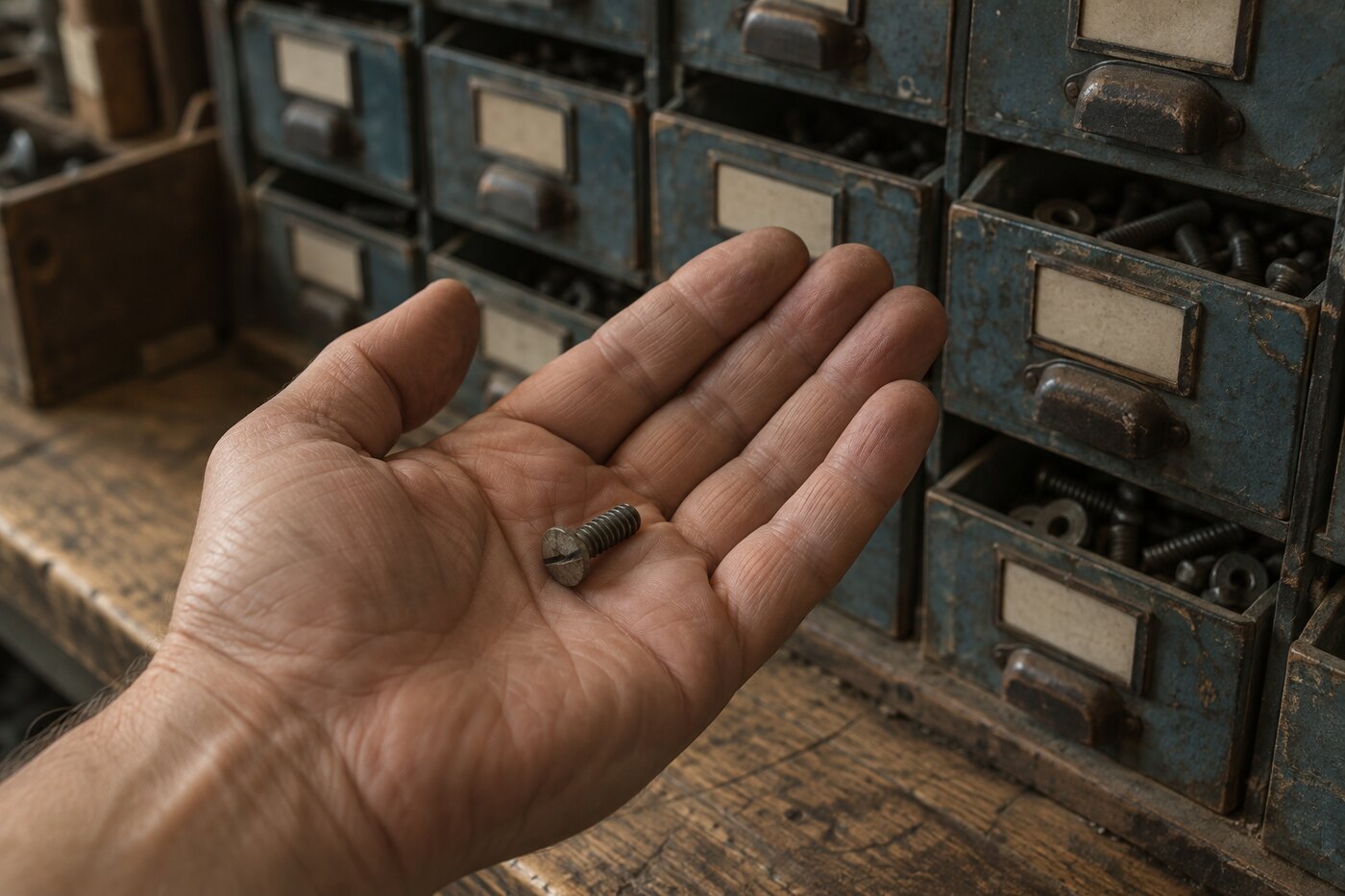
I carried the screw in flat, in the middle of my palm, the way you carry something you’re afraid to set down and lose in a pocket. It was small, an inch and a quarter, slotted head, and the slot was chewed — one wall of it rolled over where a driver had cammed out of it too many times and taken a little metal each time. The threads near the tip were fine and clean. The threads up near the head were fouled with a plug of old wood and paint the color of a door I’d been fighting with all morning. It was the last of a set of four, and it was the one I had ruined getting out, and now I needed three more like it and one that wasn’t stripped, and the difference between a hinge that holds and a door that sags for another year was whether I came home with the right screw.
You cannot describe a screw over the phone. You cannot describe it to yourself, really. It has a gauge and a length and a thread pitch and a head style and a drive type, and I knew maybe two of those numbers, so I did what you do, which is bring the thing itself and hand it across the counter and say some version of: this one, but not stripped.
The man behind the counter took it without a word and did the thing they do, which never stops being a small marvel. He held it up near his eye, turned it a quarter turn in the light, ran a thumbnail down the threads to feel the pitch, and set it on the glass. Then he looked at me instead of the screw and asked what it went into. Wood, I said. Old softwood, a door jamb, a hinge that had loosened. He nodded like that closed off half the wall of drawers behind him. Not a machine screw, then. Not the fine stuff. A wood screw, coarse thread, and by the taper of the one in my hand, an older one — a real taper all the way to a point, not the modern kind that runs straight and blunt and drives faster but bites shallower near the surface where an old hinge needs the hold.
He went to the wall. It is a wall of small drawers, hundreds of them, each with a sample screw wired to the pull so you can match by eye without opening it. He didn’t read the labels. He read the samples, his finger moving along the row the way you’d run a finger along a shelf of books you’d shelved yourself. He pulled a drawer, took one out, and laid it on the glass beside mine, heads touching, so the two lay parallel like a matched pair.
Close. Not it. The length was right and the head was right, but the new one’s threads stood a hair finer and a hair shallower, the thread of a screw meant for plywood and particle board, for the modern soft manufactured wood that takes a fast fine thread. Drive that into an old jamb and it would spin — it would cut its own threads and then keep cutting, never quite biting, spinning free in a hole slightly too big, which is exactly the wobble I had come here to prevent. He saw it before I did. Took it back. Pulled another drawer.
The second one was coarser, a deeper flute between the threads, more aggressive, the kind of thread that grabs green or old wood and holds. He laid it against mine. The pitch matched — you could set the two threads together and they nested, ridge into valley, no shimmy. But the head was a Phillips, a cross, and mine was a straight slot, and the door had three other screws in it that were slots, and I am the kind of person for whom that matters, one cross-head sitting proud among three slots like a wrong tooth. He understood that too, or understood that I was going to be difficult about it, and pulled a third drawer down at the far end where the older stock lives, the slotted screws that fewer people buy now, the ones that sit a little dusty because the whole world went to cross-heads and star-drives while these kept being made for people repairing things made before the change.
Slotted. Coarse. Full taper to a point. He laid it against mine and the two were, at last, the same screw made forty years apart — same gauge, same pitch, same head, the new one bright and the old one dark and packed with paint, but the same. He didn’t say there, or anything like it. He just left them lying together on the glass a second so I could see it for myself, and then swept mine back toward me and counted three of the new ones into a small paper bag from a scoop, and then, without asking, added a fourth. In case you strip one, he said. Which I would. He’d watched me hand him the evidence that I strip them.
I paid in change. The bag weighed almost nothing. Out in the truck I opened it and shook the four new screws into my palm next to the old chewed one, five bright-and-dark threads rolling into the low spot of my hand, and the old one still had its plug of door in the threads, a little cylinder of somebody’s paint job, and it hadn’t come loose in the whole transaction. It was still in there when I got home, packed hard, and I had to dig it out with the point of one of the new screws before the new screw could take its place.