The rubber aisle announces itself before you turn into it. You smell it from the paint end — that flat, warm, tire-shop smell, the smell of a material that was cooked into being and remembers it. It is not a good smell and it is not a bad one. It is the smell of practical refusal. Rubber is the thing you buy when you have decided that water, or cold, or pressure, is going to stay on one side of a line whether it wants to or not.
I had come for a gasket. The outdoor tap had started to weep at the packing, a slow bead building at the stem no matter how hard I cranked the handle, and hard cranking is how you strip a valve seat and turn a drip into a job. Somewhere in this aisle was a little rubber washer the size of a shirt button that would fix it for eleven cents, if I could find the one whose inside diameter matched a thing I had not thought to measure before I left the house. So I was going to stand here and hold candidates up to the light and guess, which is most of what this aisle is for.
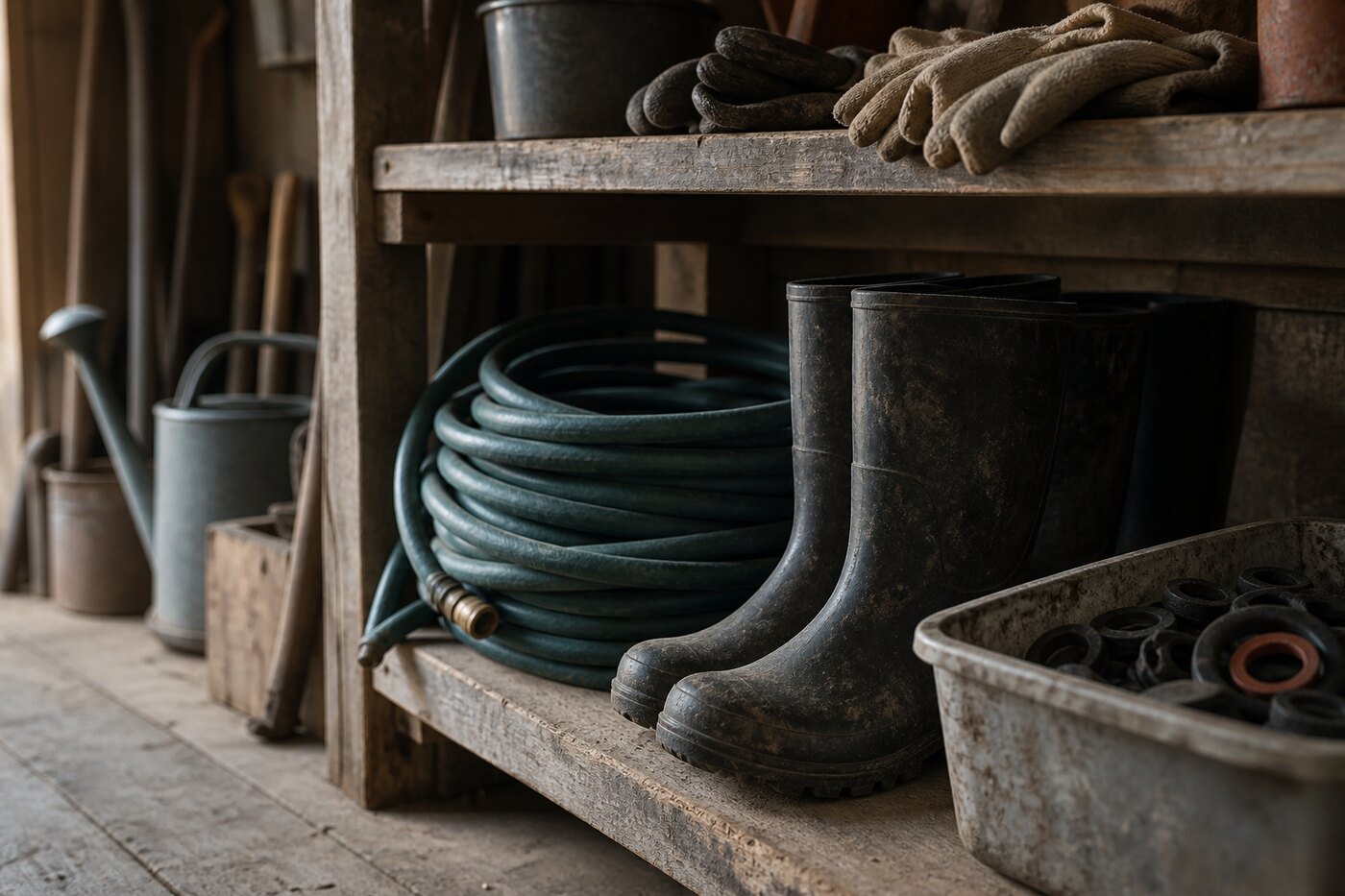
The boots stood along the bottom shelf, black and shining and empty, arranged by size but tipped and leaning like they were tired. I picked one up. The good ones have weight — a density in the sole, a thickness at the ankle where the cold comes for you first. The cheap ones are light and bright and the rubber has a skin that will crack across the flex point by the second winter, right where the foot bends walking, and then the crack becomes a seam and the seam becomes a wet sock and the boot is not a boot anymore, just a shape that used to keep water out. I bent the toe of a good one and it came back slow and sure. I bent a cheap one and it came back too fast, eager, the way a thing is eager when it hasn’t got much to give.
The hose hung in coils on the pegs above, green and black, the black ones rated for hot water and the green ones just for garden pressure. A hose is rubber pretending to be permanent and failing on a schedule. It kinks at the same three places every time, learns the kinks, keeps them, and then splits at a kink some August afternoon with the sprinkler running and nobody home. I ran my thumb down a length of the black one. It had a woven jacket under the skin, threads you could feel through the rubber, and that is what keeps it from ballooning when you cap the end and the pressure has nowhere to go. The green one had none. The green one was just a tube that hadn’t burst yet.
Gloves in a bin, the rubber kind and the coated kind. I pulled a coated pair off the rack, palms dipped in orange nitrile, and pushed my thumb into one to feel the give. Too thick and you can’t find a nut in a cold housing. Too thin and the wet comes through in twenty minutes and your hands are worse off than bare, because now they’re wet and can’t get to a pocket to warm up. The right glove is a negotiation between the water you’re keeping out and the work you still have to do with your fingers, and there is no glove that wins both. There is only the one that loses least at the job in front of you.
The gaskets were at the far end, in a wall of little drawers and hanging cards, washers and O-rings and flat rings in graduated sizes, black and red and the occasional pale silicone. I opened the drawer marked for faucet washers and it was, as those drawers always are, half a size short of organized — a few in the wrong bin, one card empty, thumbprints of old plumber’s grease on the plastic dividers. I fished out a handful and rolled them in my palm. They are almost nothing, a gasket. A ring of rubber with a hole in it. But the whole tap depends on one, on the exact moment the rubber is squeezed hard enough to fill every imperfection in the metal seat and not one turn harder, because one turn harder splits the ring and you are back in this aisle in a month.
I found one that looked right and I held it up against the old one I had, at last, thought to bring — pulled it out of my coat pocket where it had gone flat and gray and taken a permanent set in the shape of the stem it had been crushed against for a decade. The new one was black and round and full of itself. The old one had given up its roundness entirely. That is what rubber does at the end. It stops springing back. It holds the shape of the pressure that finally beat it, and then it lets the water through.
The two sat side by side in my palm at the end of the aisle, under the flat warm tire smell, the new one holding its circle and the old one holding the ghost of a valve stem. I could not tell yet if the inside diameters matched. I would not know until I got it home, and had the tap apart, and the water off, and the moment came to slide it down over the stem and find out whether I had guessed the right eleven cents.