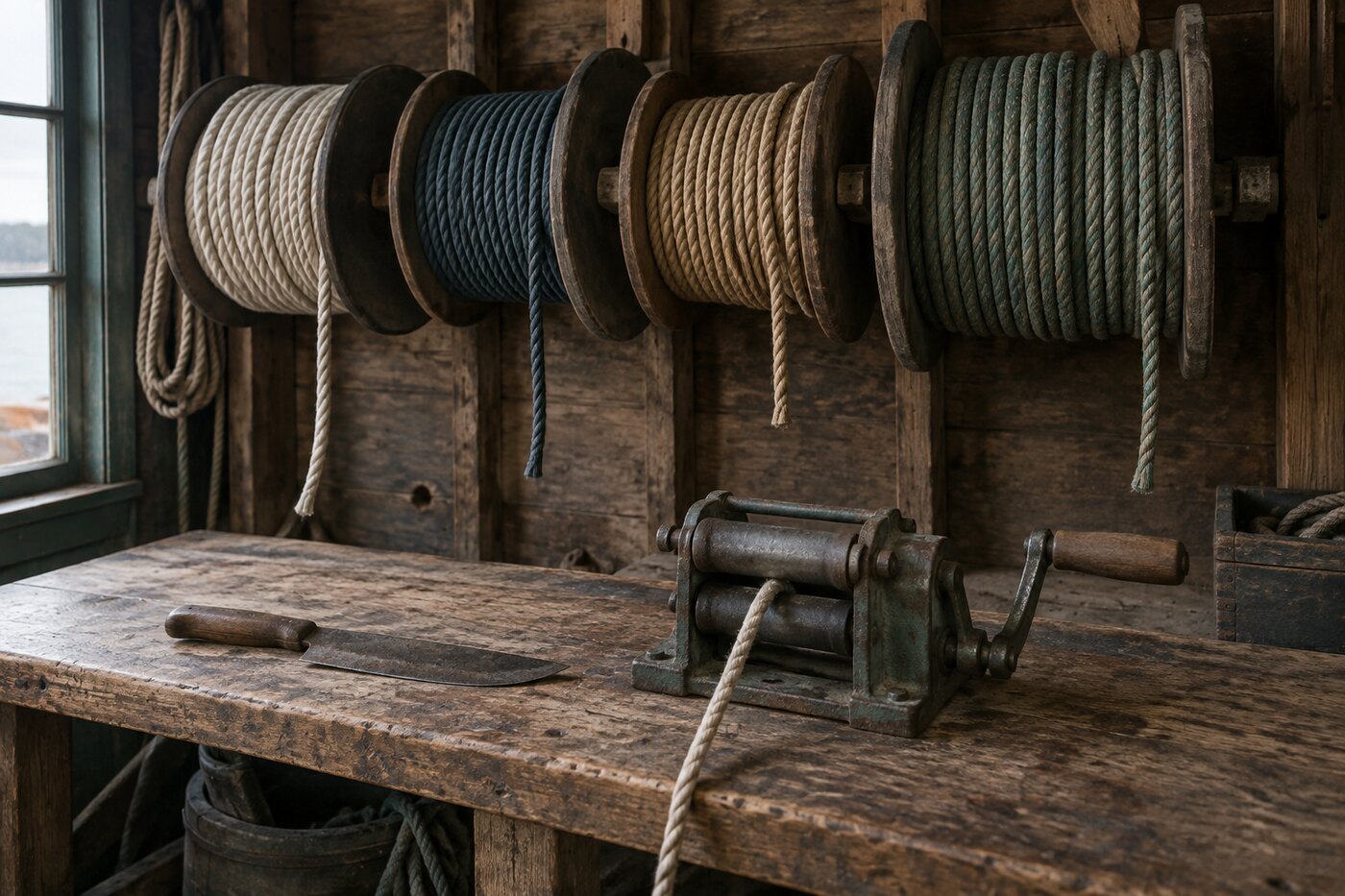
The rope came off a wall of spools, each one on a steel axle, each one a different diameter and a different color of intention. Yellow poly on the left, slick and cheap. White nylon in the middle, the kind that stretches and doesn’t like knots. Manila on the far end, brown and hairy and honest, the rope that looks like rope. I went to the manila first out of habit, then stopped, because the job was going to live outdoors and get wet, and manila swells and rots and then it lies to you about how much it can still hold.
The tarp over the woodpile had let go in the wind. The old line had gone gray and furred, and when I pulled on it that morning it came apart in my hands with almost no argument, the fibers powdering where the sun had been working on them for two summers. So I had a length of failure in my pocket for reference and a rough number in my head, and the number was the problem.
There is a blade bolted to the counter for this. A hooked knife set into a slot in the wood, its edge worn shiny, the wood around it scored pale from thousands of cuts landing a hair long or a hair short. Beside it, a measuring wheel on a crank, brass numbers, a little counter that clicks over the feet. You feed the rope in, you turn the handle, the wheel eats the length and tallies it. The man behind the counter did not offer to do it for me. He watched to see if I knew the rope needed tension on it while it measured, or it would read short.
I pulled the poly off the spool and it came reluctantly, holding the memory of the coil, wanting to spring back into the shape it had learned. That is the thing about the slick rope. It doesn’t want to be straight and it doesn’t want to be tied. But it doesn’t rot, and it floats, and it costs a third of what the nylon does, and the tarp did not need a rope with opinions. It needed a rope that would still be a rope next April.
How much. That was the whole transaction, standing there doing arithmetic against a woodpile I could see in my head. Four tie-downs, corner to corner, plus enough to cross the middle where the wind gets under. Plus the truth that every knot eats rope, a foot here for a taut-line hitch, a few inches there for the bight you tie and untie and retie until it sits right. Plus the fact, learned and relearned, that I always cut it too short. Every time. I stand at the counter feeling thrifty and I get the rope home and I am eight inches shy of the cleat and there is nothing to be done about eight inches except drive back or make a worse knot.
So I measured what I needed and I added a little. Not double. A little. The crank clicked over the feet — twenty, then twenty-two, then I let it run to twenty-five and stopped. The extra three feet were the tax you pay for not knowing exactly. The man nodded like the number was reasonable. He had watched a lot of people be wrong at this counter and I was, at worst, only slightly wrong in the safe direction.
Then the cut. He laid the rope in the slot and pulled it down across the hooked blade in one motion, no sawing, and the poly parted clean and immediately started to unravel at the fresh end, the three strands wanting to become three separate things. That is the other tax on the cheap rope. You cut it and it comes undone in your hand, and you have to seal it or whip it or it will unlay itself all the way up the length given a week and a little wind.
He had a lighter for that. He held the flame to the cut end and the poly shrank and beaded and went glossy and black, the three strands fusing into one hard shining knob, and the smell came up sharp and chemical, the smell of a material that was never alive and never pretended to be. He rolled the melted end against the counter with a scrap of leather to blunt it before it burned my fingers. Manila would have taken a different mercy — a wrap of tape, a whipping of thin twine — because manila will hold a raw end for a while out of its own coarseness. The poly needed fire or it needed nothing at all.
He coiled it around his forearm, elbow to thumb, the way you coil rope that you want to pay out clean later, and tied the coil off with a slip of its own tail so it wouldn’t birdnest in the truck. He wrote the footage on a tag. Twenty-five feet at whatever it was a foot, a number small enough that the extra three feet had cost me almost nothing, which is the whole argument for buying the extra three feet.
I carried it out under my arm, and it was lighter than it looked, the way poly always is, the weight all in the coil and not in the strand. At home I would cut it into working lengths and each cut would unravel and each one would need the lighter, and I would burn a fingertip on at least one of them because I always do.
The old gray rope was still in my jacket pocket. When I pulled the new coil out to start, the old piece came with it and dropped in the snow, still furred, still holding the exact curve of the cleat it had spent two years learning. It did not uncurl. It lay there in that shape while I worked.