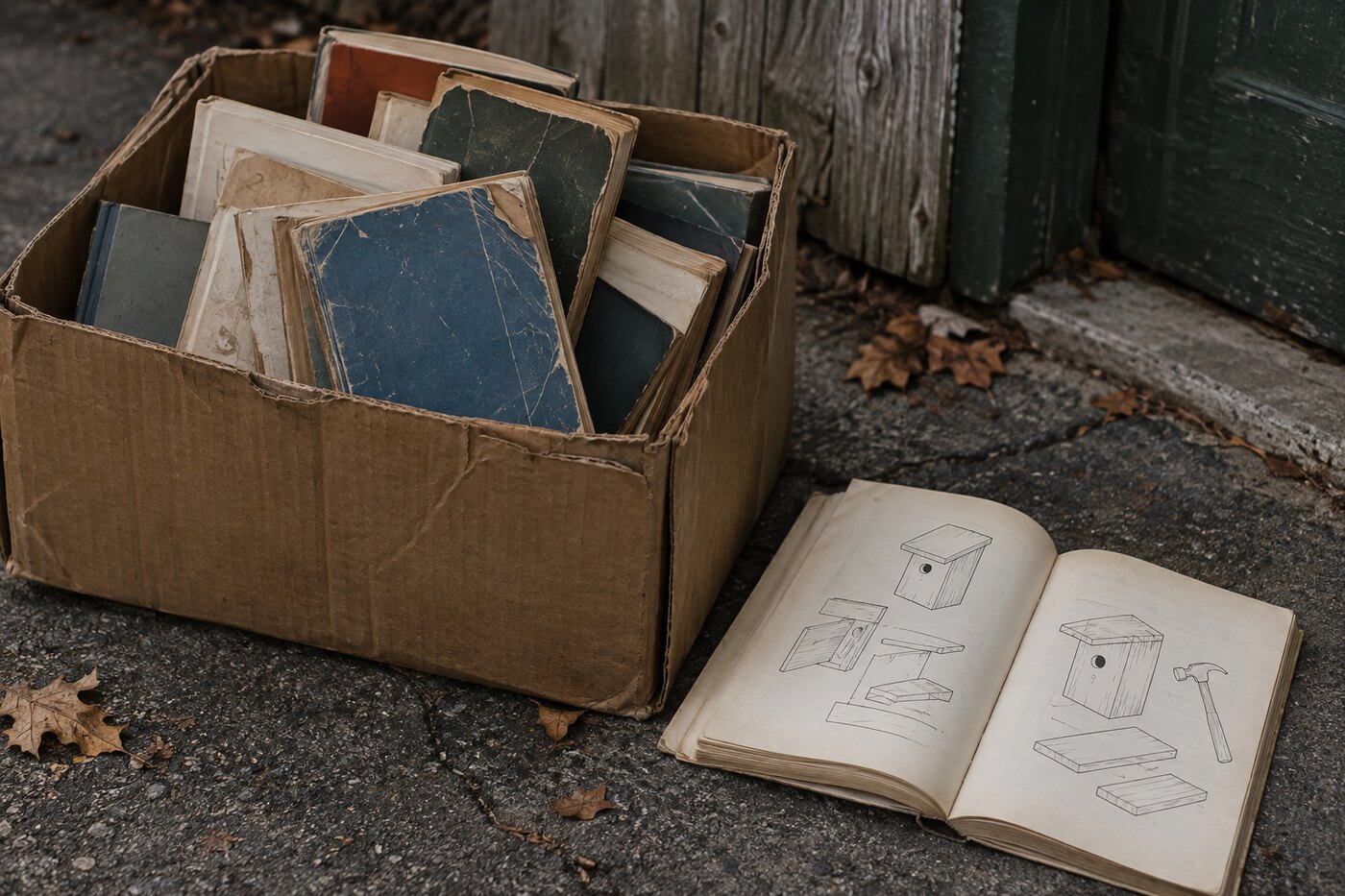
The box had been rained on. You could tell before you touched a book, from the box itself, the way the cardboard had swelled along the bottom seam and dried in a wave, so the whole thing sagged like a hammock and the books had slid to the low corner and set there, fused a little at the page edges. FREE BOOKS, said the flap. Then, in different ink, someone had crossed out FREE and written 50¢. The books had gone up in price by getting rained on, which is backwards, but the second writer had his reasons, and one of them was probably that free books don’t leave and priced ones sometimes do.
These weren’t for reading in the way people mean when they say books. Nobody was going to curl up with them. They were tools that happened to be made of paper. A book on chainsaw maintenance with a chain-tension diagram on the cover, the corner worn soft where a thumb had opened to that page a hundred times, because chain tension is the thing you forget and have to check. A book on making jam, its pages stiff and cockled and stuck in one spot where something sugary had dried between them, so that the section on pectin was now a single laminated brick you’d have to tear to read. Basic home wiring, with a previous owner’s pencil in the margins — NO, it said, next to one diagram, hard enough to dent the page, a man arguing with his manual and, you had to hope, winning.
I went through the box on my knees on the driveway, because that’s where the box was and it wasn’t going to come up to me. The warp had done different things to different books. The thick ones had fanned. The thin ones had curled into shallow bowls you could have used to bail a boat. My hands smelled like the box after a minute, that basement smell, mildew and old glue, the smell of paper that has been damp and dried and doesn’t trust the world anymore.
There was a mushroom identification book and I handled that one longer, because a mushroom book is a book you could die by. Somebody had used it. The edible pages were dog-eared and the poisonous pages were clean, which is either good sense or terrible luck, depending on which way you read it. A pressed specimen fell out from between two pages, a flattened brown disc that had once been a cap, kept as a bookmark or a trophy or a piece of evidence, now just a stain and a shape. I did not put it in my mouth. I put it back in the book, at a different page than it fell from, so the next person would find it in the wrong place and wonder.
A diet book, one, the way there is always one. Its spine was the least broken in the box, which tells you something the book itself wouldn’t. Bought with intention, opened with intention, and then set down, its resolutions still crisp, undamaged by use. It weighed the same as the wiring book and had done far less.
Then the tax guide. 1998. A tax guide is the most perishable book there is. It’s out of date the year after it’s printed, wrong in every particular, describing a code that no longer exists, brackets that have moved, forms that have been renumbered. And yet somebody had kept it twenty-odd years, through moves, through the rain that got the box, all the way to this driveway. Not because it was useful. It had never been useful again after April of 1999. It got kept the way things get kept — not decided on, just not thrown out, riding along in whatever box the books rode in, until the box itself became a thing to get rid of.
That’s what the box was, finally. Not a library. A stratum. All the intentions a household forms and doesn’t finish, pressed together and rained on and priced at fifty cents. The chainsaw somebody meant to maintain. The jam somebody made one autumn and never again. The wiring somebody did themselves and argued with the book about. The mushrooms somebody actually walked out and found. The diet somebody bought. The taxes somebody survived. Every book was a machine for doing a thing, and the box was the record of which things got done and which didn’t, sorted now by nothing but which corner the rain had chased them into.
I took the chainsaw book and the wiring book, because I have a chainsaw and I have wiring, and those two were tools I could still put to work. The jam brick I left, sealed shut by its own sugar. The diet book I left, clean-spined and hopeful. The tax guide I left, because 1998 is over and knows it.
I gave the man a loonie for the two and he waved off the change, which put me back into free territory, the exact place the box had started before somebody thought better of it. The books were warm from the driveway. Their pages had that stiff reluctant feel of paper that has been wet, that will never lie flat again, that opens with a small crackle of protest.
I set them on the truck seat. The chainsaw book fell open on its own to the chain-tension page, the worn one, the one the last owner had gone to a hundred times, the cover creased so deeply along that spot that the book had decided, without me, which page it wanted to be.