I put the key on the counter and it stopped being mine for a while.
The man picked it up without looking at me, the way you handle a part, and turned it to the light to read the cuts. A key is just a code carried in metal. Five or six notches at set depths, and the depths are the whole message, and everything else — the head, the brand stamped on it, the worn brass gone the color of an old coin — is packaging. He read it the way you’d read a torn label, checking whether there was enough left to go on. My key had thinned at the deep cuts from years of turning. He ran a thumbnail into one notch and felt the bottom of it.
Kwikset, he said, to himself, and went to the board.
The board is a wall of blanks, hundreds of them, hung on little hooks by the hole in the head, sorted by a system that looks like chaos and isn’t. Each blank is a key that hasn’t decided anything yet. Same head shape as a family of locks, but the blade is a smooth ramp, uncut, no code in it at all. He took one down and it caught the light differently than mine — bright, unhandled, the brass still sharp at the edges where mine had rounded off. New brass has a smell if you get close, a cold penny smell. He set the two together on the counter, mine and its blank future, and for a second they looked like the same key photographed twenty years apart.
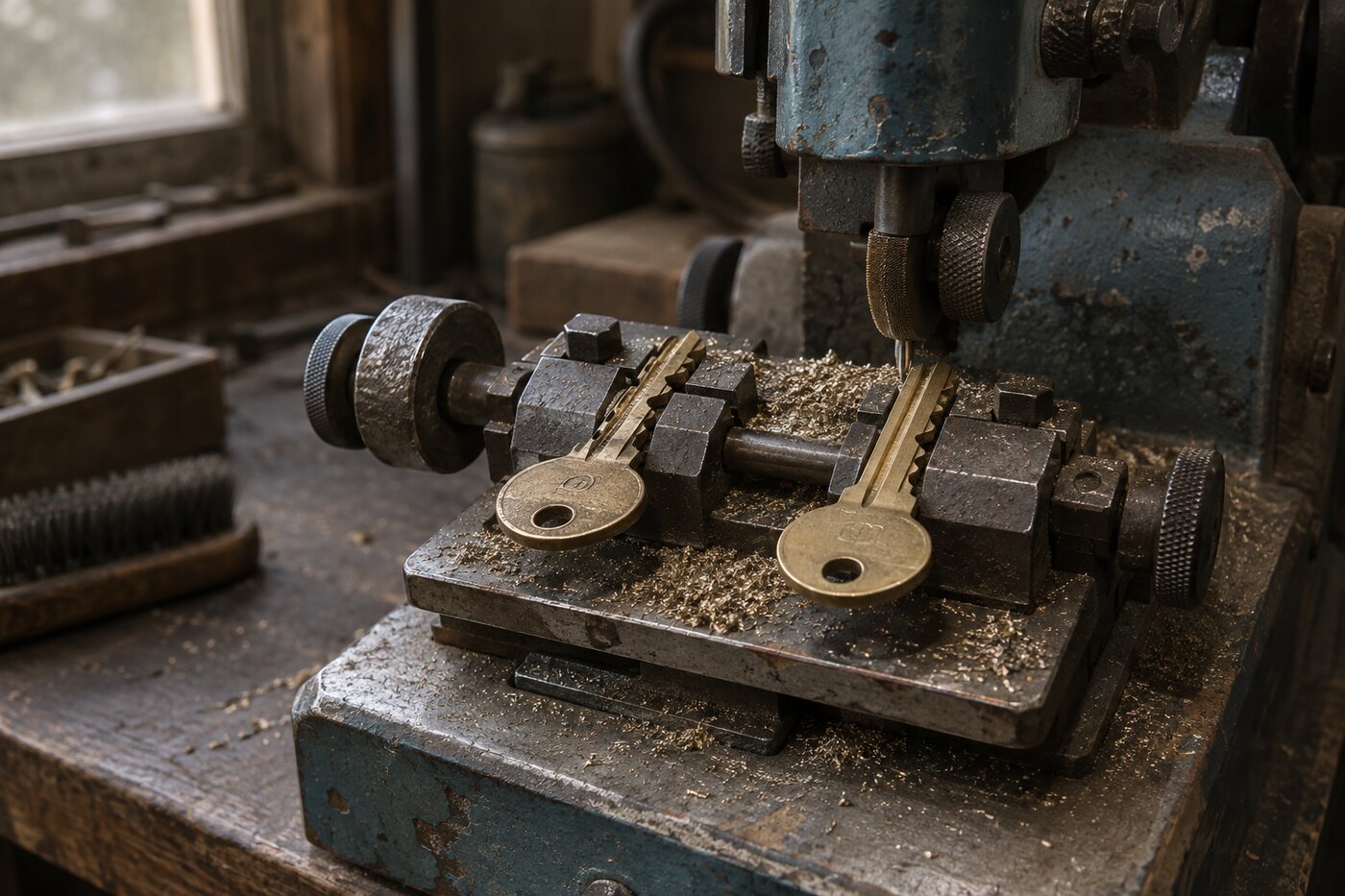
The machine is the part that sounds like violence. He clamped my original in one jaw and the blank in the other, lined up along a bar so that whatever happened to one would happen to the other. There is a stylus that rides the original and a cutting wheel that rides the blank, and they’re joined, so the wheel copies the finger. He flipped it on. The wheel spun up to a whine and then he drew the carriage across and the whine dropped into a grind as the steel bit brass, and the sound is exactly the sound of something being taken away, because that’s what cutting is. You don’t add a key. You start with too much metal and remove everything that isn’t the key.
The filings came off in a fine bright spray and then, where the cut went deep, in tiny curls. They collected on the bed of the machine, a small warm heap of brass dust, the actual difference between a blank and a key, measured in what fell off. He made two passes. The first to rough it, the second lighter, to clean the notches. The smell changed under the grinding, hot metal now, sharp in the back of the throat.
Then the quiet came back and he unclamped the new one and it was hot. He held it by the head and touched the blade to test, quick, the way you test an iron. The freshly cut edges had a burr on them, a whisker of brass standing up along each notch where the wheel had pushed metal instead of cutting it clean. That burr is the difference between a key that turns and a key that jams. He took it to a wire wheel bolted to the end of the bench and touched each cut to it, brief, and the burrs went off in sparks so small you felt them more than saw them, and he blew across the blade, and wiped it on his apron, and the new key came out of all that looking like it had always existed.
He laid it next to the original one more time. This is the moment the whole trade rests on. He’s comparing two profiles by eye, deep to deep, shallow to shallow, checking that the copy has the same silhouette as the thing it copies. If a cut is a hair too shallow the key won’t seat. Too deep and it might turn a little and stop. He can see a lot of it. But he can’t see the one thing that matters, which is whether it will turn the actual lock, because the actual lock is not here. It’s on a door across town, with its own wear, its own grit in the pins, its own opinion.
That’s the strange bargain of a cut key. Everything about it is checkable except the only question you’re asking. He can measure the cuts against the original. He cannot measure them against the door. The test doesn’t happen at the counter. It happens later, alone, when you slide the bright new key into a lock that has never met it and turn, and either the pins lift into their shear line and the cylinder rolls, or they don’t, and you stand there jiggling it, feeling for the catch, learning that a copy of a code is not the same as a working key.
He handed it to me across the counter and it had cooled to just warm. Two dollars. Try it before you make a bunch, he said, which is the honest thing, the thing that admits the machine can’t finish the job. The finishing is done by the lock.
I put both keys in my pocket, the old worn one and the new sharp one, and they clicked against each other on the walk out, brass on brass, indistinguishable by sound. I didn’t drive straight home. It sat in my pocket the rest of the afternoon, an untested claim, a code copied faithfully off another code, the little burrs he’d wheeled away leaving each notch with a bright unweathered edge that hadn’t yet touched a single pin.