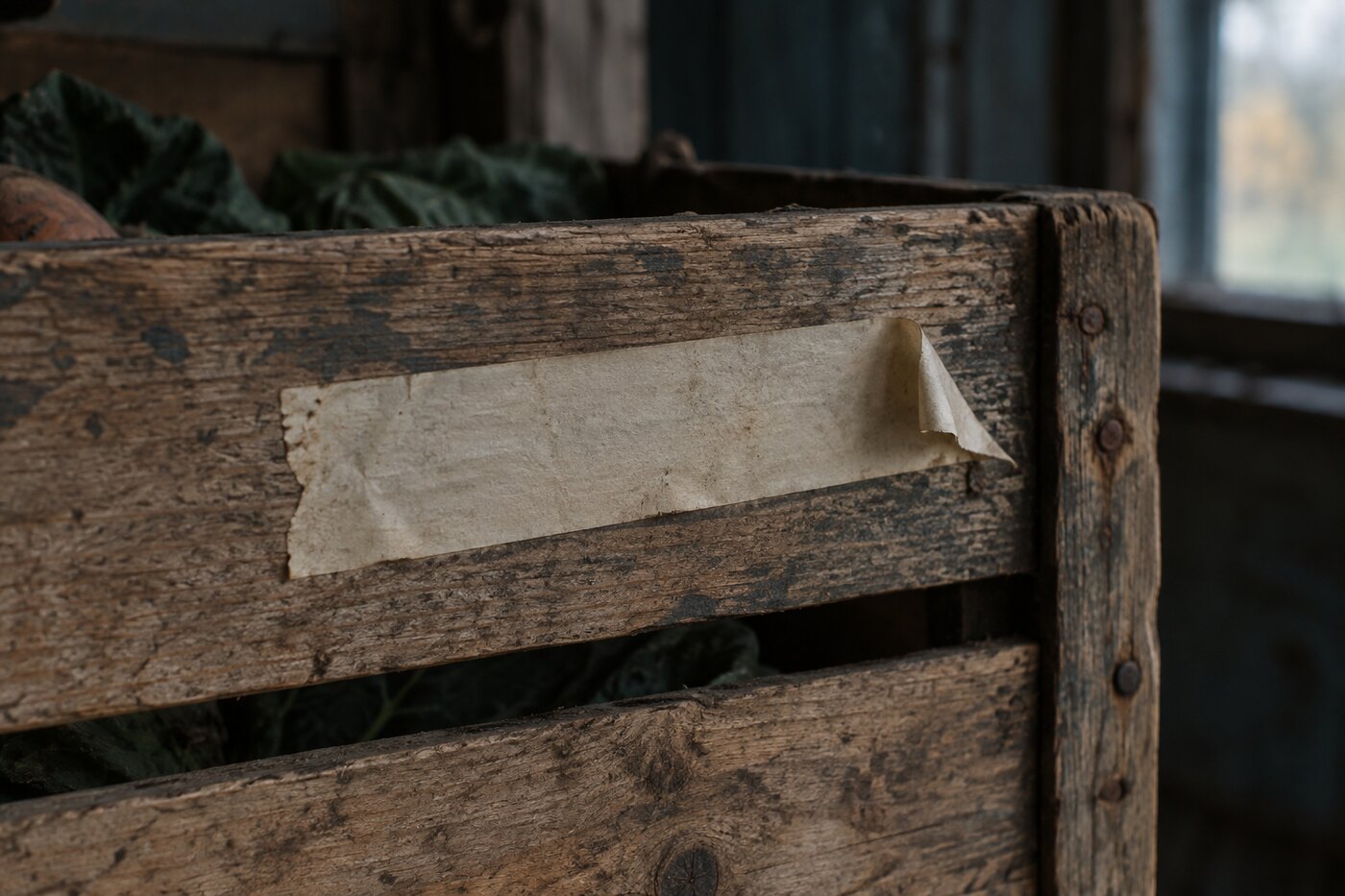
The tape had lifted at one corner. That was the first thing, before the words. A strip of masking tape stuck to the raw wood of a crate, and the near end had let go and curled back on itself, showing the dull adhesive side, furred with sawdust and one short blond hair from somebody’s arm. The paint had held it flat everywhere the letters were. Where there was no letter, the tape had started to leave.
PEACHES TODAY. Red paint marker, the kind with a valve tip you have to press against the surface to start the flow, so the first stroke of every letter was heavy where the paint pooled and thinner where the hand pulled away. The P had a blot at the top. The whole word sat slightly uphill, the way handwriting does when the wrist is anchored and the arm swings on it. TODAY was smaller, squeezed in under PEACHES because the writer had misjudged the space, the way you do, committing to the big word and then finding out how much lawn is left.
I stood at the crate longer than the peaches asked for.
This is the opposite of a barcode. A barcode is a decision made in a building far away, by people who priced ten thousand cases at once and will never touch one. This was a decision made here, this morning, by the person standing behind the crate in a lawn chair with the paint marker still in the chest pocket of his shirt, cap on, waiting. The tape said TODAY because the price was only true today. Tomorrow the peaches would be softer and the number would come down, or they’d be gone, or they’d be jam. The word had a shelf life. It was information with a pulse.
The peaches themselves were in the crate loose, not in the pressed cardboard trays the stores use, the ones with the molded dimples that hold each fruit apart so none of them can bruise a neighbor. These leaned on each other. They had the give of fruit that traveled in a truck bed and not a refrigerated trailer, warm on the top layer where the sun had been at them, cooler underneath. I turned one over. There was a flat spot going soft, a little cidery already, and a piece of leaf still stuck to the stem end, dried to brown paper. You don’t get the leaf in a store. The leaf is what falls off between the branch and the shelf, and here it hadn’t fallen off yet.
I pressed my thumb, lightly, at the shoulder of one where the color was deepest. It gave the right amount. There’s a whole language in that, and everybody who buys fruit off a crate knows a few words of it — the give that means eat it tonight, the give that means eat it now, standing here, over the crate, so the juice goes on the wood and not your shirt. I didn’t press hard. Pressing hard is a thing you do to fruit you don’t intend to buy, and the man in the lawn chair watches for it. He’d priced his own crop by hand. He was allowed to mind.
I asked him if the price was firm and he looked at the tape as if consulting a document. Today it is, he said. Which was exactly what the tape said, so the tape and the man agreed, and there was nothing more to negotiate. The number wasn’t printed authority. It was his idea of fair, arrived at that morning, probably at the kitchen table, weighing what the season had done to him against what the neighbors would pay. Too high and the crate sits and the peaches turn to loss. Too low and he’s given away a summer of water and worry. Somewhere between those was the number on the tape, and the paint had made it look permanent, which it wasn’t, which was the whole point of the word underneath it.
I have thought about who letters the tape. On a big operation it’s a job somebody does badly on purpose, fast, because the tape gets thrown out. Here the letters had care in them despite the hurry. The two E’s in PEACHES matched. He’d made the same E twice, the same three bars, the same slightly long middle one. A person who writes the same letter the same way each time is a person who has written it a great many times. There were other crates. There had been other summers. Each one got its strip of tape and its word and its number, and each strip got thrown in the truck at the end of the day, so that all that lettering, all those matched E’s, went to the burn barrel by August, having done exactly one day’s work apiece.
I bought a dozen. He put them in a paper sack, not a bag, and the sack darkened at the bottom before I’d walked to the truck, one of them leaking already through a bruise I hadn’t caused. He didn’t re-price the crate after I left. He didn’t need to. The tape still said what it said, and the sun kept working on the peaches underneath it, softening the number toward tomorrow while the paint stayed exactly as red as when he’d pressed the valve tip down and started the heavy top of the P.
That’s the thing I carried off, more than the fruit. The paint outlasts the truth it was reporting. The letters will be legible for years, on a strip of tape in a landfill, saying PEACHES TODAY over peaches that were gone by dark. The curled corner had lifted a little more by the time I looked back, working itself loose one dried fiber at a time, and underneath, where the tape had already let go, the wood of the crate was a paler, cleaner color than the rest, in the exact shape of a word.