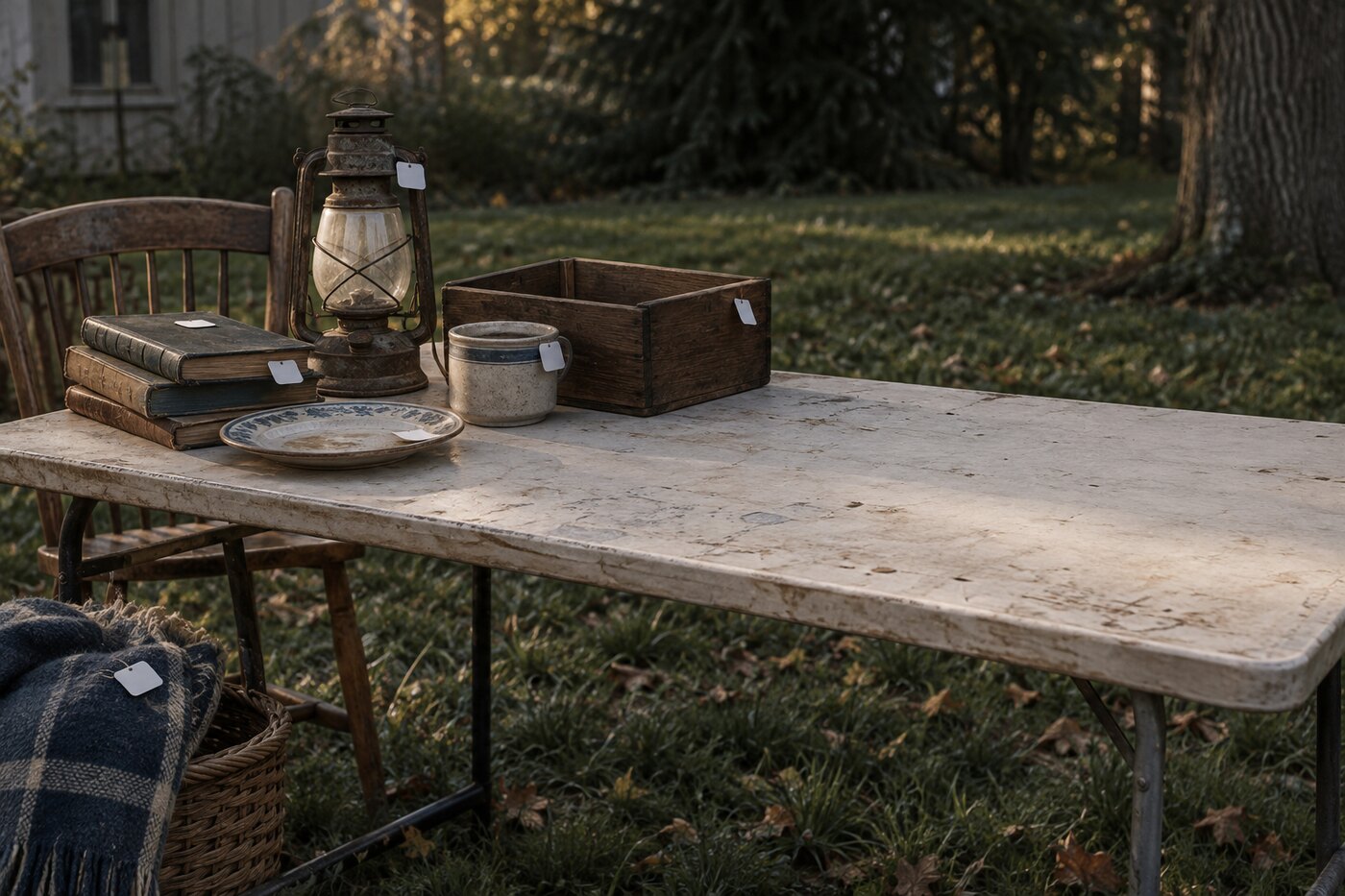
The tables had been out since seven and the sun had crossed all of them. I put my hand flat on the nearest one and the particleboard was warm through the sheet thrown over it, an old flannel sheet gone to gauze at the fold lines. Whatever had sat there in the morning had left rectangles of clean color where the light hadn’t reached. You could read the shape of a stack of records, a lamp base, a run of paperbacks, all of them absences now.
By three-forty the good stuff was a rumor. People talk about garage sales like a hunt, but by the last hour the hunt is over and what remains is the settling. The objects that nobody wanted enough to carry across a lawn. They have a smell together, these leftovers, warm plastic and mildew and the sweetish rot of a cardboard box that got rained on once and dried wrong.
I walked the row slowly, which is the only way to walk it. There is no rush in the last hour. The rush was at eight, at the coffee still in the cup, and I’d missed it on purpose.
A bread machine sat at the end of the first table with its lid up like a mouth. Three dollars, said the sticker, in the round hand of someone who had priced fifty things and gotten tired of it around item twenty. The cord was wound tight and tucked into the pan, and the pan had a scoured shine at the bottom where the paddle had turned a thousand loaves and then, at some point, stopped. I lifted it. It was heavier than it looked, the way small motors are. I set it back. That is most of what happens in the last hour. You lift a thing and you learn its weight and you set it down where it was, and the setting down is its own small verdict.
The prices had a downward drift by now. There were second stickers on some things, the first number crossed out with a single line and a lower one written beside it, and on a few, a third. A box of drinking glasses had gone from a dollar each to the whole box for two, and the whole box for two had a slash through it as well, and above it, in pencil this time because the marker had died, someone had written make an offer. That is the last stage of a price. First it is what the thing is worth. Then it is what you’ll take. Then it is a question you’re asking the lawn.
The woman running it sat in a folding chair with a cash box on her knees and the look of someone who has been polite for nine hours. Take it, she kept saying. Just take it. A man had asked about a weed trimmer and she’d waved him off the price entirely, and he stood there a second, unsettled, because free breaks the arrangement. Free means the thing has crossed over. It isn’t for sale anymore, it’s just in the way.
What held me was the sorting. Somebody, at the start of the day, had made decisions no stranger could follow. The Christmas things were with the canning jars. A single ski pole leaned in a bucket of kitchen utensils, and the utensils were sorted by nothing, spatulas against a garlic press against a meat thermometer with the needle bent. On the far table the books had been shelved standing up, spines out, the way you’d do a bookcase, which meant that for a while this morning somebody had cared how the books looked. By now they’d been pawed flat, but the intention was still legible underneath, the way you can see where furniture stood by the dents in a carpet.
There was a logic to it and the logic was a household. That’s the thing about the last hour. What’s on the tables isn’t a store. It’s a house turned inside out on a lawn, and the categories are the categories of a life — the drawer everyone in the family calls the drawer, the shelf of half-finished hobbies, the good dishes and the everyday dishes and the third set that came from somebody who died. You can’t buy your way into that order. You can only notice it going.
I found a colander, aluminum, dented on one side where it had been dropped hard enough to fold the rim. The dent had been there long enough that the metal had darkened along the crease. Somebody had kept using it dented. You could see that in the wear pattern, the polish worn brightest right at the deformed edge where a thumb had gripped it to tip out the water. A dollar. I turned it over. On the bottom, in the grease-pencil hand of a much older sticker underneath the new one, a price from some earlier sale: 25¢. The colander had been sold before. It had gone across a lawn, into a kitchen, served years, and come back out onto a lawn again, marked up seventy-five cents for inflation and wear it had earned in between.
I paid the dollar. Not because I needed a colander. Because the twice-sold thing had a gravity to it, the way a stone that skips twice seems more deliberate than a stone that sinks.
The woman dropped my dollar in the box and didn’t make change out of anything, because a dollar is exact and exactness was a relief to her by then. She said, that’s a good one, it drains fast. Which meant she’d used it too, or the person before her had told her the same, passing along the one fact a colander can offer.
At four she started folding the flannel sheet with the objects still on it, gathering the corners so the leftovers slid to the middle in a heap. The bread machine, the bent thermometer, the glasses nobody offered on. She lifted the bundle and the whole day’s remainder swung together inside the cloth, knocking, and the clean sun-rectangles on the bare table stayed exactly where they were, holding the shapes of things already gone.