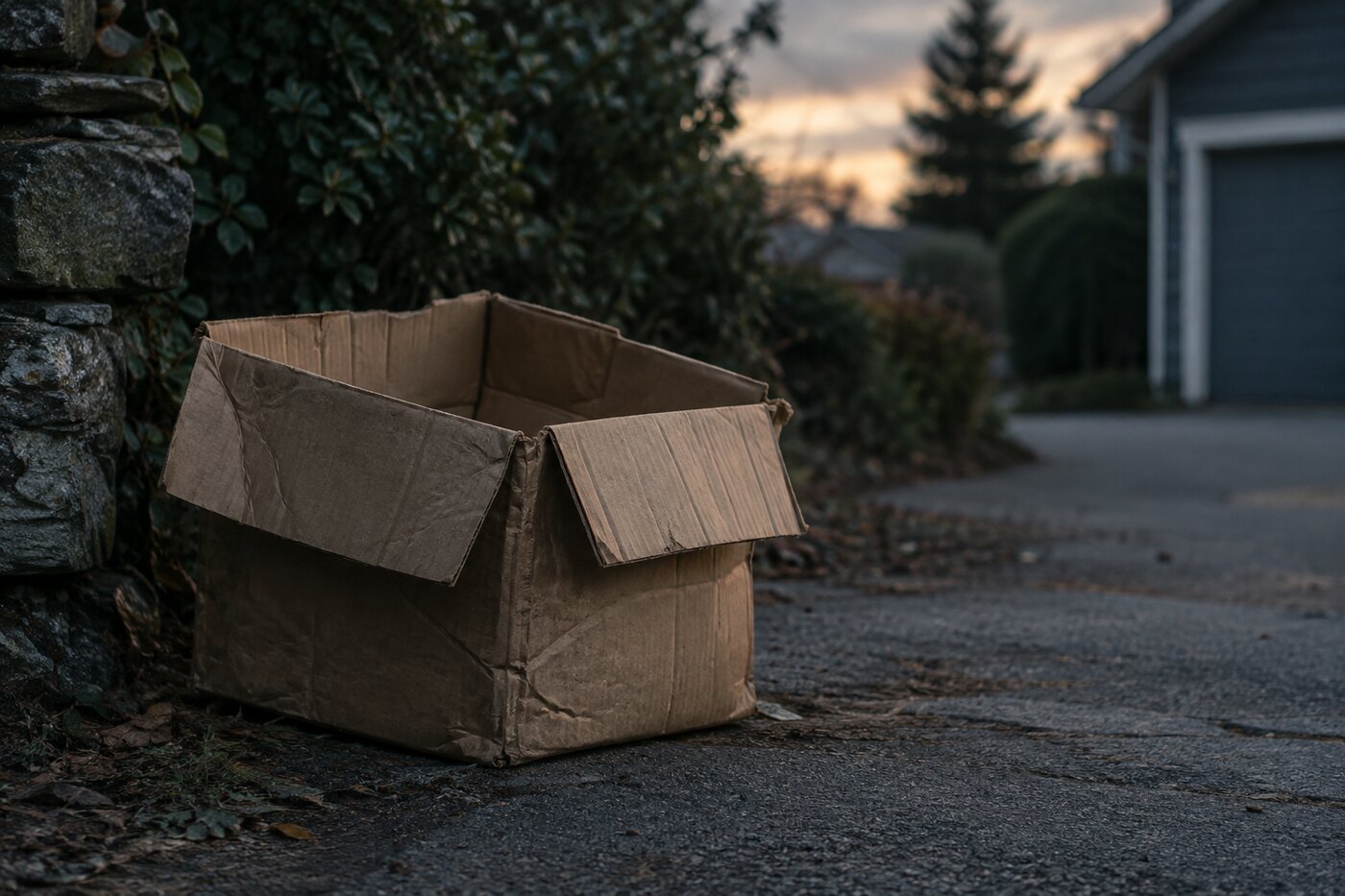
The FREE box sat at the foot of the driveway where the merchandise stopped mattering. Someone had written the word on the side in marker, pressing hard, and the cardboard had gone soft at the corners from a morning of dew and a morning of sun, so the box slumped a little, holding its contents at a defeated angle.
Everything in a FREE box has failed twice. It failed to be wanted enough to keep, and then it failed to be wanted enough to price. A thing on the tables has a number on it, a dime or a dollar, and the number is a kind of dignity — someone thinks it is worth something. The FREE box is where the numbers give out. These are the things the seller couldn’t bring themselves to charge for and couldn’t quite carry to the curb either, so they built this cardboard purgatory and set it at the edge of the sale and let the objects wait.
I went through it the way you can’t help going through it. A single roller skate, the old kind with the metal wheels and the key. A coffee mug with a company logo from a company I’d never heard of, which meant the company was either dead or too small to have reached me. A stack of place mats, quilted, stained in one corner with something that had set years ago. A phone charger for a phone shape that no longer exists. A trophy — second place, some tournament, some year — with the little gold figure frozen mid-swing at a ball that was sold separately, apparently, and never included.
You pick a thing up out of a FREE box and immediately you are in a negotiation, except the negotiation is entirely with yourself, and it has no money in it, which makes it worse. To take the thing is to say out loud, with your hands, that you have room in your life for what a stranger found unbearable to keep. To take the roller skate is to become the kind of person who takes a single roller skate. And to put it back is its own small verdict — you have judged a free thing and found it not worth the price of free, which is a price paid in shelf space and in the admission that you took it.
And you are watched the whole time. Not accused, just watched. The seller, folding a card table twenty feet off, would rather you took something, because every object you lift out of the box is one they don’t have to deal with when the sale is over. There is a faint pressure coming off them, a hope that you’ll be the one to make the trophy someone else’s problem. And the objects themselves seem to be watching too, in the way abandoned things do, running out of chances, each hour in the box moving them closer to the curb and the truck and the end of being objects at all.
I have taken things I did not need out of FREE boxes because leaving them felt like a failure of nerve, or of imagination. A jar of assorted screws — those I’ll always take, screws being the one thing that never really goes free, always finding a use. A wooden spoon, worn thin on one side of the bowl by decades of stirring against the same wall of the same pot, taken because the wear on it was honest and I couldn’t stand to leave a tool that had clearly earned its keep. It hangs in my kitchen now. I stir with it sometimes and think of the pot I never saw.
But most of it I left, which is what most FREE boxes are for — being left. The box is less a place things leave from than a place they arrive at to finish becoming garbage slowly, in public, with a chance at reprieve that mostly doesn’t come. An object in a FREE box is waiting for a person with lower standards than the last owner, or a better imagination, someone who can see the roller skate as a bookend or the trophy as a joke or the place mats as still, technically, place mats. Most of the time that person doesn’t drive by. Most of the time the box just gets rained on.
I picked up the trophy last, because I kept ending up back at it. Second place. The little gold man swinging at nothing. I turned it over and there was a felt pad on the base, half peeled, and under the peeled half a smear of dried glue gone amber and hard. I set it back in the box, upright, facing out, giving it that much at least. The felt pad, loose at one corner, curled up a little more as I let go, and stood there peeling itself off the base one slow degree at a time in the last of the light.