I went in for one thing. A bag of layer pellets, because the barrel at home had gone down to dust and a few pellets rolling in the bottom, and the hens had started giving me the look they give when the feed runs thin, which is a look with an opinion in it.
The door has a bell on a bent bracket, and it doesn’t so much ring as clunk. Inside, the smell arrives before your eyes adjust — grain first, that dry sweet dustiness, then rubber from the wall of boots, then the cold flat smell of the metal shelving and the concrete floor that never really warms up even in summer. It is a smell I would know blindfolded, and I stood in it a second longer than the errand needed, the way you do in a place that smells like a whole category of your life at once.
The feed is stacked in the back on wooden pallets, the bags lying on each other in courses like a rough brick wall. Layer pellets, the bag with the printed hen looking well-fed and slightly smug. Fifty pounds. I know the weight before I touch it, but knowing and lifting are different departments. I squatted, got both hands under the middle where the bag wants to fold, and stood up with it, and the bag did what a bag of feed does — it sagged around my grip and tried to become a liquid, all its weight pouring toward the low corner. You carry it against your chest with your chin nearly on it, or you get it up on a shoulder and walk lopsided. Either way the store watches you do it and nobody offers to help, because everybody in here has carried one and knows it’s a private negotiation.
Up front there were two men at the counter and no hurry in either of them. I set my bag down by my feet — you don’t hold fifty pounds while other people talk — and waited, and the talk was the practical kind. One of them had lost part of a fence to a moose, an actual moose, that had walked through the wire like it was a suggestion. The other one knew a guy with a post pounder to lend. The clerk listened and rang me up sideways, half his attention on the moose. This is how you learn things at a feed store. Nobody announces the news. It leaks out at the counter between transactions, worth the trip on its own.
The clerk asked how many birds I was running now, which is the feed-store version of asking how you’ve been, because the answer is also the reason you’re here. I told him, and he nodded like the number checked out against the size of the bag, which it did.
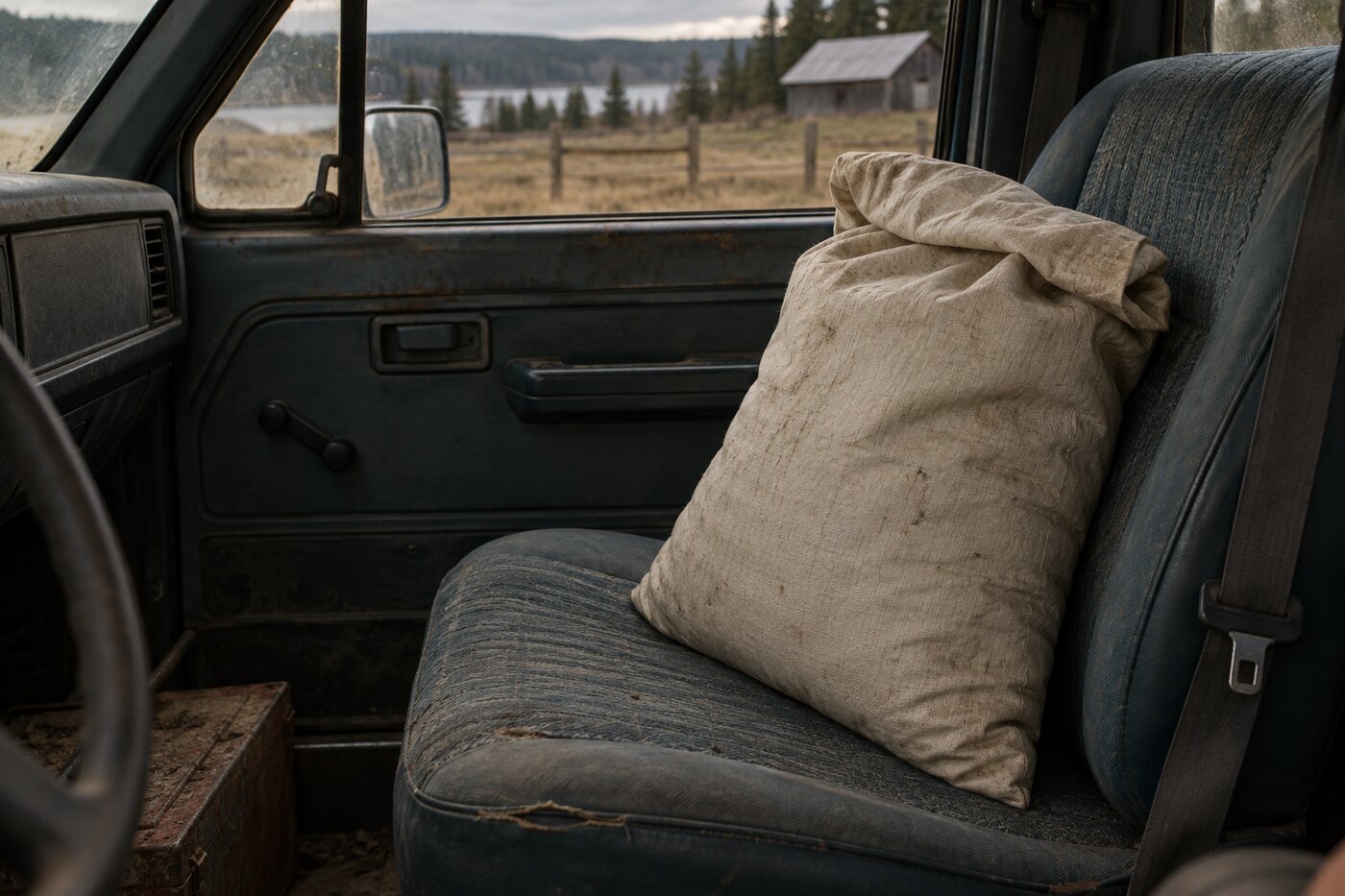
Then the haul to the truck, which is the real event. Out the door, across the gravel, the bag on the shoulder now, gravel shifting underfoot so you plant each step deliberate. I dropped the tailgate and swung the bag off my shoulder onto the bed, and it landed with that soft heavy whump, pellets shifting inside, and settled into the shape of whatever it landed against. I thought about belting it into the cab like a passenger, the way I’ve done in worse weather, but the bed was dry and the drive was short.
Everything you buy in that store implies something waiting at home, and the whole way back the bag was a promise riding behind me. Fifty pounds of pellets means the hens, means the barrel to be filled, means the scoop and the morning and the whole small machinery of keeping animals that expect you. You don’t buy feed the way you buy other things. There’s no version where you get it home and decide you don’t want it after all. Something with feathers has already committed you.
At home I backed up to the coop and carried the bag the last stretch and cut the top with my knife — feed bags have a string sewn along the top that pulls clean if you find the right end and pull the right way, and unravels into a tangle if you don’t. I found the wrong end. It broke off in my hand and left half the seam still closed, so I sawed the rest with the knife, rougher than I meant to, and pellets ran out fast into the barrel with a hard bright rushing sound.
The barrel filled and the bag went slack and empty, and I shook the last dust out of the bottom corner into the barrel. The hens were already at the wire, loud about it. The empty bag lay on the ground with its cut string trailing, the printed hen on the side creased across her smug face, and a fine feed dust had settled over everything — my sleeves, the lid of the barrel, the top rail of the coop. It was still on my hands at supper, that dust, a pale film in the creases of my knuckles that the water at the sink hadn’t quite reached.