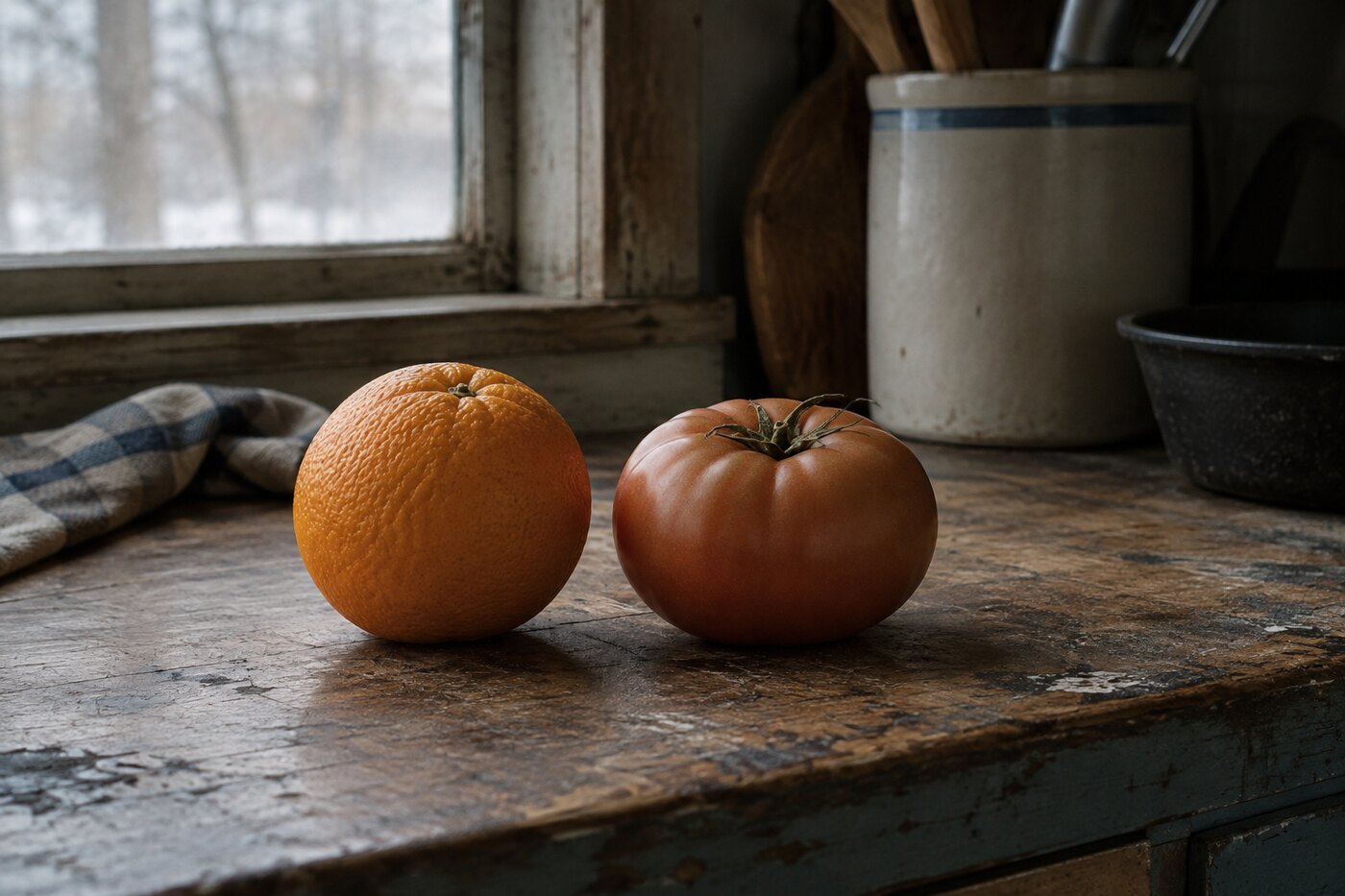
Most of what a thing went through to reach you is invisible by the time it’s in your hand. The tomato does not come with its route printed on it. It comes looking confident, red and round and firm, and then you cut it and it tastes like luggage — like something that was built to survive travel rather than to be eaten at the end of it.
That is the first thing you learn if you start wondering where the food came from. The look and the taste have quietly become two different projects. A tomato picked green in a place I’ll never see, gassed into redness on a truck, arrives at the store having accomplished exactly one thing: it looks like a tomato. The taste was left behind somewhere on the road, in the days it spent being firm enough to stack.
The oranges in winter are the honest miracle nobody’s amazed by anymore. It is January, there is frost on the inside of the window, and here is a fruit that grew in heat, on a tree, in a place with a completely different sky, and it costs less than a magazine. You hold it and it’s cold from the store, but it came from warmth, and it carried that warmth across a distance the price refuses to account for. I peeled one and the oil sprayed up from the skin, sharp and specific, the one part of the route that couldn’t be faked or flattened — the smell was still exactly itself.
Apples are the long-memory fruit. The one in the bin in spring did not grow this spring. It grew last fall, and it has been asleep since, kept cold and kept still in a room engineered to lie to it about the season, waxed to hold its water in. You rub one on your sleeve and the wax comes up to a false shine, and under your thumb you can feel it, that too-smooth coat that isn’t the apple. The apple is months older than it looks. It has been waiting in the dark for you longer than some friendships last.
Flour has been through more machines than anyone wants to picture — grown, cut, threshed, hulled, ground, sifted, bleached maybe, bagged, and it arrives as a smooth white anonymity that gives no hint of the wheat it used to be, the field, the weather that field had. You put your hand in the bag and it’s just softness and dust. The whole violent mechanical history of it has been ground out along with the husk.
Coffee is the one that gives itself away at the smell. Open a bag and it tells you more than the label does — the label says a country, a roast, a mountain range in a font meant to sound rugged. The smell says something more specific than that, something about this particular batch, and you can’t name it but you can tell it apart from the last bag. The route is invisible but the evidence leaks out the top of the bag the second you break the seal.
The fish is where the route hides in plain sight. Frozen, in a box, with a barcode on the side, and the barcode is a map if you knew how to read it — caught here, processed there, which is often somewhere else entirely, a fish pulled from one ocean and cut apart on the far side of a different one and shipped back to be sold near where it started. The whole globe is folded up in that little box, and it costs what it costs, and the price is the one number that has been carefully arranged to not tell you any of it.
I am not building a case here. It isn’t an ethics thing, or not only. It’s more that every ordinary thing on the counter came a distance nobody bothers to imagine, through hands and machines and weather I’ll never see, and arrived pretending it just showed up. The pretending is almost the whole skill of modern food. It arrives looking like it has no history.
I cut the confident tomato for lunch anyway, because it was what I had. It sliced clean, firm all the way through, the flesh pale toward the center and the seeds sitting in their jelly looking like they meant business. It tasted like the idea of a tomato held at arm’s length. I ate it. On the board it left a thin watery ring, colorless, already spreading toward the edge, and the ring outlasted the taste by a good while — still there when I came back to wipe the board, a faint wet map of where the tomato had been.