An object in a house is quiet because it is surrounded by its reasons. The same object on a flea-market table, stripped of the drawer it lived in and the hand that reached for it, gets loud. It has to explain itself now, and it can’t, and the not-being-able is the whole strange music of the place.
One table held, in the space of an arm’s length: a tray of costume jewelry with the rhinestones gone cloudy, three socket wrenches of different drives, a single pair of baby shoes with the soles still white, and a commemorative spoon from a state I doubt the seller had been to. None of these things had anything to do with any of the others. They had been made neighbors by the accident of ending up on the same table on the same morning, and the proximity was doing something no museum arrangement could — it was telling the truth about how objects actually pile up in a life, which is not by category, but by the simple fact of not being thrown out yet.
I picked up a socket wrench. The ratchet still worked, that fine dry clicking, twenty small teeth catching one after another, and the sound was so exactly right that I stood there working it back and forth like a man winding a watch that doesn’t need winding. Someone had used this. The handle had a wear-shine on one side where a thumb had ridden it for years. It was three dollars. The baby shoes beside it were also three dollars, and the equivalence was its own small comedy — the tool that had done ten thousand jobs priced the same as the shoes that a foot had outgrown in a season.
There were paintings leaned against the table leg that nobody could explain, least of all the seller. A lake, maybe, in a frame worth more than the lake. A portrait of someone’s aunt or someone’s idea of an aunt, staring out with the flat confidence of amateur oil. These are the true orphans of the secondhand world — things made by hand, with real hours in them, that meant everything to exactly one person who is no longer available to explain why.
Lamps stood in a row without their shades, cords wrapped around their necks, looking undressed. A lamp without a shade is a peculiarly naked object, all socket and no purpose, waiting for a shade in a size nobody makes anymore. You could see the pull-chain on one, the little knurled ball at the end, and I pulled it out of habit and of course nothing happened, there being no bulb and no wall and no house.
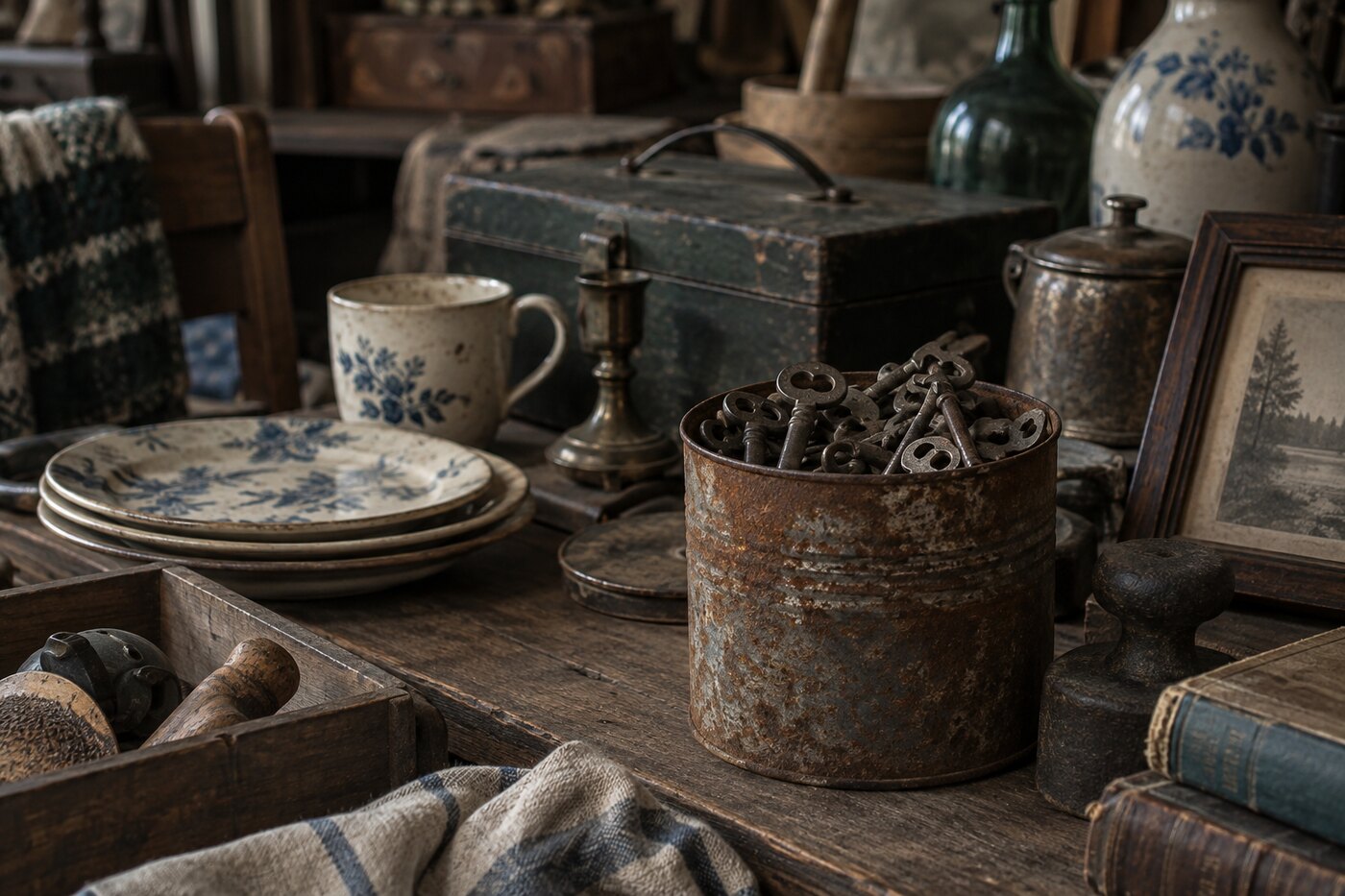
But the thing I keep is the coffee can of keys. It sat in the middle of the table, an old can gone soft-brown with rust at the rim, full to the top with keys — house keys, car keys, the little flat ones for padlocks and diary clasps, skeleton keys with real teeth. Hundreds of them. Every one had once opened something. Every one had been kept because throwing away a key feels like tempting fate, like the lock might come back asking. And here they all were, together at last, a can of solved problems, each key still perfectly capable of its one job and none of them within a hundred miles of the lock that job belonged to.
I ran my hand into the can and the keys shifted around my fingers, cold and heavier than they looked, and made that sound — the sound of a lot of keys, which is a sound of a lot of doors. I didn’t buy any. You can’t buy one key. A key alone is nothing. The value, if there was value, was in the whole can of them, the mass of abandoned access, and I didn’t have a use for a hundred keys to nothing.
Near the end of the table was a box, and the box was marked, in marker, MISC. It is almost too honest a word. Everything on the table was misc, really; the box just admitted it. Inside was a doorknob, a length of chain, a harmonica, a spool of picture wire, and a thing I could not identify at all, some bracket or clip that had been essential to a machine I would never see. I turned it over twice. It gave up nothing. I set it back in the box, in among the other things that had stopped meaning what they meant, and it settled with a small tick against the doorknob and stayed.