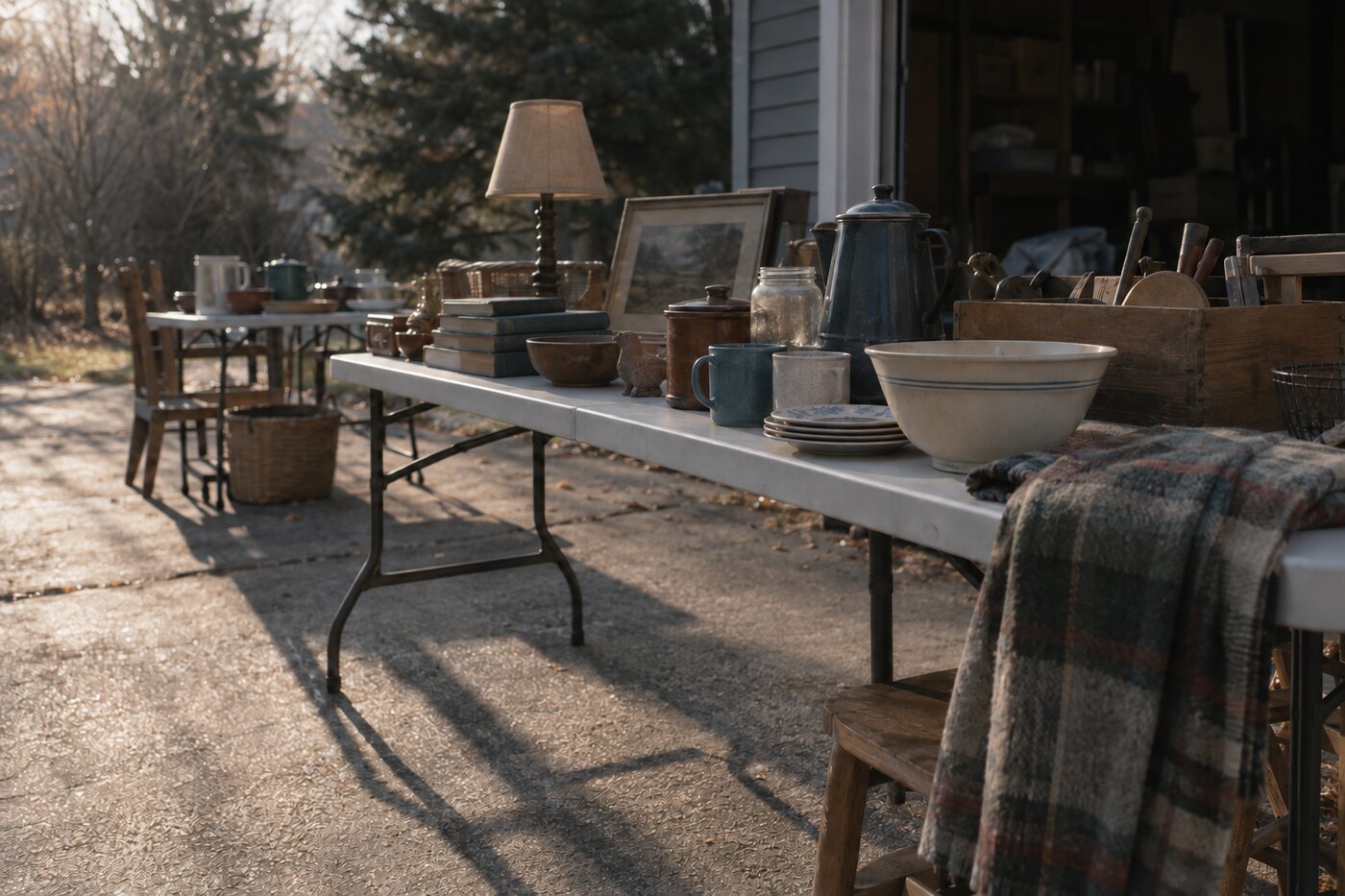
You arrive early and pretend you didn’t. Everyone does. The sign said nine and the driveway had cars at eight-forty, people walking up slow with their hands in their pockets, looking at the sky, as if they’d simply found themselves there, as if the folding tables were a coincidence.
A garage sale is a house briefly turned inside out. The things that lived in the basement and the back of the closet are dragged into the driveway and set in the sun, and the sun is not kind to them. You can see, all at once, everything a household decided it could finally let go of. The bread machine. The exercise thing with the resistance band still twist-tied to its own frame, never once stretched. A box of cords that go to nothing anyone present can name.
The tables are sorted by a logic that isn’t category. It’s family logic. Here is the shelf of a particular person’s hobby, abandoned at a particular depth — the good paints and the cheap brushes, together, because they were bought in the same hopeful week. Here is a child’s whole former size, folded and stacked, the outgrown made suddenly public. You read a stranger’s house off these tables the way you’d read tree rings, and nobody meant for you to, and you do it anyway.
The haggling is the strange theater of it. You will stand there and offer seventy-five cents on a thing marked a dollar, a thing that costs less than the coffee going cold in your car’s cupholder, and the seller will pause as if considering a real proposition, and you both know the money is not the point. The point is the small ceremony of the object changing hands with a mark left on it, a negotiation, a moment of both parties agreeing on what a used thing is worth, which is almost nothing, which is the honest number, and somehow still worth arguing over.
I bought a wooden box once because it had good screws. Not for the box — the box was split down one corner and the lid didn’t sit — but the four brass screws in the hinges were solid, slotted, the real thing, and worth more than the quarter I paid for the whole assembly. I took it home and drove the screws out one at a time into a jar and put the box in the burn pile. The box was a container for the screws long after it had stopped being a container for anything else.
Then there is the FREE box, and the FREE box has a morality all its own. It sits at the end of the driveway, cardboard going soft at the corners, holding the things too unwanted to price and too usable to throw out. To take something is to admit you have room in your life for what a stranger couldn’t stand to keep. To leave it is to feel, obscurely, watched — by the seller, who would rather you took it, and by the object, which is running out of chances. I have picked things out of the FREE box and put them back and picked them up again, doing a moral arithmetic over an object worth exactly zero dollars.
By late afternoon the sale has a different weather. The good things went in the first hour to the early people who pretended they weren’t early. What’s left is the pile — the things that were looked at forty times and set down forty times, and now sit in a heap because the tables are being folded and the driveway wants to be a driveway again. The seller looks at the pile the way you look at leftovers you know you won’t eat. Some of it will go back in the basement. Most of it will go to the curb, or to the FREE box, upgraded from merchandise to charity to garbage in the course of a single Sunday.
I stayed too long, the way I do. Bought the screws, left a coffee can of buttons I keep thinking about. When I pulled out, the seller was carrying a folded table back into the open garage, and the FREE box sat alone at the foot of the drive with the light going amber across it. On top was the exercise thing, the resistance band still twist-tied, still never once stretched, waiting now for someone with either lower standards or a better imagination than anyone who had come by all day. It was still there in my mirror when I turned the corner.