Nothing in a feed store is bought for the pleasure of owning it. Everything in the building is a promise you are making to something at home that cannot come to the store itself.
You feel it the moment the door lets you in — the smell, first, which is grain and rubber and cold metal all at once, dusty and mineral, the smell of a place that keeps its doors open to the loading yard. The floor is concrete gone gray, and there is always a broom leaned somewhere and a thin drift of chaff along the base of the shelving that the broom is losing to.
The salt licks sit low because they are heavy and because nobody impulse-buys a salt lick. They come as blocks, reddish or white, wrapped in paper that tears at the corner, and they are dense the way only compressed salt is dense — you lift one and your arm learns something. It will sit in a field on a stump and a cow will wear it into a shape like a melting tooth over a season. You buy it now because the last one is nearly gone, worn down to a rind, and the animal is already looking for it.
Rubber boots hang by their pull-tabs in a wall of black and green, sized by a number printed on the sole you have to turn over to read. They are not fashion. They are the answer to standing in a place that is wet and will stay wet. You squeeze the calf to feel whether the rubber has gone stiff and cracked from a winter in a cold shed, because rubber remembers cold, and a boot that cracks at the ankle is a boot that lets the wet in exactly where you didn’t want it.
There are seed potatoes in the spring, in open crates, dusty and eyed, each one a small argument for the future — plant this and in months there will be more of it underground than you buried. You pick them up and turn them, looking for the eyes, avoiding the soft ones, and your hands come away with a fine pale dirt that isn’t quite dirt.
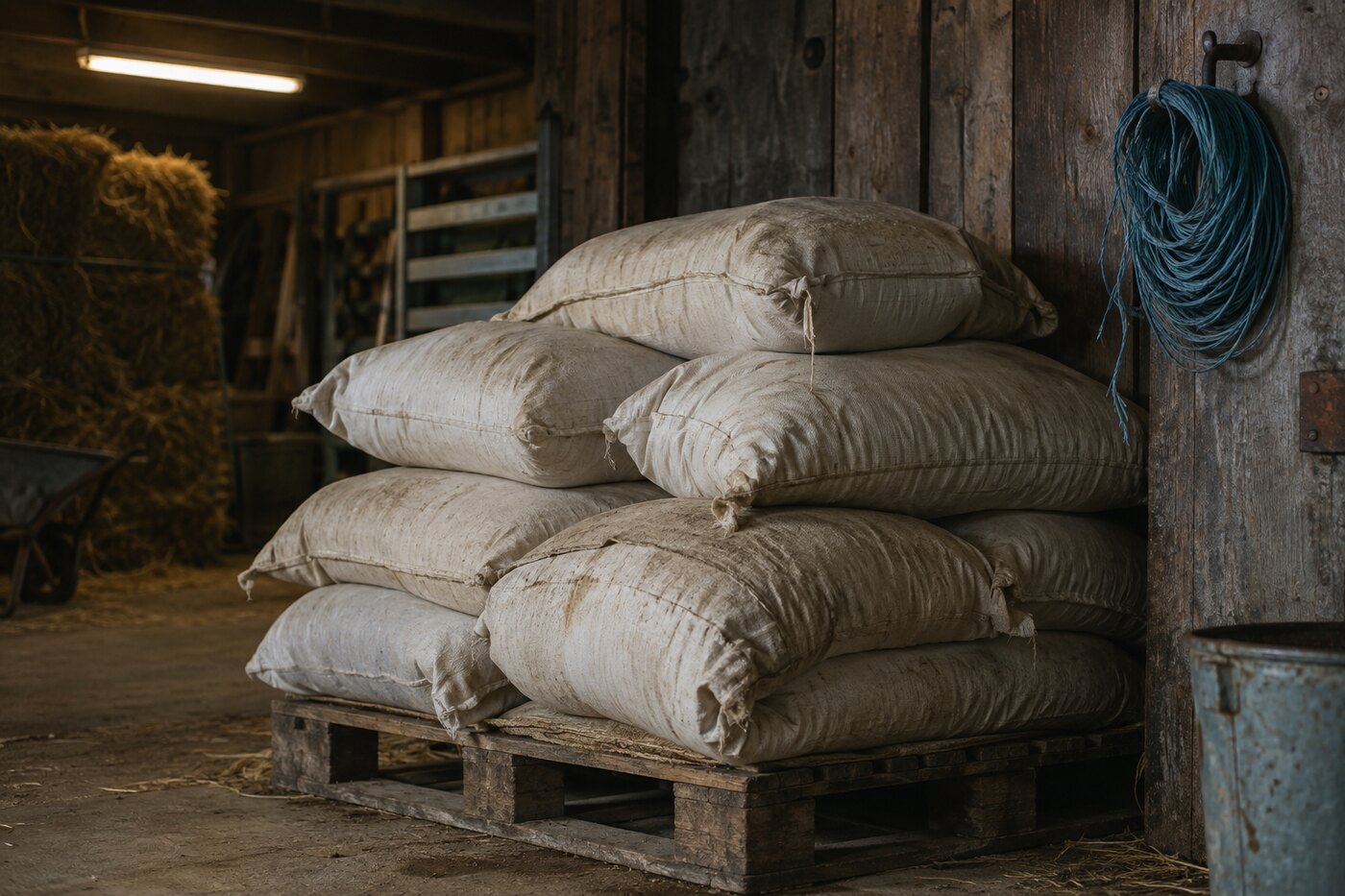
The chicken feed comes in bags with a printed hen on the side looking prosperous, and the bag weighs what it weighs, which is more than you want to carry but exactly what the flock will eat down to nothing in a set number of days. You can do the arithmetic in your head standing there — birds times days times appetite — and it comes out to this bag, this weight, no smaller.
Dog biscuits in a barrel, sold loose by the scoop, the big ones shaped like bones and the small ones shaped like nothing, and a metal scoop chained to the barrel so it won’t wander off. Twine in the corner, coiled tight in plastic, orange and blue, sold by the roll to people whose bales are coming apart in the loft. Fence staples in a bin, sold by weight, a small heavy heap poured into a paper sack that the clerk folds twice at the top. You buy staples because a wire is down, and a wire being down means something is getting out, or in.
Everything is too heavy to be aspirational. You cannot browse a feed store the way you browse other stores, drifting, imagining a better self. The bags won’t let you. They sit there being exactly as heavy as the work they represent, and you buy the amount of work you actually have, not the amount you wish you had.
Near the counter is where the store stops being a store for a minute. Two or three people stand with their elbows on the worn wood, and the talk is practical gossip — whose well went dry, what the coyotes got into, which cut of the road is washed out again. Nobody is in a hurry at the counter. The information traded there is worth as much as the goods, and it is free, and it is why some people come in for one thing they didn’t really need.
I came for staples and stood in the smell longer than the errand required, because the building is a good place to stand. Then I paid, and folded the sack down once more myself so it wouldn’t spill in the truck. It rode on the seat beside me, heavier than its size, the staples shifting against each other with every turn. In the yard at home the wire was still down where I’d left it, one strand curled back on itself, waiting for the weight I had just carried out the door.