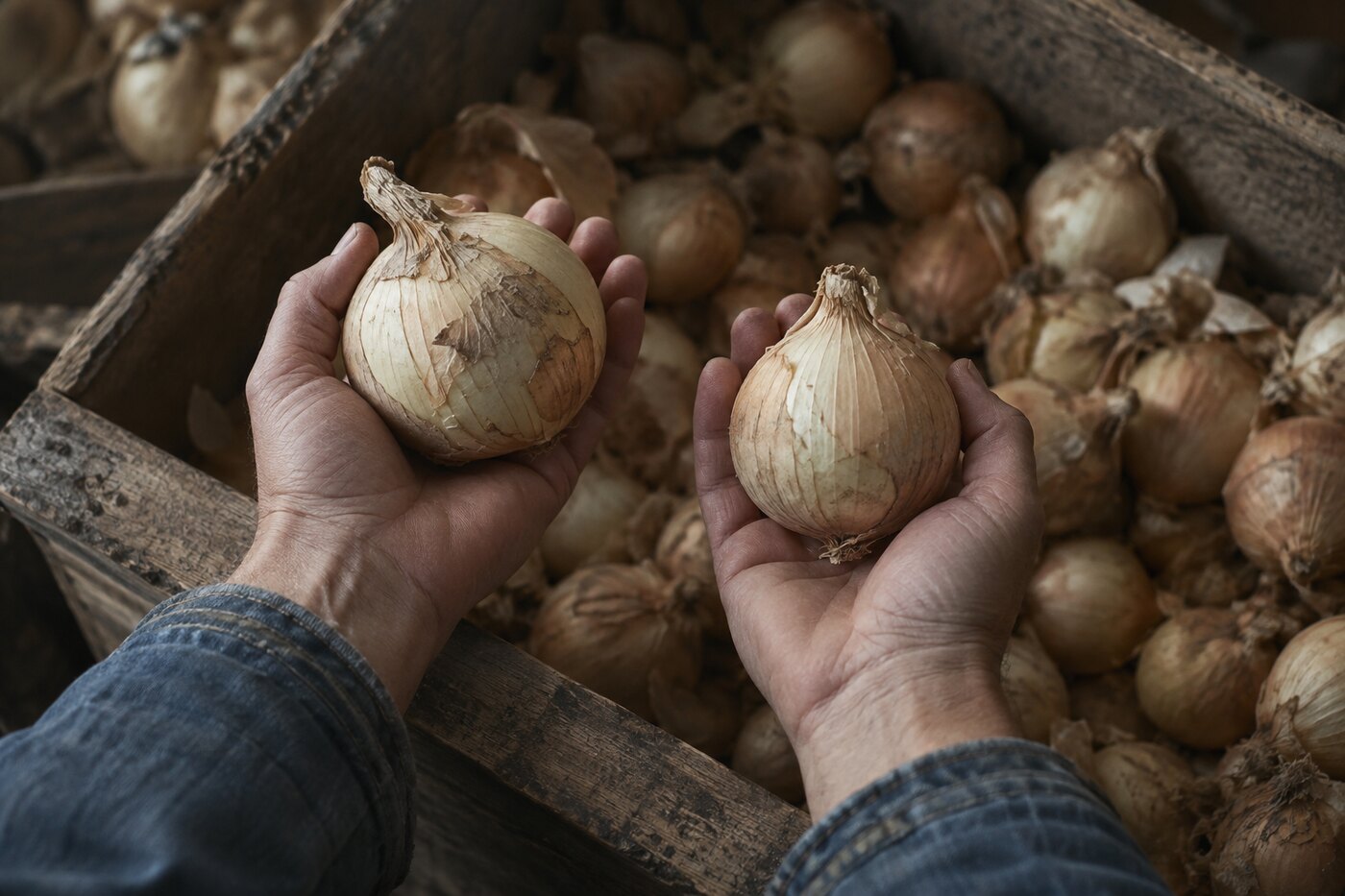
The label tells you a price and a country. It does not tell you whether the onion is any good. For that you have to pick it up, and picking it up is a skill nobody teaches you and everybody eventually has.
An onion you judge by weight first. Two of the same size, one in each hand, and the heavier one wins — heavy means dense, means it grew tight, means the layers went in close instead of loose. Then the sound. You bring it near and give it a small squeeze and it should be silent, papery, dry as an envelope. A whisper of give at the neck is the beginning of the end. I have carried an onion home that passed the weight and failed the neck, and found the soft brown coin of rot at the center a week later, having paid full price for the disappointment.
The avocado is the one people get wrong, mashing it in the store like they mean it harm. You don’t press with a finger — that leaves a bruise that shows up as a black thumbprint at dinner two days on, someone else’s violence surfacing in your kitchen. You cup the whole thing and squeeze with the flat of the palm, gentle, feeling for a give that is even all the way around. Uneven give means a hard shoulder and a rotten hip. And you pop the little stem cap, and under it should be green. Brown under the cap and you are buying a coffin.
Melon is nose work. You find the stem end, the scar where it left the plant, and you smell it. A cantaloupe that is ready smells like a cantaloupe from a foot away, sweet and slightly musked, almost too much. One that smells like nothing is nothing, and will taste like the inside of a refrigerator. The stem end should give a little too, a soft breathing give, and the netting on the rind should stand up rough under the thumb like a scab.
Carrots I trust more when they still look like the ground was recently involved. The washed ones, bright and smooth in their bag, have given something up to look that way. A carrot with dirt in the creases and the greens still on, limp but present, was pulled closer to now. You snap one if you can get away with it — a good carrot breaks with a wet crack and a spray you can almost see. A bendy carrot has been out of the dirt long enough to start forgetting it was ever crisp.
Eggs you open the carton for and you do not apologize. You lift each one a half inch and set it down, checking that it isn’t glued to the cardboard by a crack that already wept. Then you turn them, all twelve, a quarter spin in their cups, and any that stick have leaked and dried and married the carton. It takes ten seconds and saves you the small horror of the shell that comes apart in your hand at the counter.
Potatoes are the ones you choose by their future. A baking potato is a big honest oblong with a thick skin, chosen for the oven and the long dry heat. A boiling potato is smaller, waxier, picked because it will hold its shape in water instead of falling into the pot as paste. You cannot choose a potato without first deciding what you plan to do to it. I have stood over the bin holding one, not knowing yet whether it was dinner tonight or the week’s supply, and the not-knowing made the choosing impossible. The hand can’t judge a potato in a vacuum. It needs to know the plan.
That is the thing about all of it. Buying food is the first motion of cooking it, done in advance, in public, with strangers reaching past you for the same bin. The hand that presses the avocado is the same hand that will halve it. You are already in the kitchen, standing in the store, and the choosing is the first cut.
I filled the bag with the onions that had passed both tests, weight and neck, and knotted it. At the register one had a fleck of dry skin peeling loose, and I worried it with my thumbnail while I waited, and it came away in a curl, translucent, catching the light like the shed skin of something. I let it fall to the belt. It was still there, that pale curl, when my groceries had gone and the belt carried it forward toward the next person’s things.