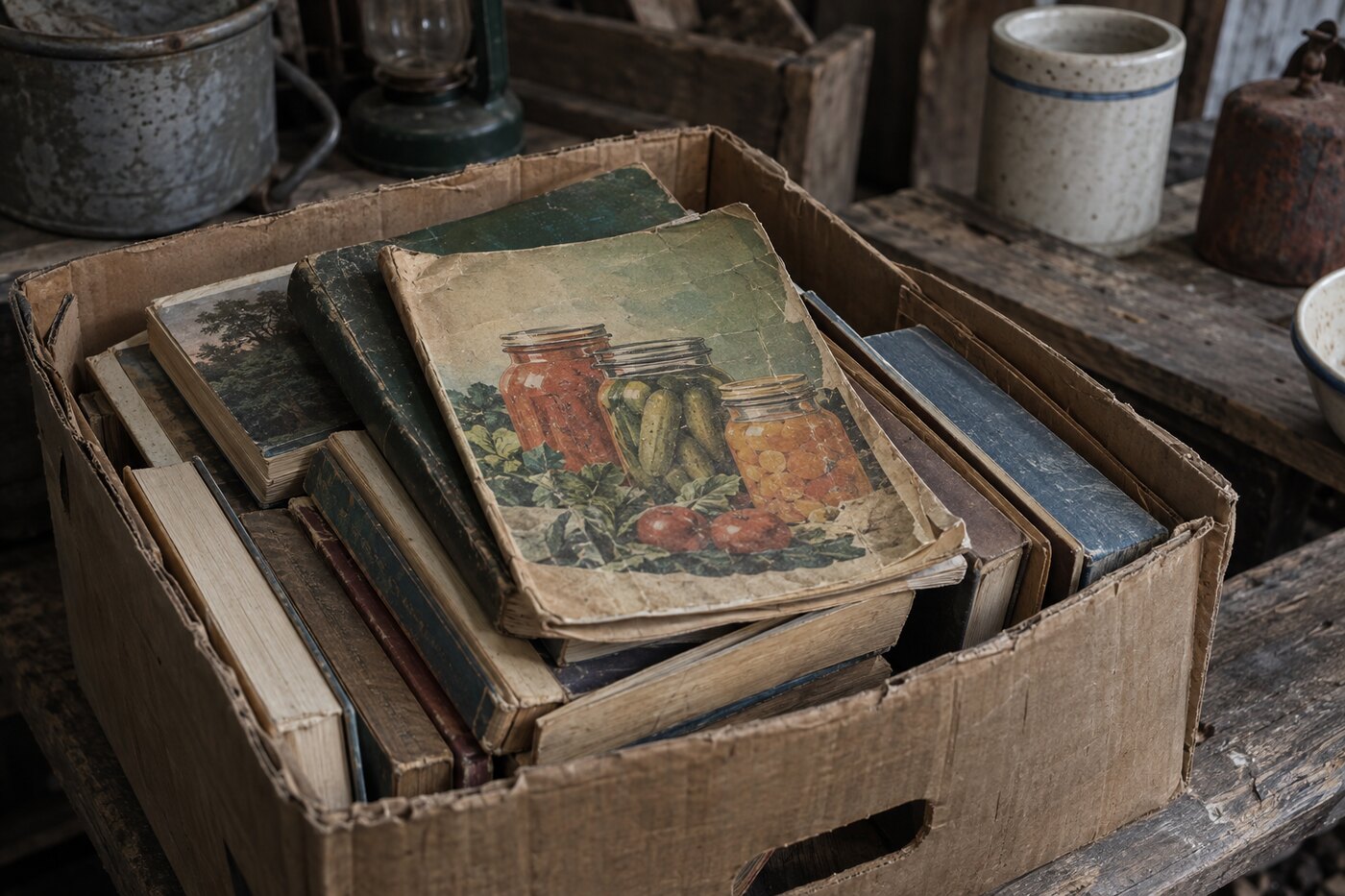
The good box of books at any sale is not the box of novels. The novels are clean. Nobody wanted them enough to hurt them. They stand up straight with their spines uncracked, read once or never, and they sell by the inch to people who like the look of a shelf. Skip that box. The box worth going through is the one on the floor, heavy, that the seller almost left home — the box where books stopped being literature and went back to being paper that did a job.
I dug through one behind a hardware stall. On top was a pressure-canner manual, the staple-bound kind that comes with the pot, and it had done real time. The pages were warped in a wave, swelled and dried and swelled again in a kitchen full of steam, so the whole booklet had a ripple to it and would not close flat. The processing-time chart was the most worn page, soft as cloth at the corner where a wet thumb had found it every August. And on that page one line was underlined three times, hard, the pen almost through the paper — the line about jars that seal and then unseal, the failures, the botulism warning. Three underlines. Somebody had scared themselves once and marked the spot so they would never have to be scared the same way twice.
That is the book you buy. Not the novel with the mysterious inscription. The manual with the fear in it.
Under it, a seed catalogue, years old, useless for ordering because the company was surely gone or the prices a joke, but somebody had gone through it with a pen and circled. Circled the short-season tomatoes, the ones that ripen before the frost that comes early up here. Circled and starred and, beside one variety, written “no” and a year. A record of hopes tested against a garden. The paper had gone tan and brittle at the edges and shed little flakes when I turned the pages.
There was a repair guide for a make of small engine, greasy at the fingertips of every page, so the diagrams were shadowed with the prints of a hand that kept coming back to the same carburetor. The grease had soaked the paper translucent in places. You could hold it to the light and see the diagram from the next page bleeding through. A book used at arm’s length from the thing it explained, propped open with a wrench, consulted and smeared and consulted again.
A cookbook, spiral-bound, community-made, the kind churches and auxiliaries print with everyone’s name under their recipe. The binding had a hardened splash across the fore-edge where something had boiled over and dried, gluing four pages lightly together at their outer margin, and those four pages were the ones with the most food on them. You could find the best recipes by the damage. The clean pages were the ones nobody trusted.
Then the true bottom of the box, the pulp. Old magazines, a stack of them, sold by the pound because that is what time does to a magazine. The opinions in them had expired. The news had happened and unhappened. What was left was weight, paper by the pound, worth what any paper is worth once the words have gone stale — the almanac from a dead year, the flyer of grocery prices no store would honor, the appliance booklet for a machine long hauled to the dump. A notebook, too, spiral, half its pages torn out, and the pages that remained held lists. Groceries. A phone number with no name. A column of figures added twice and not agreeing. Somebody’s arithmetic, kept by accident, sold by mistake.
This is the honest life of a book. It gets bought for what it says, and then, if it is any use, it gets wet and greased and dog-eared and underlined until it stops being a thing you read and becomes a tool you reach for, and then it wears out, and then it is paper, and then it is sold by weight to somebody like me crouched on a cold floor going through a box.
I bought the canning manual. Fifty cents. The seller did not look up from his coffee. I wanted the three underlines more than I wanted the times themselves, which I could find anywhere.
It sits by my own pot now, and it still will not close flat. The warp has set. When I set the pressure-canner manual down open on the counter, the swollen pages lift themselves back up an inch, slow, on their own, refusing the flat the way a thing does when it has taken on more water than it can give back.