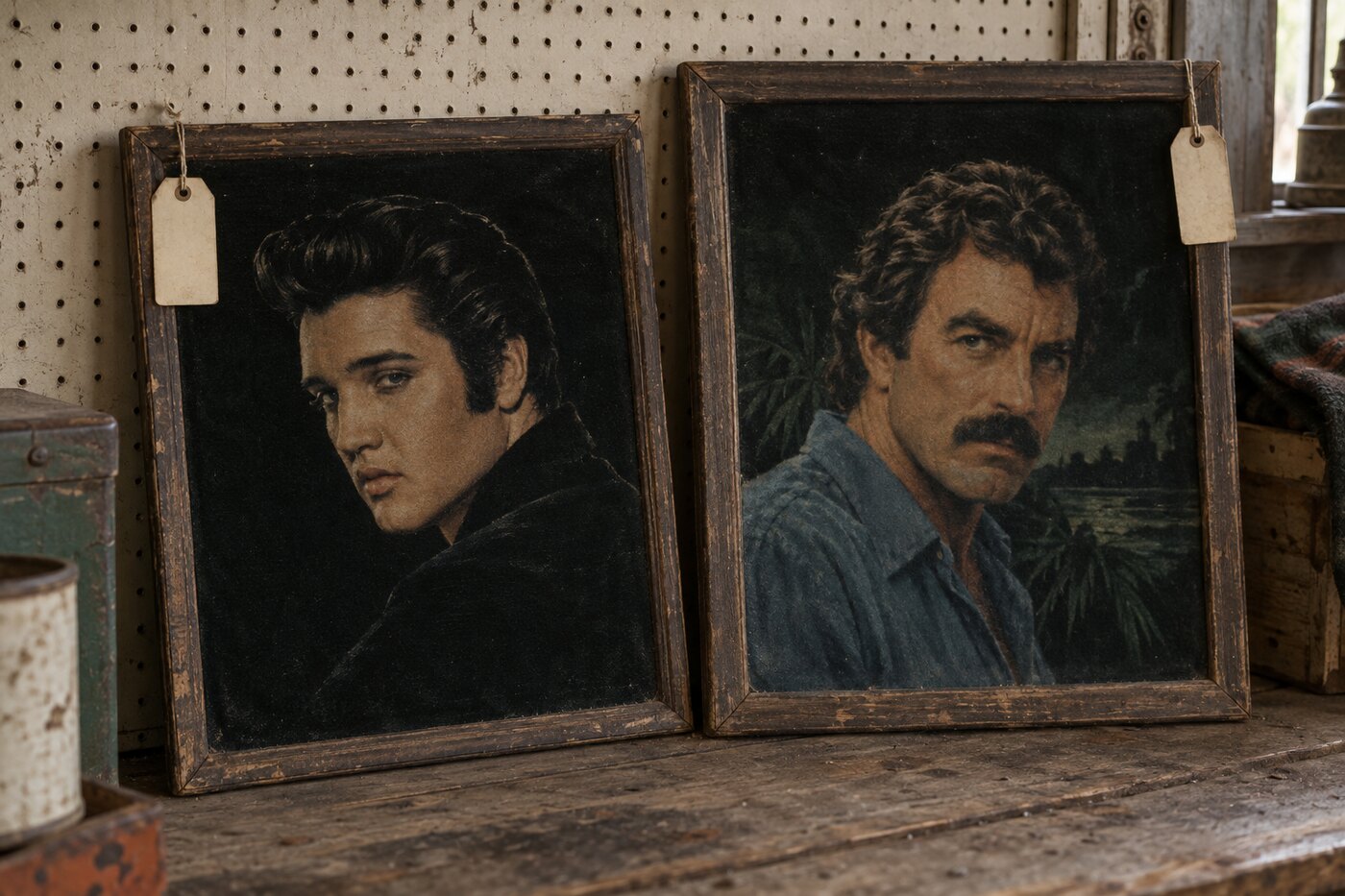
The velvet paintings hung on a sheet of pegboard leaned against the back of the stall, and they hung close, the way things hang when the seller has run out of wall and started overlapping frames. Elvis was on the left. He had the white collar up and the light coming from somewhere below his chin, so his jaw glowed and the rest of him sank into the black nap of the fabric. Beside him, touching frame to frame, was a man with a mustache and a brown blazer who I was fairly sure had been a television detective, though I could not have told you his name or the network or the decade with any confidence.
They were painted on the same stuff. That was the first thing. Black velvet takes paint differently than canvas — the pile eats the shadows, so the painter only has to bother with the light. Whoever did Elvis and whoever did the detective, and they were surely not the same hand, had both understood this. You paint the collar, the cheekbone, the wet shine on the lower lip, and you let the velvet do the dark for free. It is an efficient way to make a face. The face floats. There is no room around it, no chair, no window, just the man rising out of nothing because nothing is what velvet is good at.
I put a finger on the edge of Elvis’s frame, not the painting, and tipped it forward to see the price. Fifteen dollars, in marker, on a round garage-sale sticker. I let it fall back and tipped the detective. Fifteen dollars. The same round sticker, the same marker, maybe the same afternoon of pricing, the seller going down the wall assigning worth by the foot. Elvis, who filled stadiums and got buried under a plane’s worth of flowers, and a man who solved fictional crimes on Tuesday nights, were worth exactly the same amount of money on a Saturday in a cold barn, which is to say they were worth whatever moved them off the pegboard.
This is the thing the flea market does that no museum does. It flattens the wall. In a museum the frame tells you where to stand and how long. Here the frame is just what keeps the velvet from curling, and the wall is just pegboard, and the ranking that fame spends a lifetime building comes apart in the space of one marker and one roll of stickers. Elvis and the detective were neighbors now. Whatever gap had separated them in the world had been priced away.
I took the detective down to look at the back. The frame was staple-gunned, the velvet stretched and stapled at the corners by someone who had pulled it a little too hard on the top and left a pucker along the bottom edge, so the man’s brown blazer had a slight ripple in it that no light would ever paint out. There was writing on the back of the board in pencil. Not a name. A number, “24,” and under it what might have been “lot 6,” faded. So he had been in a sale before, in a lot, a batch, moved by number through some other room full of other people’s walls. He had been changing hands for a long time. The velvet had a smell when I brought it close, dusty and slightly waxy, the smell of a thing that has hung in a smoking house and absorbed the ceiling.
Elvis I left on the wall. His frame was better, a gilt plastic molding with the gold worn off the high points where hands had gripped it to straighten him, over and over, on some hallway wall that pitched him crooked every time a door slammed. You could read the whole history of straightening in the wear. Somebody had loved him enough to keep him level. Nobody straightens a painting they don’t care about. The detective had no such wear. His frame was clean at the corners. He had hung, if he hung at all, somewhere quiet, and been dusted rarely.
That was the difference the price could not see. Fifteen and fifteen, but one man had been touched a thousand times and the other left alone. The market had no way to charge for that. The marker does not know about the worn gold. It only knows the size of the frame and the seller’s guess at the day’s traffic.
A man came by while I stood there and picked up Elvis without ceremony, turned him over the way I had, saw nothing he needed to see, and put him back not quite level. The frame sat crooked on the peg. Nobody moved to fix it. In a house someone would have reached out inside the hour. Here he could hang tilted all day, at the same wrong angle as the field the fence outside leaned into, and it would cost him nothing, because the tilt was not a flaw anyone was paying for.
I did not buy either of them. I am still not sure that was the right call. The detective’s name came to me two days later, in the truck, unbidden and useless, and I said it out loud to no one and it did not bring him back off the pegboard.
The garage-sale sticker on Elvis’s frame had lifted at one corner from the tipping — mine, the other man’s, everyone who checked the price. By the end of the day the fifteen would be smudged past reading. The gilt would keep wearing wherever a hand found it. And the velvet would go on doing what velvet does, which is hold the dark and give back only the parts somebody chose to light.