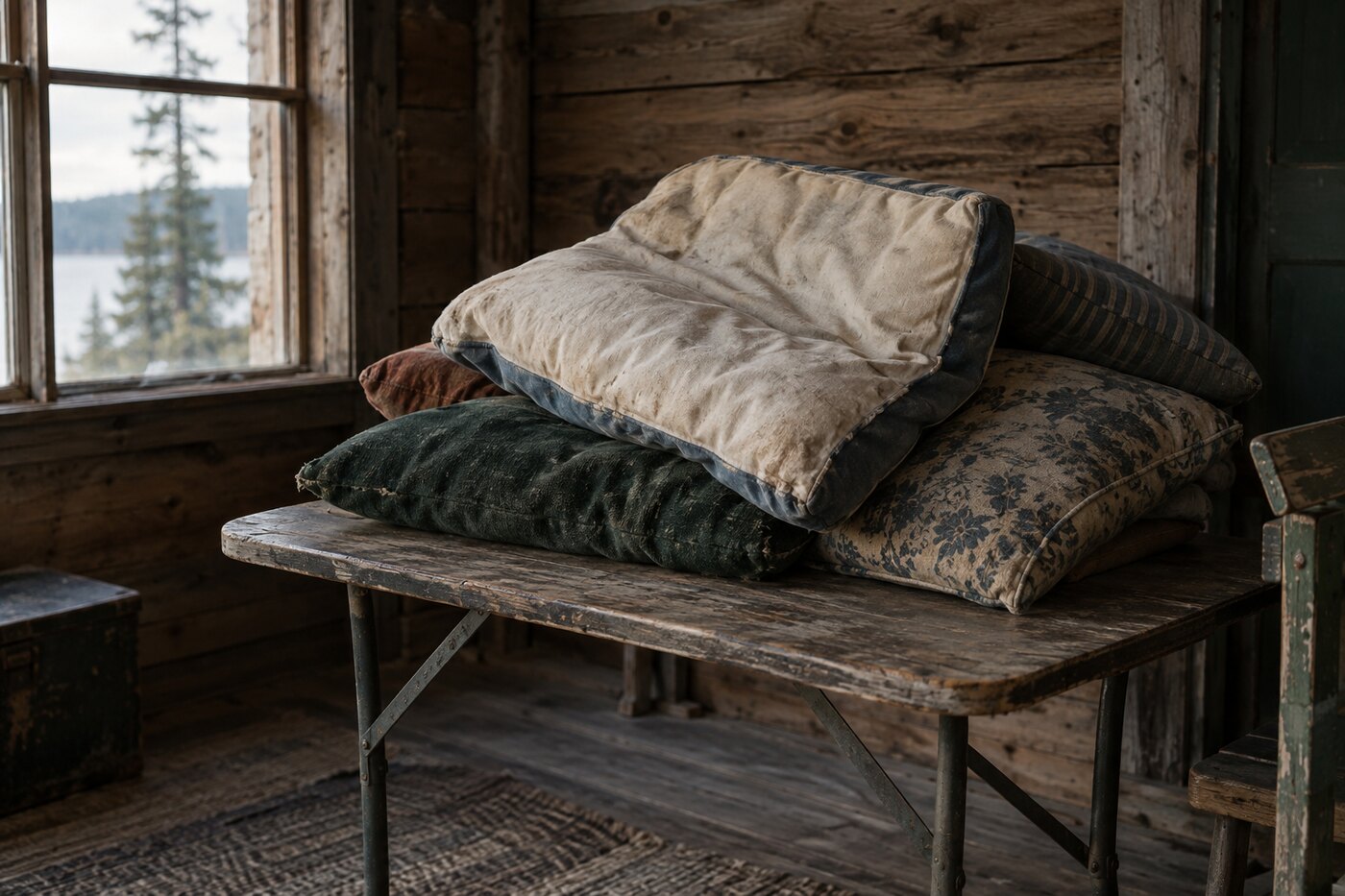
The cushions were stacked past leaning, held up by their own weight and the corner of the table. Someone had priced them at two dollars each, or three for five, in marker on a strip of masking tape that had lost its stick at one end and curled away from the vinyl like a lip.
I put my hand on the top one before I meant to. That is how you learn a cushion. The palm goes down and waits. This one gave, then stopped giving, then pushed back a little late, the way old foam does when it has forgotten how to be one thickness all the way through. Somewhere inside it there was a firm part and a dead part, and the dead part had won more ground than the firm.
The top face was a floral. Roses, I think, though the sun had taken most of the argument out of them. One side had gone to the color of weak tea. The other side, the side that had faced the wall or the house or whatever it leaned against, still held a pink with some blood in it. You could draw the line where the light stopped. It ran diagonally, which meant the cushion had sat at an angle for years, on a chair that faced a window it did not face square.
I turned it over. The back was a different fabric entirely. A brown weave, coarser, the kind that comes on furniture built to survive children. Someone had married the two. There was a zipper down one edge, painted over at the pull with a fleck of white, so the cushion had been near a wall while somebody rolled a brush past it and did not stop to be careful. The zipper still ran when I tried it. Three inches, then it caught on a thread, then it went again.
The pile had maybe fifteen of them and no two matched. This is the honest sign. A matched set comes from one house at one time, bought and used and given up together. A pile like this comes from many houses, gathered by somebody who takes what the estate people won’t bother with, the soft things, the things that hold damp, the things that carry the smell of the room they sat in longest.
And they did carry it. I leaned down closer than I would admit to and there it was, under the flea-market smell of dust and cold concrete floor. One cushion smelled faintly of woodsmoke, deep in, past washing. Another had the sweetish edge of a house with a dog and a closed-up summer. A third smelled of nothing but foam breaking down, that chemical sourness they get near the end, when the inside starts to turn to crumbs and powder. I have cut one open before. It comes out in yellow flakes. It does not go back.
There was a green one near the bottom with a dent in it. Not a crease from stacking. A dent. A round soft crater worn into the middle of the seat where a person had sat, the same person, in the same spot, for long enough to teach the foam a shape and then leave it holding that shape after they were done sitting. I pressed my hand into the crater and it fit a body I would never meet. Heavier than me. Patient. The foam had given up trying to rise back and just stayed low, a bowl, a print.
I weighed a couple in my hands, one against the other. The heavy ones were heavy with old foam and maybe with moisture they’d taken on in whatever shed they’d waited in. The light ones were light because they had almost nothing left inside, the batting compressed to paper, the cover doing most of the work of pretending to be a cushion. You could tell the good buy from the bad buy by weight alone, if what you wanted was a cushion. I am not sure that was what I wanted.
The woman running the table watched me handle them without much interest. She was working a knot out of a tangle of extension cords and did not look up. “Those come from a lodge,” she said, when I had gone through about half. “They closed. Everything soft they couldn’t sell, I took by the truckload.” She said it flat, no story attached, and went back to the cords. So the woodsmoke was a lodge stove. The dog smell was somebody else’s lodge, or the same one, years of guests and dogs and people who put their feet up and left.
I found one I liked. A mustard corduroy, worn shiny along the ribs where hands or backs had rubbed the pile flat, so the wale showed as bright lines against dull. The corners were still square. The foam still argued back. Two dollars. I could have used it. I turned it over twice, found the shiny worn patch, ran my thumb along the flattened ribs, and I could feel exactly how somebody had gripped it to move it, over and over, the same two corners.
I put it back on the pile. I don’t fully know why. The shape somebody else had worn into it was doing fine without me, and I did not want to be the next thing it learned.
The masking-tape price tag had curled a little further off the vinyl while I stood there, warmed by nothing, just old glue letting go. By afternoon it would drop. The cushions would still be there, holding their separate weathers, holding the dent, and the tape would be on the floor under the table where nobody would read what any of it had cost.