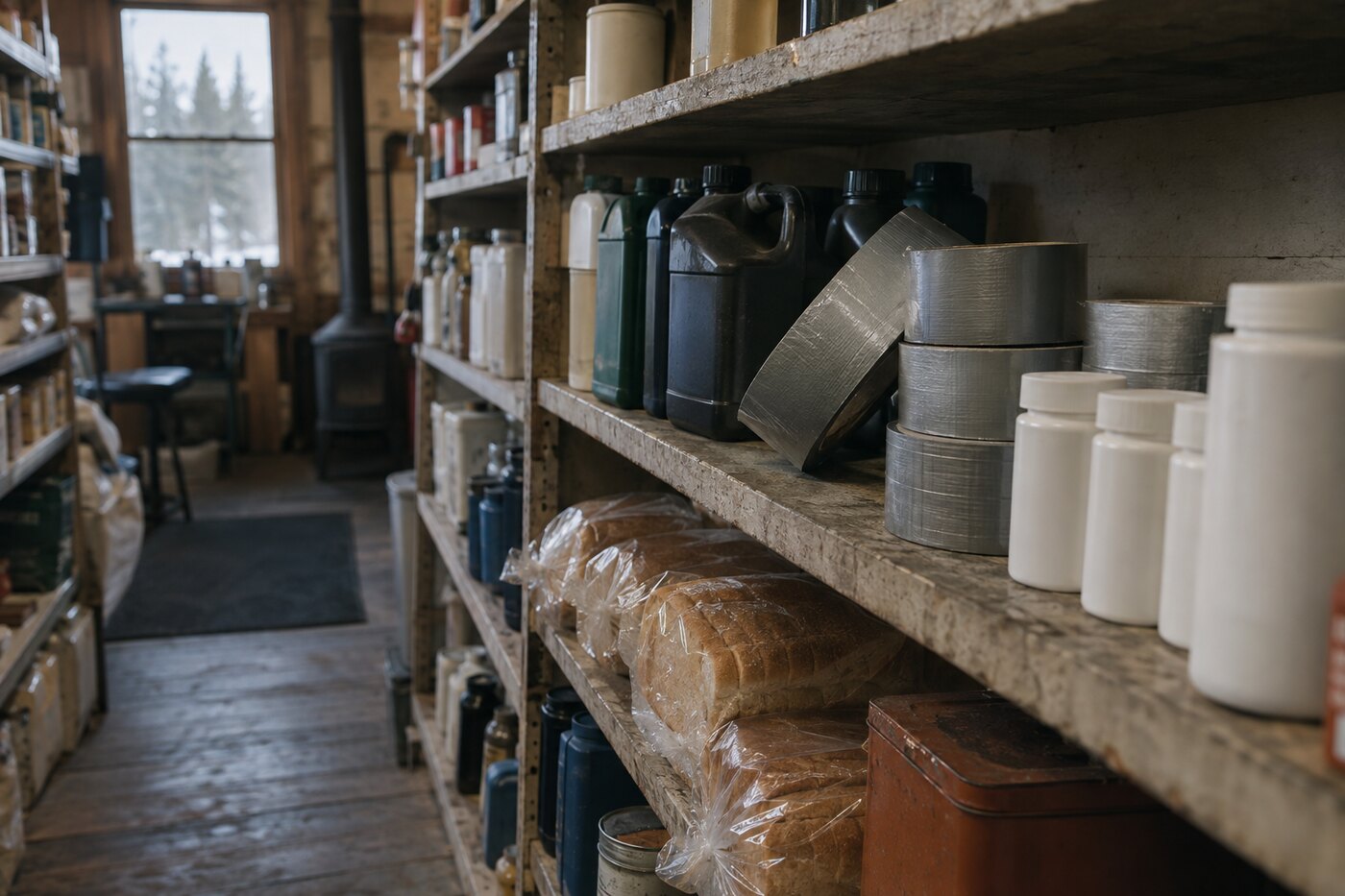
There is one store on that stretch of road and it is thirty miles to the next, and its shelves are a map of everything the area runs out of at the worst possible time. You can read the trouble the region gets into by walking the two aisles. Nobody arranged it as a statement. It got arranged by demand, item by item, over years, each thing earning its shelf space by being the thing somebody once drove back for at nine at night, and that is a more honest inventory than any planogram a chain ever printed.
The milk is by the door in a cooler that hums too loud, because milk is what you forget and remember and turn around for, and a store on a lonely road survives on the turnaround. Next to it, and this is the whole store in one glance, the bait fridge. Worms and a minnow tank, because the river is close and the fish do not care that you also need milk. The two coolers side by side, the household and the river, the thing you drink and the thing you drown to catch a thing you eat. A chain would never shelve those together. Here it is just true.
Then the medicine, one short shelf of it, and the medicine tells you what hurts out here. Tylenol and ibuprofen in the small overpriced bottles, the size you buy because you need it now and not the value you would buy in town. Antihistamine, because of the hay and the stings. A tube of the burn cream and a tube of the antibiotic ointment, because people out here work with their hands and their hands get opened up, and a cut on a Saturday is thirty miles from a clinic, so the store carries the ointment and the butterfly bandages and a roll of the gauze, a small triage station between the chips and the motor oil. There was a heat wrap for a bad back, one, hanging on a hook, and I thought about who had needed the store to carry that, whose back had gone out lifting something on a Sunday, and how the store had answered by stocking exactly one, because one is how many go out per whatever the interval is.
The duct tape had its own hook and it was nearly empty, which tells you it moves. Duct tape is the whole philosophy of the place. Something is broken and it is thirty miles to a real fix and the tape will hold it till Monday, the hose or the boot or the window or the wing of the truck. Beside it the electrical tape and the baling wire and a small bin of hose clamps in three sizes, and a can of the starting fluid for the mornings an engine will not catch, and the windshield fluid stacked by the door in the blue jugs, because the salt trucks throw a film you cannot see through and you run out of the fluid exactly when you need it most, in the middle of the worst of it, wipers smearing. So the store keeps a wall of it. The wall of blue jugs is a weather report.
The lottery machine glowed in the corner, and the scratch tickets under the counter glass in their long ribbon, and that is on the map too, in its way, the one shelf that sells not a fix for a trouble but a ticket out of all of them, bought a dollar or two at a time by the same hands that bought the duct tape and the Tylenol. There is no judging it. It is just another thing people run out of and come back for, hope in a foil strip, and the store stocks it because the demand is as steady as the demand for milk.
And the pie. On the counter under a dome, a whole pie, homemade or close to it, sold by the slice, sitting incongruous among the motor oil and the bait like a small act of faith. The pie does not fit the emergency map. Nobody drives thirty miles in a panic for pie. The pie is the one thing on the shelves that is not about trouble, and maybe that is why it is up front by the register where everyone sees it, the store’s single unpractical offering, a slab of sweetness in a place otherwise stocked entirely for things going wrong.
I needed a hose clamp, as it happened, a small one, because a heater hose on the truck had started to weep at the fitting and I could smell the coolant, sweet and hot, and thirty miles is a long way to drive smelling that. The store had the size. Of course it had the size. It had three sizes and one of them was mine, because somebody before me had wept coolant on this same road and the store had learned to carry the clamp. I found it in the little bin, the worm-drive kind with the slotted band, and I turned it in my fingers and read the range stamped on it and it was right, and it cost more than it would cost in town, and I paid it gladly, because the alternative was not a cheaper clamp, the alternative was no clamp and a longer smell and maybe a walk.
The man at the register knew what the clamp was for the second he saw it in my hand. You do not buy a single hose clamp for any reason but the reason. He asked which hose and I told him the heater hose and he nodded and said they go, at that age they go, and rang it up, and did not try to sell me the pie, which I respected, though I bought a slice anyway.
I put the clamp on in the gravel lot with a screwdriver from the glovebox, right there, because the store’s lot is where half of these clamps get installed, I would bet, the last practical shelf between here and thirty miles of nothing. The old clamp had rusted thin and it broke coming off rather than loosening, snapped at the band, and I dropped it in the gravel and it lay there among the other small rusted things the lot had collected over the years, and the new clamp bit down clean on the hose, and the sweet smell stopped, and there was still a small dark spot of coolant spreading in the gravel under the truck where the hose had wept while I worked.