She rang up my milk and looked past me at the door and said the road would be bad by four, and she was right, though the sky out the window was still doing nothing anybody could point to. That is the thing about the counter at the small store. It is a forecast office that also sells snacks. She was not reading a radar. She was reading the till.
You learn a lot standing where she stands. All day the door swings and people come in and buy the specific thing that their specific trouble requires, and the things add up into a picture the way a barometer adds up pressure. When the road is going to freeze, the men who plow start coming in for coffee and the big candy bars, stocking a cab for a long night. When a storm is really coming, the bread goes, and the milk goes, and then the batteries go, and she has watched the shelf empty in that order enough times to know the order by heart. She does not need the weather service. She has a hundred small purchases a day and she reads them the way you read tracks in snow, this animal came through, and here, and it was moving fast.
She knew my milk. That is the part a chain sands off. At the big store I am a card and a phone number and a cloud of data that some computer three states away uses to print me a coupon for the thing I already buy. Here I am the person who gets the two percent, not the whole, and she reached for it before I asked, and when they were out of the two percent last month she told me before I got to the cooler and saved me the walk. That is not a loyalty program. That is a person who remembers, and the remembering is the whole product, the thing the store has that the chain cannot stock. The chain has lower prices and eleven kinds of everything. It does not have somebody who knows you take the two percent and knows the road ices at the low spot by the creek before it ices anywhere else.
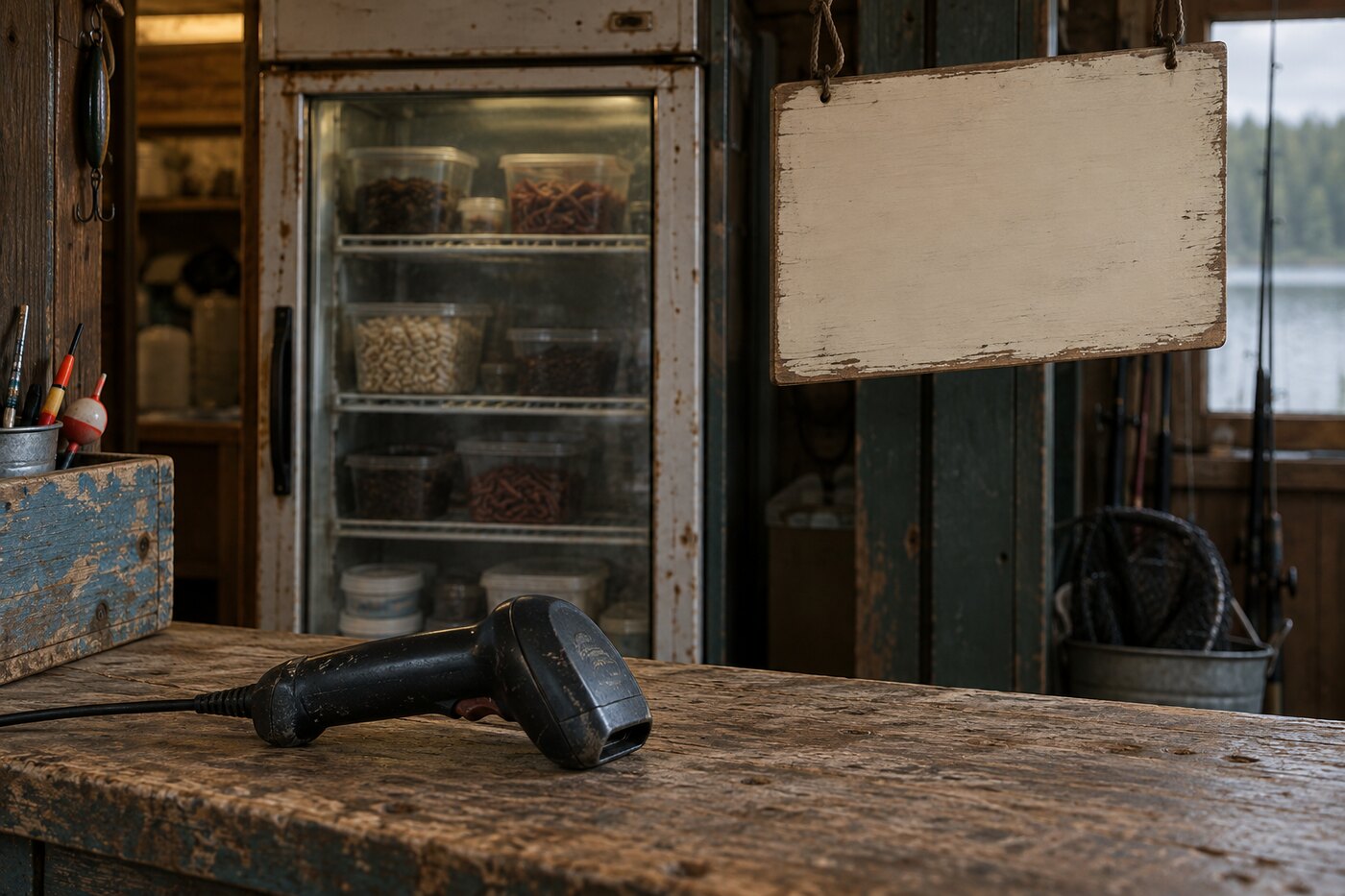
Behind her, the fridge with the bait in it, styrofoam tubs of worms bedded in dirt, and a hand-lettered sign taped to the glass with the price and the word MINNOWS and an arrow pointing down at a tank I could hear bubbling. She knew the fishing too. She knew who came in for bait and when, knew the guy who bought a dozen worms every Saturday had not been in for three weeks and asked me, since I live out that way, if I had heard whether he was all right. I had not. She filed it. That is a thing the counter does, keeps a rough census of the regulars by their purchases, notices the absence of a standing order the way you notice a missing tooth with your tongue. The chain notices nothing. The chain’s regulars are a churn rate.
The counter itself was worn to the particle board at the two spots where a thousand people a day set down their things and slid them forward, two pale ovals rubbed through the laminate, the geography of the transaction printed into the surface. There was a jar for a can with a photo taped to it, someone’s medical bill or someone’s funeral, I did not look close, the kind of jar that sits by a small-store register and fills a coin at a time with the change people do not want to carry. There was a rack of lighters and a rack of jerky and a spinner of sunglasses that had faded in the window until they were all the same nothing color. And there was the pie. There is always the pie, under a plastic dome, a whole pie somebody’s aunt or somebody’s contract baker had brought in, sold by the slice on the honor of a person cutting it with a knife kept behind the counter, and she cut me a slice without my asking whether I wanted one, because it was Thursday and I get a slice on Thursday, apparently, a fact about myself I had not known was on file.
She bagged the milk and the pie in a thin bag and told me again about four o’clock, and told me to take the long way if it got bad, the low way floods but the low way does not ice, and the high way ices but the high way does not flood, and you have to pick your poison by which the sky is handing out, and she knew which the sky was handing out today the way I know my own kitchen in the dark. None of this was on a screen. All of it was in a person who had stood at that counter through enough winters to have the whole road memorized by its failures.
I paid cash and she made change out of a drawer that stuck, hitting it with the heel of her hand to pop it, an old drawer that had been hit in the same spot so many times the spot was shinier than the rest, and she counted the change back into my palm the old way, coins first, then the bills up to the total, a way of counting change that the chain registers do for you now on a screen so the person does not have to know how, and she knew how, and did it fast, and closed my fingers over it with a tap that meant we were done and the next person could come up.
Outside the sky was still doing nothing. I put the milk on the floor of the truck and the pie on the seat where I could watch it, and I took the long way home out of respect for the counter’s forecast, and about a quarter to four the light went that flat pewter color and the first ice started ticking on the windshield, small and dry, not sticking yet, and by the time I turned up my own road it was sticking, and I thought about her at the counter reading the next hour off whatever the last few customers had carried out the door.