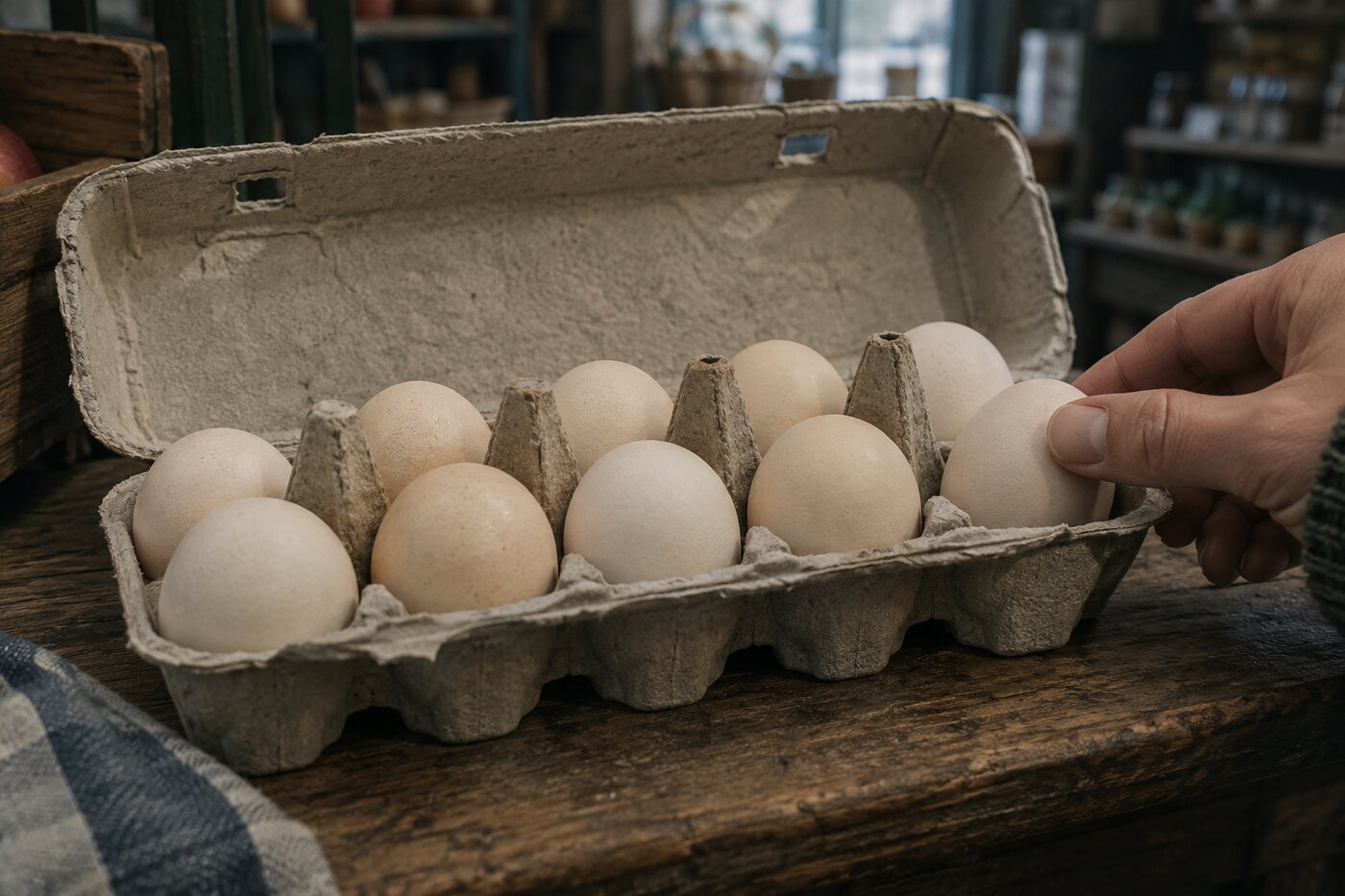
You open the carton in the store. Everybody does it and it is the one permitted act of suspicion, the one time you are allowed to inspect a sealed thing before you own it, and the store not only permits it but has designed the carton to allow it, the little tab you press to lift the lid without tearing anything. I lifted mine and looked down at a dozen eggs in their molded cups and started the check that my hands do before I have decided to do it.
You look for the obvious first. A cracked shell is a break in the seal, a way in for whatever is on the outside of an egg to get to the inside, and a leaked egg glues itself to the cardboard and takes the shell of its neighbor with it when you lift the carton. So you scan for the shine of wet, the dark stain in the paper cup, the one shell caved at the shoulder. None here. Then the second check, the one you have to do by hand, because an egg can crack on the bottom where it sits against the cup and show you nothing from above. You turn each one. A quarter turn, thumb and finger, and you feel for the small catch of a shell that is stuck to the cardboard, because a stuck egg is a leaked egg, and you watch the underside come up into the light for the hairline you could not see. Twelve eggs, twelve quarter turns, a small rosary of doubt performed over a carton under fluorescent light while other people reach past you for their own.
The shells were brown, uneven, one of them freckled with darker spots, one noticeably longer and more pointed than the round ones beside it. That unevenness is supposed to mean something now, mean small farm and real hen and not a machine, and maybe it does and maybe the unevenness is printed into the marketing as carefully as everything else. I could not tell from the shell. A shell is just a shell. It told me the egg was whole and it told me nothing about where it came from that I could trust more than the box’s word.
The box’s word was a farm name, printed on the lid, with a little drawing of a barn and a field. The name was one of those that wants you to picture a place — a family word, a road, a founding year. I read it and could not picture anything, because it was too far away to picture, an address in a state I have driven through and not stopped in, a farm that might be one barn and might be a operation the size of a small airport with the family name kept on for the label after the family sold. There is no way to know from the carton. The carton is the last and smallest object in a chain I was holding the very end of, and the chain ran back out of the store and down the loading dock and onto a truck and back along a cold highway to a place with hens in it, thousands of hens, and feed coming in by the ton, and a person who does this all day, and a cardboard plant somewhere making the cartons, and a refrigeration bill that runs day and night from the barn to the truck to the case I was standing in front of. All of that, so that I could turn twelve eggs a quarter turn each and carry them home.
You could stand in the egg aisle and follow that chain out in your mind until it swallowed the whole morning. I have done it. I have stood there and thought about the person who stacked this case before the store opened, who came in at whatever hour the dairy cooler gets stocked, and loaded these cartons in with cold hands, front to back so the old stock sold first, and I bought the carton in front, which meant I was buying the newest, which meant I was quietly working against that person’s careful rotation, taking the fresh and leaving the old for someone less picky or less awake. Breakfast does not require you to think about any of this. Breakfast is eggs and a pan and eight minutes. But the egg aisle invites the thinking, the way any object does when you hold it long enough, and then you have to put the carton in the cart and stop, because the eggs are not going to answer and the store is closing the gap of the aisle behind you.
I closed the lid. The little tab caught with a small cardboard click. There is a satisfaction in that click that is out of all proportion to what it is, the carton agreeing to stay shut, the inspection concluded, the eggs signed for. I set the carton flat in the top basket of the cart, in the child seat, where nothing would come down on it, because a carton of eggs is the one grocery you carry like it might already be broken, the way you carry the bulk nails, cupped and watchful, except the eggs you protect from the world and the nails you protect the world from.
The price was by the dozen, printed on the shelf tag, and it had gone up since the last time I had let myself notice, up enough that eggs had briefly been in the news as a thing that cost too much, a whole economy readable in a shelf tag, chickens and feed and a disease that goes through a barn and a supply that never quite catches up to a demand. I paid it. You pay it. There is no philosophy at the register, only the tap of a card and the receipt curling out.
At home I opened the carton again on the counter to put the eggs in the door of the refrigerator, which is the wrong place to keep them, everyone says so, the door is the warmest part and the eggs deserve the cold shelf in the back, and I put them in the door anyway because the door has the egg-shaped dents molded into it and the shape asks to be filled. One egg had a tiny fleck of feather stuck to it, a single downy barb caught in the brown of the shell, come all the way from the hen through the truck and the cooler and my careful quarter turns without letting go, and I left it there and shut the door on it.