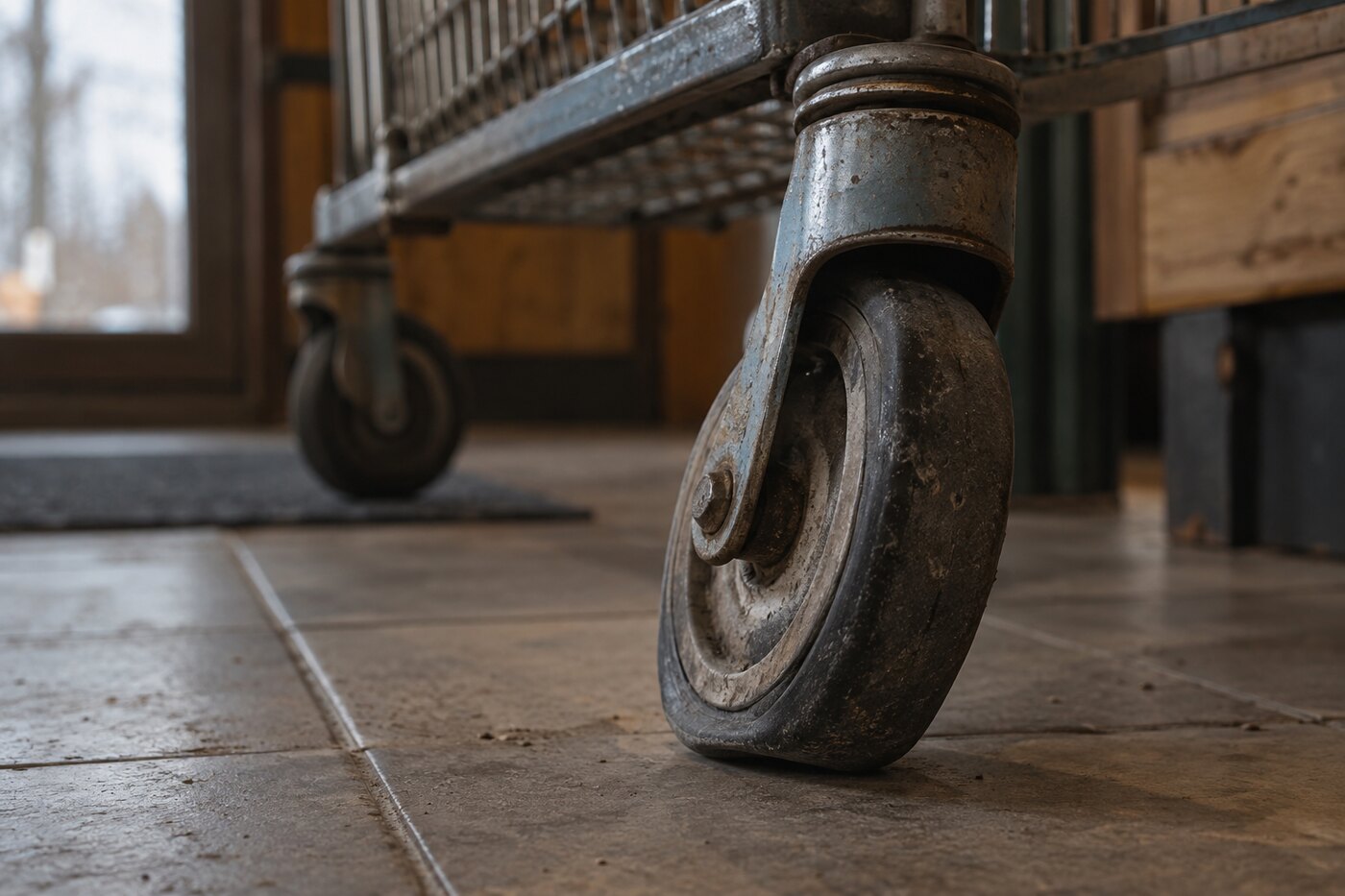
I knew before the door that this one was wrong. You know at the corral, pulling the carts apart, that first shove to break the nested row loose, and this one came free with a shudder that went up my arms, one wheel not rolling but skidding, a flat drag instead of a turn. I should have pushed it back and taken another. I did not, because the corral was jammed and there were people behind me and switching a cart is a small public admission that you cannot manage a cart, so I took the bad one, and the bad one and I were together for the next forty minutes whether we liked it or not.
The wheel was a front caster, and front casters are the ones that swivel, and this one had stopped swiveling. It had locked itself pointing a few degrees off from straight and would not correct, so it dragged sideways across the tile with a sound like a fingernail, a fine grinding skid, and it pulled the whole cart to the left. Not hard. A steady, patient left, the way a current pulls a boat, so that if I pushed straight ahead and let go in my mind for even a second the cart would drift toward the shelves and clip an endcap. To go straight I had to steer right, constantly, a small pressure held the whole time in my right hand, and after a while my right forearm knew it, a low ache from doing nothing but resisting a machine’s opinion.
The cart had beliefs. It believed in left. Whatever had happened to that caster — a flat spot worn into the wheel, a bearing gone dry and seized, a bag handle wound around the axle years ago and melted on — it had given the cart a permanent conviction, and no amount of my steering changed the conviction, only overrode it, moment to moment, at the cost of my attention. I could not fix it. That is the thing about a store cart. It is a broken machine you did not choose and cannot swap in the middle of the job. Once you are three aisles deep with a cart half full of your groceries, transferring everything to a good cart is more work than just fighting the bad one to the end. So you commit. You marry the cart at the door and you do not divorce it until the parking lot.
The rattle was separate from the drag, a second problem the same wheel had. On the smooth tile of the main aisles it was a hum, but the tile in this store had lines of grout, and every grout line the flat-spotted wheel crossed it gave a knock, so that going down an aisle was a rhythm, a knock-knock-knock at the speed of my walking, a metronome I was setting with my own pace and could not turn off. People looked. You cannot push a rattling, veering cart through a quiet store without people looking, a quick glance that finds the source and dismisses it, ah, the bad cart, we have all had the bad cart. There is a small fellowship in it, unspoken. Everyone has pushed the cart that pulls.
I loaded it and the load changed the fight. Empty, the cart pulled left and rattled. Full, with the milk and the bag of flour and the cans down low, it pulled left and rattled and now also did not want to stop, the weight carrying the bad wheel’s skid forward past where I meant to halt, so that at the deli counter I overshot and had to haul it back, and hauling it back the locked caster chattered against the tile in protest. The physics of the thing had shifted. It was no longer a cart that drifted. It was a loaded sled with one bad runner, and steering it was less like driving and more like the thing you do on ice, anticipating the slide, correcting before the drift became a swerve, reading the machine a half-second ahead of where it was.
There is a labor in this that nobody counts. Shopping is supposed to be the easy part, the pushing and the reaching and the choosing, the body at rest and only the eyes and the hands working. A bad cart puts the body back in it. By the frozen aisle my shoulders were up around my ears from the low constant work of correction, and I caught my reflection in the freezer glass leaning into the cart at an angle, bracing against its leftward will, a person in an argument with a machine that could not hear them. The freezer door fogged and I could not see the reflection anymore, only the shapes of the peas and the corn behind the frost.
At the register I unloaded it and the empty cart, relieved of the weight, went back to pulling left and rattling, lighter and just as wrong. The checker did not notice. The cart is invisible to the checker; it stops at the belt and the groceries come off and the cart might as well not exist. Only the pusher knows the cart. Only the pusher has spent forty minutes learning its one flaw by heart.
In the lot the tile gave way to asphalt and the asphalt was worse, rougher, and the bad wheel skittered and caught on the seams and the whole cart tried to jackknife toward the row of parked cars, and I fought it to the trunk and loaded the bags and then had the last small problem, which is what you do with the bad cart when you are done. The corral was forty feet off. I could have left the cart by my car, the way people do, let it drift on its own bad wheel into someone’s fender. I walked it to the corral instead, the last forty feet of the argument, and shoved it into the nested row where it belonged, and it did not go in clean, the locked caster hung it up crooked on the frame of the cart ahead of it, cocked sideways, one wheel off the ground and still slowly spinning down from the shove, ticking against nothing, and I left it like that for whoever pulled the row apart next.