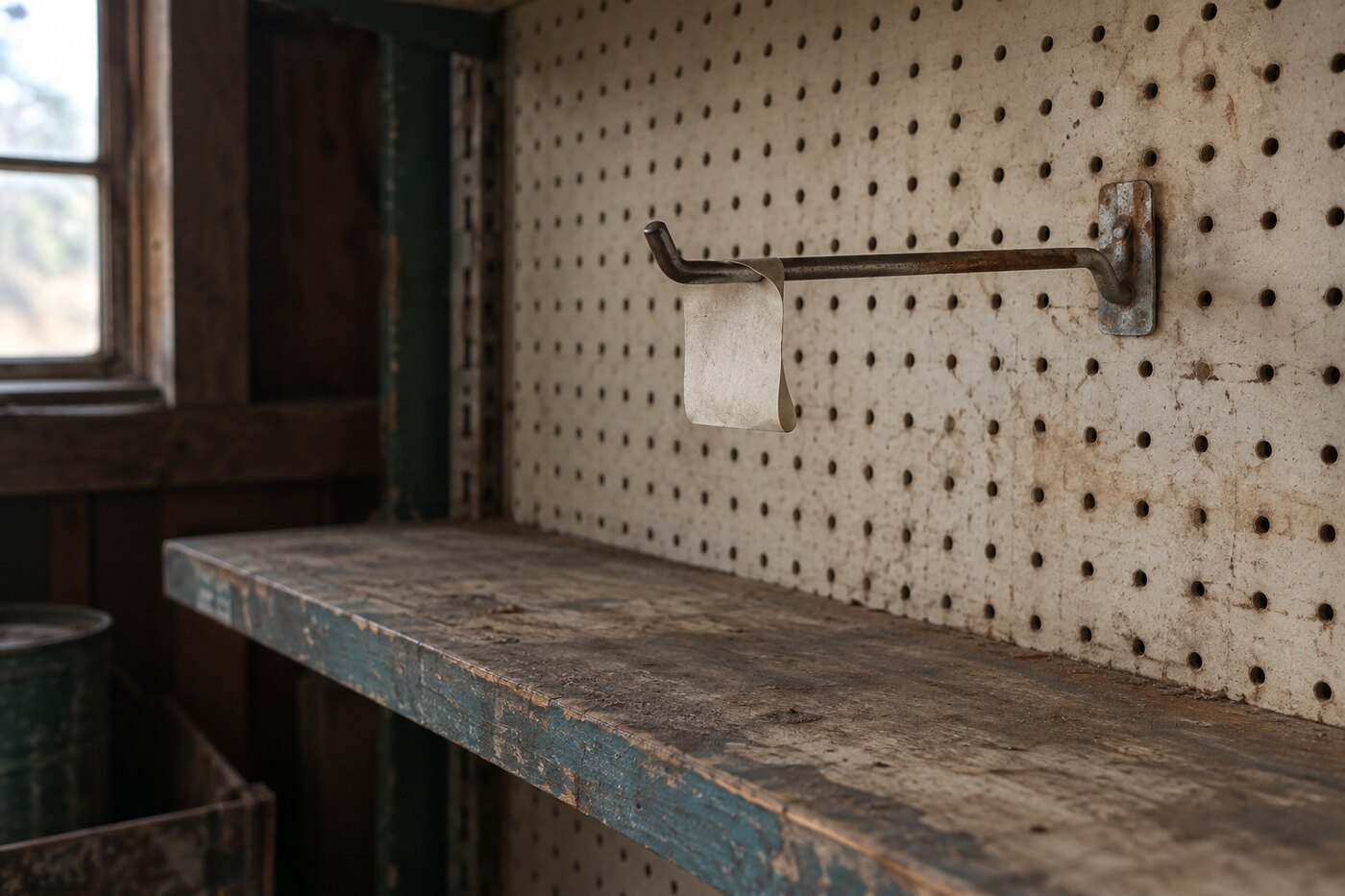
The lids were not there and the place where they were not there was very specific. A shelf tag, a hook, a printed price, and behind them nothing. That is a particular kind of empty. An empty shelf where nothing is expected is just a shelf. An empty shelf that still wears the full uniform of stock — the label, the peg, the little plastic price flag — is a shelf that is telling you something used to be here and is supposed to be here and is not, and will not say when it will be again.
I had come for the flat lids, the ones that go under the ring band, the part of the canning jar you cannot reuse. The jars last forever. The ring bands last for years, rust a little at the crimp, keep going. But the flat lid with the rubber compound around the rim seals once and once only. You use it, it flexes and grips as the hot jar cools and pulls the metal down with that small tin sound, the ping that means the seal took, and after that it is spent. You cannot boil it again into usefulness. So every jar of anything you put up needs a fresh flat lid, and if there are no flat lids there is no putting up, no matter how many jars and bands and how much fruit you have. The whole operation hangs on the one disposable part.
The hook still had its tag. The tag said the brand and the count, a box of a dozen, and the price, and the price had not been changed, which somehow made it worse. If they had crossed the price out I would have understood the item to be discontinued, done, a thing the store had decided to stop carrying. But the live price meant the store still intended to sell these, still had a slot for them in the system, still expected the truck to bring them. The truck just was not bringing them. Somewhere up the line, at a factory or a distributor, the flat lids had become a thing that did not arrive, and the shelf here was the far downstream end of that not-arriving, the visible tail of a shortage whose head was a thousand miles away in a supply chain I would never see.
There was dust on the shelf where the boxes should have sat, but not much, and not everywhere. There were clean rectangles in the dust, four or five of them, where boxes had stood recently enough to keep the dust off, and the clean rectangles were the ghost of the last shipment, the shape of what had been here and gone fast. You could count them. Five boxes, roughly, had stood here and sold through, and nothing had come to replace them, and the dust was already starting to reclaim the clean spots at the edges. In a week the ghosts would be gone too and it would just be a dusty empty shelf with a hopeful price tag.
The rings were still there, the bands, a full peg of them, because nobody was buying bands you cannot use without lids. And the jars were there, a stack of cases of them, the glass catching the fluorescent light, quart and pint, full supply, useless. That was the juxtaposition and it just stood there being true — everything for the job except the one part the job could not skip. It was like a shelf of guns and no primers, boots and no laces. The store had ninety percent of a season’s canning and the missing ten percent was the ten percent that made the other ninety mean anything.
I stood there and did the arithmetic a garden makes you do. The beans were coming. The tomatoes were setting fruit already, green and hard, and in six weeks there would be more of them than any household could eat fresh, bushels of them, and the whole point of a summer garden in a place with a real winter is that you do not eat it in summer, you put it in glass and eat it in February. The lids were how the summer got to February. No lids meant the tomatoes would come and ripen and pile up on the counter and go soft and then go over, and I would eat what I could and give away what I could and watch the rest become a compost problem, a whole row’s worth of work rotting because a factory could not make enough small flat disks of tinplate.
I have a shelf in the basement of last year’s jars, some still full, and I stood there in the aisle and tried to remember how many empties I had down there with their old lids still on, and whether the rings would come free, and whether — this is the thought a shortage puts in you — whether any of those spent lids might seal one more time in a pinch, which they will not, which everyone who has ever canned knows they will not, the rubber is crushed and the metal is bent to the last jar’s rim, but scarcity makes you consider the impossible reuse anyway. It makes you eye the garbage as inventory.
A man came down the aisle with a cart and stopped at the same gap and looked at it the way I was looking at it, and neither of us said anything, because there was nothing to say that the empty shelf had not already said. He reached out and touched the price tag, just touched it, turned it over to see if there was a date or a note on the back, and there was not, and he let it go and it swung a little on its hook. Then he moved on. We were two people who had driven to a store to buy the one part that was not there, and would drive home without it, and the tomatoes would ripen on their own schedule regardless.
I took a photo of the tag with my phone, the brand and the count, so I could look for it elsewhere, and the flash caught the empty shelf behind it, and in the photo the dust ghosts of the five gone boxes showed up plainer than they had to my eye, five pale rectangles in a row, the exact footprint of next winter, and the price tag hung in front of them still saying what it would cost if it existed.