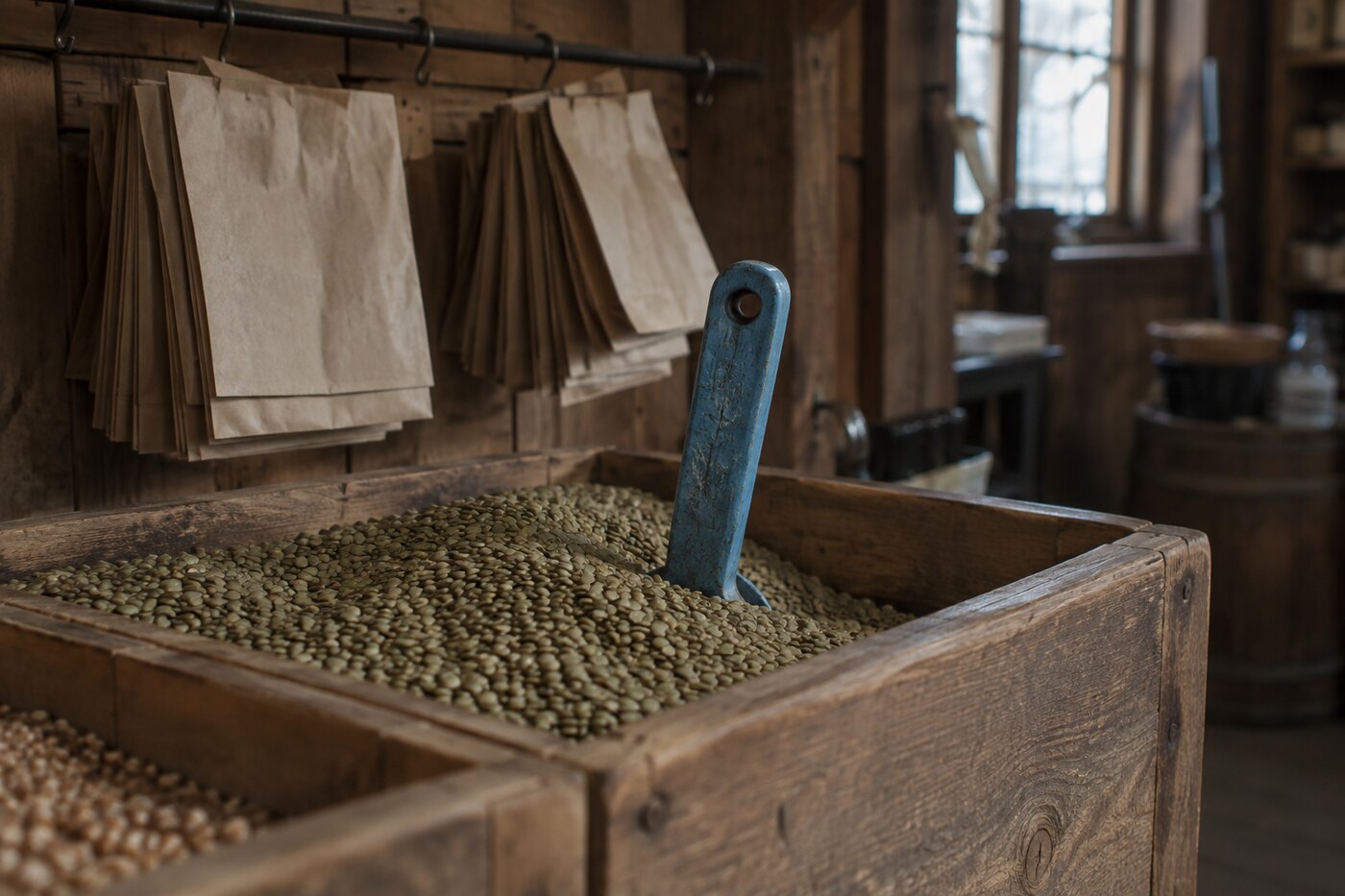
The scoop was standing up in the lentils, buried to the wrist. Somebody had left it that way, blade down, handle out, the way you leave a knife in soft ground when you mean to come back. I took it by the handle and the handle was slightly warm, which stopped me for a second. It was warm because the last person to hold it had held it, and the one before that, and the plastic keeps a little of everyone. That is the quiet fact of the bulk aisle that nobody mentions. It is the most shared surface in the store. The cart handle, at least, you can wipe. The scoop is a public tool you put directly into the food you are going to eat.
The lentils were the green-brown kind, small and flat and slightly dusty, and they made a sound when I ran the scoop through them that I can only call a hush, thousands of hard little disks sliding over each other. The scoop came up heaped and I tipped it toward the paper bag and the lentils went in with a rush and then a rattle as the last ones found the bottom. A little avalanche. Some missed the mouth of the bag and skated off across the shelf and down into the gap behind the bin, gone, joining however many pounds of escaped legumes have collected back there over the years in the dark where no scoop reaches.
The bags were the small brown kind on a rail, and you tore one off and shook it open, and the mouth never wanted to open, glued shut by static and its own flatness. You worked a finger in and ran it around and the bag sighed open. Then the number. Every bin had a number, a four-digit code you were supposed to write on the bag or the little twist tie so the checker would know what she was weighing. There was a golf pencil on a string, chewed at the end, and a pad of paper twist ties, and you wrote the code in pencil on the paper of the tie, and the pencil barely marked because the tie was waxy, and your number came out gray and doubtful. I wrote 4-4-1-1 and it looked like it might be 4-4-1-1 and it might not, and I trusted the checker to guess kindly.
The twist tie is a weak little promise. It is paper wrapped around wire, and you fold the neck of the bag over and twist the tie around it two or three times, and it holds, sort of, the way a handshake holds a deal. It will not survive the cart. It will not survive being set down wrong. Somewhere between the bin and the register the twist will loosen a half turn and the neck will gape and a few lentils will find the seam and work out, and you will get to the car and find a scatter of them in the cart’s basket, escapees, and you will leave them there for the next person to wonder about.
Then the private math. Bulk is sold by the pound and the number on the bin is the price per pound, and you are standing there with a bag of unweighed lentils doing a calculation you cannot finish, because you do not know what the bag weighs. That is the whole game of the bulk aisle. You are estimating your household’s near future by hand. This much rice is how many dinners. This much oatmeal is how many mornings. You scoop by the week you expect to have, and you are always a little wrong, and the wrongness sits in the cupboard afterward as either a shortage or a jar that goes stale before you reach the bottom. I have both. I have a jar of yellow split peas I bought for a soup I have not made in two years, and it is still up there, still technically food, going slowly to dust in the dark of the cabinet.
I filled the bag to about a soup’s worth, which is a guess dressed up as a measurement, and I hefted it in my hand to feel the weight, as if my hand had a scale in it, as if I could convert palm-heft to dollars. I cannot. Nobody can. But everybody does it, the little lift-and-judge, because the alternative is admitting you are buying an amount you cannot price until a stranger tells you what it costs.
The bins went on down the aisle, each with its scoop, each scoop a shared handle in a different grain. Steel-cut oats. Rolled oats. Two kinds of rice. Something called nutritional yeast in flakes the color of old paper. A bin of gummy bears next to a bin of dried lentils, which is the kind of juxtaposition the bulk aisle makes without apology, candy and staple sharing a wall, the same scoop mechanism, the same brown bag, the child’s want and the household’s need weighed on the same scale by the pound. Nobody arranged that to mean anything. It just happened, the way a shelf fills up according to what a distributor sends, and it sat there being true.
At the register the checker took my bag and read my doubtful gray 4-4-1-1 and typed something and set the bag on the scale, and the scale thought about it and gave a number, and she multiplied it in the machine, and the amount of my near future came back to me as a line on a receipt. Ninety cents more than I would have guessed. The math I had done by hand in the aisle had been optimistic, the way it always is.
She twisted the tie tighter before she bagged it, out of habit or kindness, and even so, in the cart on the way to the car, the neck worked loose again, and three lentils got out and rolled into the corner of the basket and lodged there, small and green and dusty, riding home with me on the outside of the bag they were supposed to be inside of.