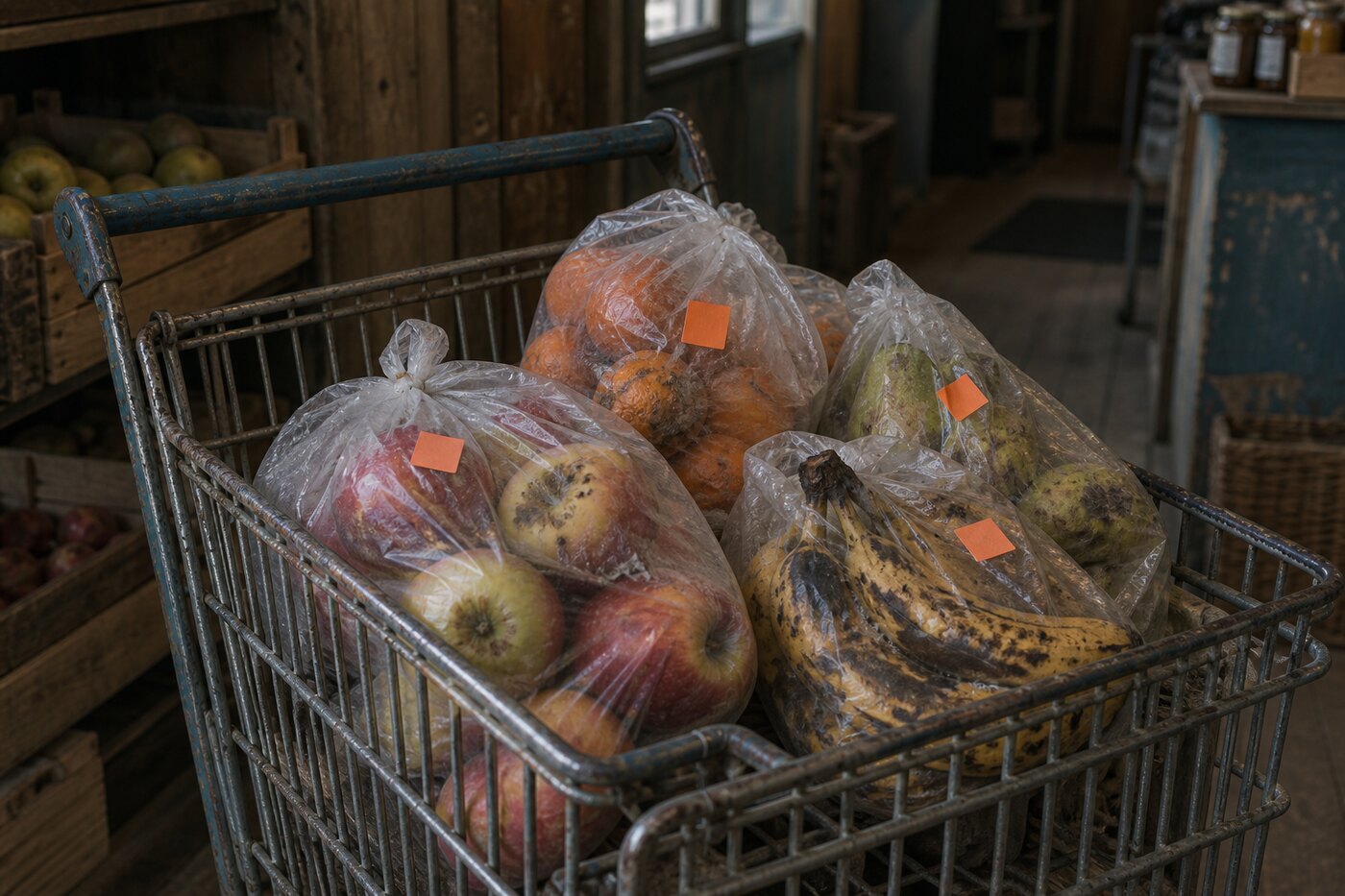
The reduced cart lived at the end of the produce aisle, past the misted greens and the pyramids of apples that had nothing wrong with them, in the corner where the light was a little worse. It was a rolling cart, not a display, and that told you everything about the store’s opinion of what was on it. The good produce got architecture. This got a cart that could be wheeled to the back and forgotten.
Everything on it wore an orange sticker over its original price. The orange stickers were hand-applied, slightly crooked, and each one carried a number that was the old number crossed out and a smaller number written under it, and sometimes the numbers were printed and sometimes they were written by hand in marker, and the handwritten ones felt more honest. A person had stood here with a gun or a pen and made a judgment about how much longer each of these had. The sticker was a small deadline you could read. Not a sell-by date exactly. A this-is-what-we-think-it’s-worth-now, which is the same thing said out loud.
The bananas were the clearest case. Bananas on the reduced cart are always the furthest along, because a banana ages in public, wears its clock on its skin. These had gone from the yellow of a snack to the freckled brown-gold of an obligation. A bright banana is a thing you might eat standing up. A banana like these was a thing you had to do something with. Bread, or the freezer, or a child who did not care about spots. The peel had gone soft under my thumb, not broken, just yielding, the fruit inside surely gone sweet and dense and a little fermented. I picked up a bunch and one of them had a split at the stem, a black seam weeping a little, and I set that bunch down and took the next, which had three good ones and one questionable, and did the math of whether three good bananas were worth inheriting the fourth’s problem.
That is the whole labor of the reduced cart. You are not choosing. You are triaging. Every item is asking to be rescued and most of them are lying about how much rescue is left in them. A dented apple, for instance. The dent itself is nothing — a bruise on an apple is a soft brown coin under the skin, cut it out and the rest is fine, apples are generous that way. But a dent means the apple was dropped or crushed against its neighbors, and where one apple was crushed others were, and the ones that hid it are the trouble. I turned each apple in my hand, all the way around, the way you check a used tire. The skin was cold and a little tacky where the misters up the aisle had never reached. Two had the give of real rot under the shine, a softness that met my thumb too easily, and those I left. One had a clean bruise, honest and shallow, and a stem that was still green. That one came with me.
There was a clamshell of strawberries with the lid fogged from the inside, which is the sign you learn to read and dread. Fog on the inside of the plastic means moisture, and moisture means one berry has already gone, is already growing the gray fur that will reach the others by morning. I opened it anyway, because you have to, and there it was in the corner, one collapsed berry gone to soft gray, and the ones touching it just beginning. If I bought it I was buying a race. Get home, throw out the dead one and its neighbors, eat the rest tonight, no waiting. A container of strawberries at half price is not a bargain. It is an assignment with a due date of this evening. I stood there and genuinely weighed it, the private math of it — half price, but I would eat six and compost six, so was it half price or was it full price for half the berries. I put it back. Someone hungrier or braver than me would take the race.
A bag of peppers, three of them, one going soft at the shoulder where a wrinkle had started. A wrinkle on a pepper is water leaving. The pepper is deflating, slowly, the way a thing deflates when no one is coming to refill it. But a soft-shouldered pepper is still a fine pepper for a pan, where you were going to collapse it with heat anyway. The cart was full of things like that — food whose only crime was that it could no longer pretend to be perfect, and perfect was all the front of the store sold. Back here, in the bad corner light, was everything that had failed the audition and was now half off and waiting to be somebody’s soup.
I filled a thin plastic bag with what I had triaged into worth-it. The dented apple. The three good bananas and their questionable brother. The soft peppers. A head of celery gone rubbery at the outer ribs, which is nothing, the inner ribs were fine and I would cook the outer ones down to nothing anyway. Each thing came with its orange sticker and its small deadline. My cart was now carrying a schedule. These things had to be dealt with by Thursday, Friday at the latest, and the receipt would say I saved four dollars and the reality would say I had signed up for an evening of work I had not had before I walked in.
At the register the checker weighed the bananas and the scale hesitated between two numbers before settling on the lower one, and she did not correct it. The orange stickers went into the trash under her counter as she scanned each one, peeled off and balled up, the deadlines discharged into the paper. In the bag on the drive home the soft banana leaned against the dented apple, and by the time I carried them in the two had traded a little warmth and the apple’s bruise had spread a fraction under the skin, and I could not have said, setting them on the counter, which of them was going to make it to Thursday and which was already past saving.