I was in the store before nine because I had run out of the one thing you cannot substitute, and the bakery lights were on but the case was half empty. That is the honest hour for a bakery. The smell had not been switched on yet. Later in the day the warm-bread smell would come up through the vents on purpose, engineered to reach you at the far end of the cereal aisle and turn you around, but at that hour it was just the ordinary smell of a hot room where someone was working, yeasty and a little scorched at the edges, the smell of labor and not of atmosphere.
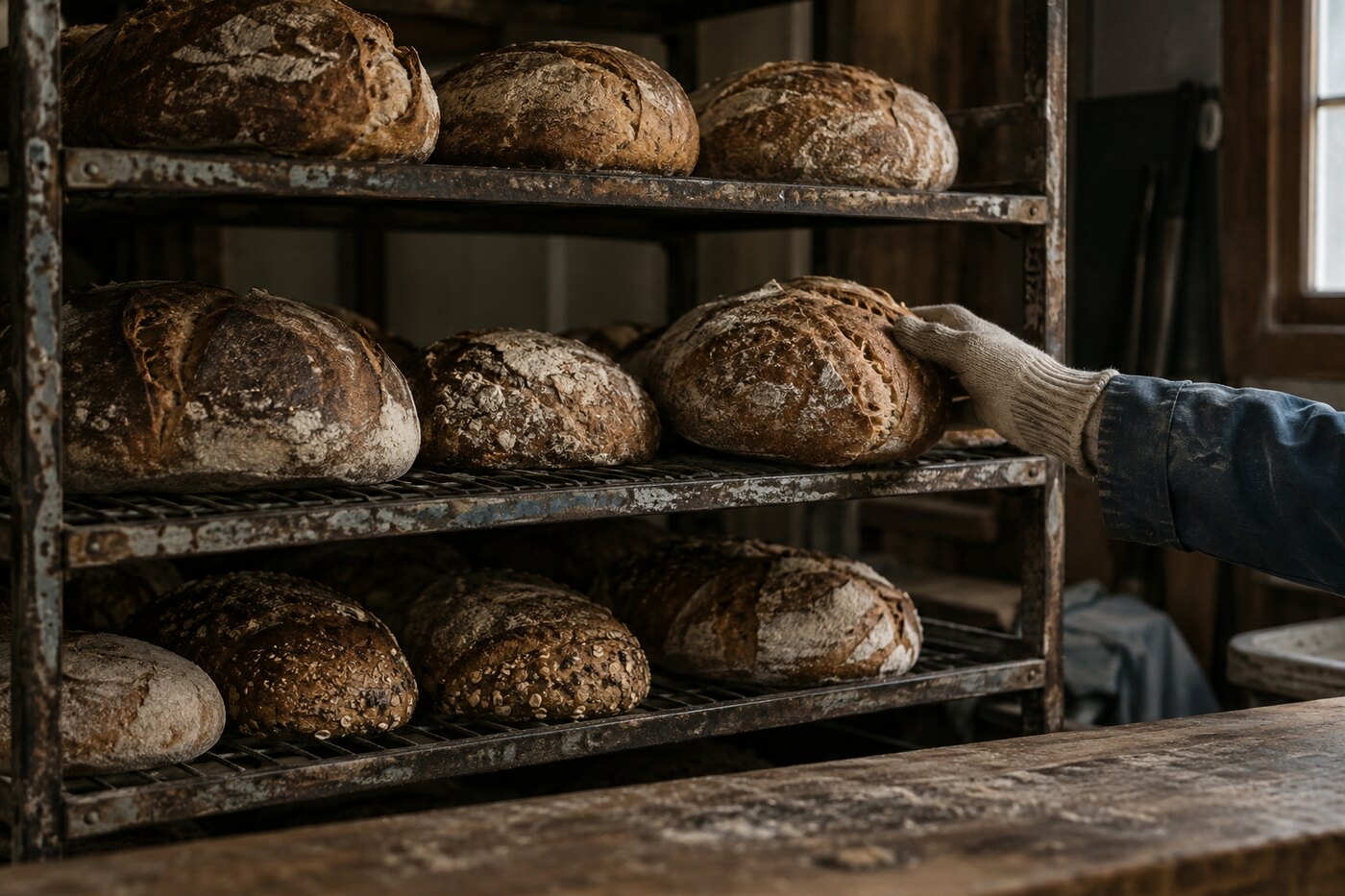
A woman came out from the back through the flapping doors, pushing a rack taller than she was. The rack had wheels, the small hard casters that shimmy on tile, and it carried maybe forty loaves on wire shelves, none of them bagged. Naked bread. That is a thing you almost never see, bread before its plastic. The loaves were shoved close together, sides touching, and where they had risen against each other in the pan they had grown a soft pale seam, a place that would tear rather than slice. She wore a glove on her right hand and nothing on her left, and the left forearm had flour on it to the elbow, dried into the arm hair in a gray dust, the kind you stop noticing you are wearing.
She took the loaves off the rack two at a time, one in each hand, and set them in the case in rows. She did not look at them. Her hands did the looking. Now and then one loaf came up wrong — too pale, or split along the top where the score had opened too wide — and that one did not go in the case. It went into a separate bin under the counter without a pause, without a decision I could see. She had a threshold in her fingers and the loaf either cleared it or it did not, and the ones that did not were still perfectly good bread, just not the bread the front of the store had promised. I wondered where the reject bin went at the end of the day. I did not ask. It was too early to make a stranger account for the imperfect.
Each loaf got a bag and a sticker. The bag was the thin printed plastic that clings to itself and to your wet fingers and refuses to open at the mouth, and she opened each one with a snap of the wrist that had nothing left to learn. Then the sticker gun. She held it in the gloved hand and it made a small hard click and left a price and a date on the twist of the bag, and she did this so fast the number was a blur to me but not to her. Click, twist, set down. Click, twist, set down. The whole motion had been sanded down over years to the fewest moves it could survive on. Nothing decorative in it. No flourish. When a person has done a thing ten thousand times it stops looking like effort and starts looking like weather, something that simply happens near them.
The stickers said the day’s date, which meant they also said, without saying it, the day the loaf stopped being sellable. A loaf comes into the world with its death printed on its hip. Two days, maybe three, and it goes to the discount cart with an orange sticker over the white one, and after that to the bin she was already loading under the counter. The bread was on a schedule from the moment it left the oven, and the schedule was the whole business. Everything I could smell was time being spent.
I took a loaf while it was still warm through the bag, which almost never happens, and the warmth surprised me. Bread I buy is always room temperature, has always been sitting, has already begun the slow drying that makes it toast and then makes it garbage. This one still held the oven in it. Through the plastic I could feel it, a low heat against my palm, and I understood I was holding something at the exact hinge of its life, the one moment it would never be again, the moment the whole store was arranged to sell me the memory of at three in the afternoon when it was cold.
The crust had a few loose flakes stuck to the outside of the bag, dark bits of itself it had shed in the pan. There was a dusting of cornmeal on the bottom, gritty through the plastic, the same grit that had been on the peel or the tray, transferred loaf to loaf all morning. Somewhere back through the flapping doors there was an oven the size of a closet and a proof box and a mixer with a hook the length of my arm, and a person who had come in at four or five to start the first rise, and none of that was visible from where I stood. Only the smell came through, and the smell was already halfway to being a product.
She finished the rack and wheeled the empty back through the doors, the casters shimmying, and for a second the doors stood open and I saw a slab of the back room, steel and steam and a second person I had not known was there, before the doors swung shut and sealed it off again. The case in front of me was full now, rows of bagged loaves under the lights, priced and dated, warm going to not-warm.
I paid up front with the milk. In the car the loaf sat on the passenger seat, and by the time I got home the warmth was gone out of it, spent somewhere between the store and the driveway, and there was a small patch of fog on the inside of the bag where the last of the heat had left the bread and had nowhere else to go.