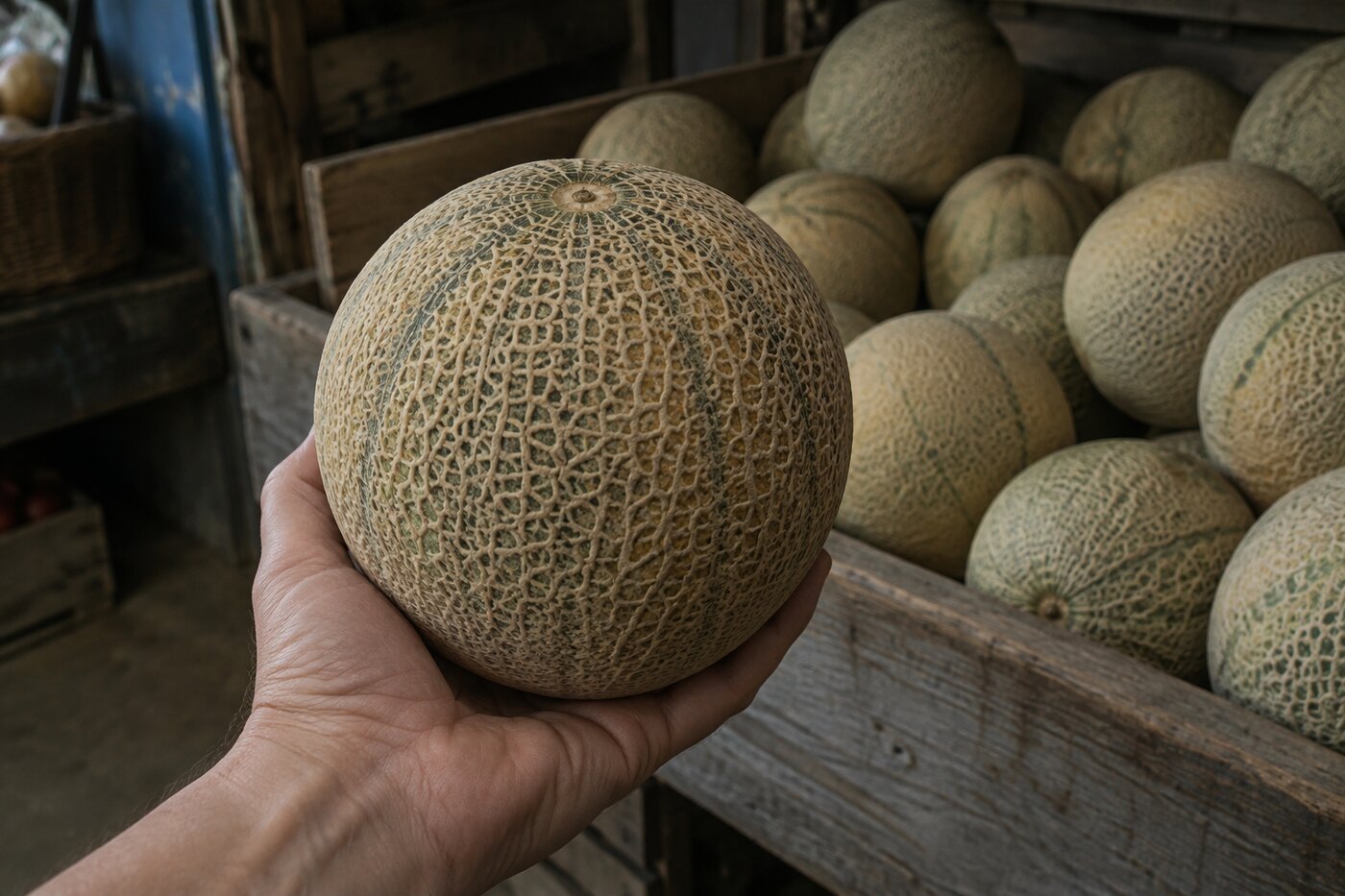
The melons came in a wire bin with a cardboard collar, and the collar had gone soft where the misters reached it. I picked one up and it was heavier than it looked. That is the first thing they teach you without saying it. A melon that weighs more than its size is holding water, and water is most of what you are buying.
I put it back and took the next. Lighter. I could feel the difference in my wrist before I could have named it in ounces. The netting on the rind was raised and dry, tan going to gray, the kind of coarse that catches on a callus. Underneath the net the skin showed through in patches, and the patches were the color of a thing deciding.
You are supposed to smell the stem end. Everyone who has ever stood at a melon bin knows this and does it with a small self-consciousness, tipping the fruit up to the face in a store full of strangers. The stem end is where the plant let go. A clean pale scar means it was cut before it was ready, pulled by a person and a knife instead of by its own weight. A slightly sunken scar, a little sticky, a little sweet at the edges — that one dropped when it meant to. I put my nose to three of them. The first smelled like nothing, like cold and rind. The second smelled faintly of the inside of the refrigerator it had ridden in. The third had it. A thread of sugar, low and green, not the full perfume yet but the promise of it, the way you can smell rain before the road is wet.
Not ready. That was the point. I was not shopping for tonight.
I pressed the blossom end with my thumb, the end opposite the stem, where ripeness shows up first and softest. You press without committing violence. The trick is to lean weight in and stop the instant before the flesh answers. Too eager and you leave a thumbprint that goes brown by morning, a small dark bruise that says a stranger doubted this fruit. I have done it. I have felt the give come one degree past where I wanted it and known I had just started a clock on something I was going to set back in the bin for someone else. So I went slow. The blossom end resisted, then yielded a hair, then held. Firm with a rumor of softness under it. Two days. Maybe three. The melon and I were going to disagree about the date and one of us would be wrong.
That is the whole gamble of buying almost-ripe fruit. You are betting against the calendar with a thing that keeps its own time. A melon on the counter is a slow event. It does not wait for the weekend. It ripens on Tuesday whether or not you are home to eat it, and it goes from perfect to swampy in the space of an afternoon you spent somewhere else. Buy it ready and you have to eat it now, tonight, ready or not, hungry or not. Buy it hard and you are making an appointment with a fruit and hoping you both keep it.
There was a sticker on the rind, an oval, blue, with a number on it and a country I have never been to. The glue would leave a gray ghost of itself when I peeled it, a little tacky patch that collects lint in the fruit bowl. The price was by the each, not the pound, which meant the store had decided a melon was a melon and heft did not enter into it. That is a mistake in the store’s favor and mine both. I had picked the light one for ripeness. Someone with a scale in their head would have picked the heavy one for value. We would each go home thinking we had won.
I set the chosen melon in the cart’s child seat where it would not get crushed under the milk, and it rolled a slow quarter turn and came to rest against the strap. The net rind made a dry sound against the plastic, a whisper of catching. I thought about the field it came from, the long low rows, the person bent over pulling and thumping and deciding, faster than I could ever decide, a thousand of these a day until the thump told them nothing new and their hands did the knowing on their own. My one careful minute at the bin was their entire dull morning. The melon did not care which of us handled it. It went on ripening on company time, in the cart, in the car, its sugars climbing by a fraction of a degree while I stood in line and paid for a guess.
At home I set it on the sill, stem end up, the way I was told to once and never confirmed the reason for. It sat there beside the salt shaker looking like a small planet, gray-tan, netted, faintly warm from the drive. I pressed the blossom end one more time out of habit and it told me the same thing it had told me in the store. Not yet. Wait.
I did not cut it that day, or the next. The third morning the whole kitchen smelled of it before I came down the stairs, that low green sugar gone full and almost too much, and I knew I had cut it too late or right on time and there was only one way to find out. The knife went in and the rind gave with a wet tearing sound and the seeds came up in a wet orange nest in the hollow, strung together with the pale fibers that hold them, and I had guessed within a day of the truth. The rind half sat on the board leaking a small pool of juice, and the pool crept to the edge of the wood and stopped there, deciding whether to fall.