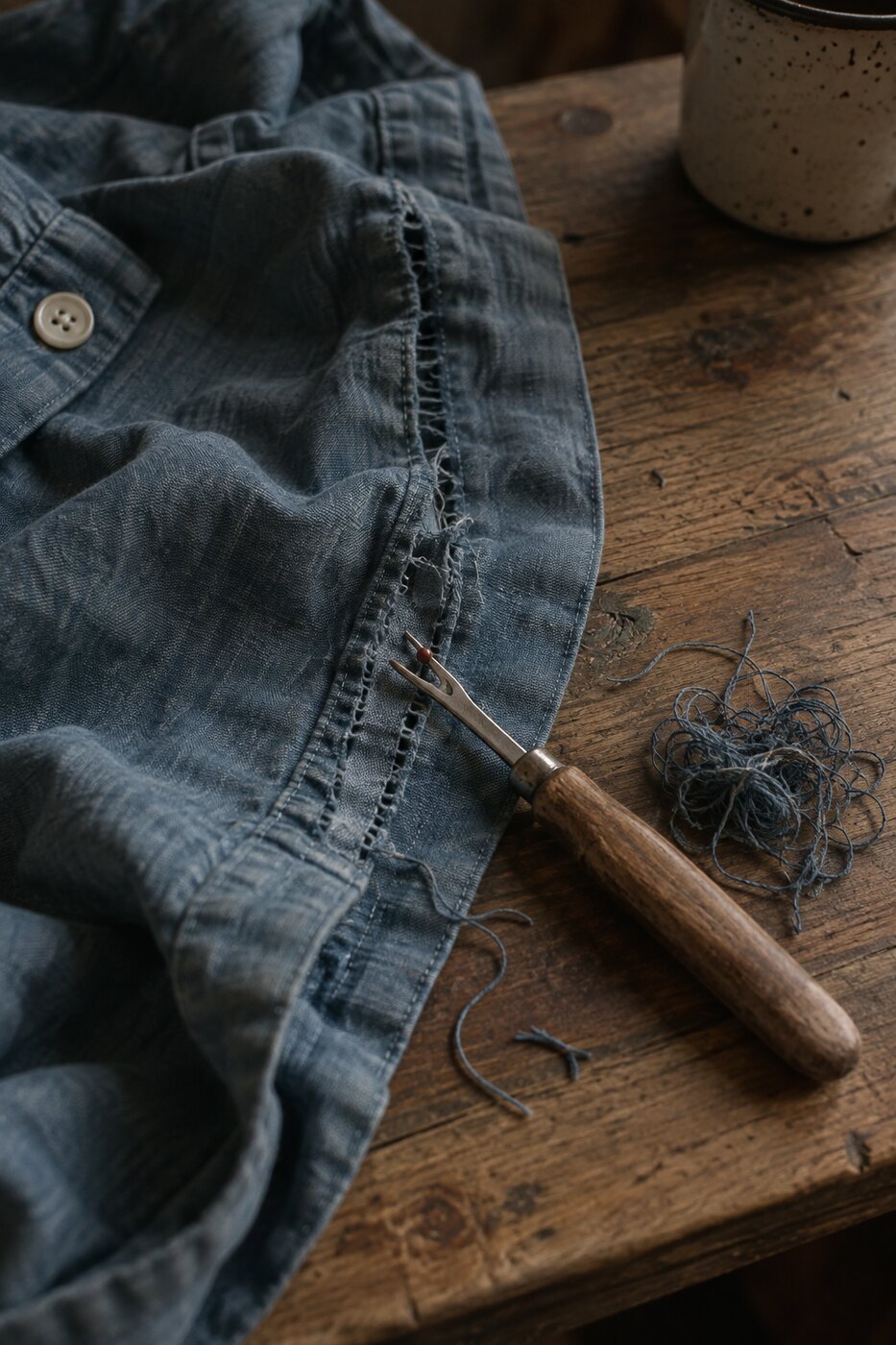
The seam had gone crooked. Not much. A sixteenth of an inch of wander over four inches of run, enough that the two edges no longer lay flat and the front pulled a little where it should have hung. I had sewn it that morning, pleased with myself, and now I had to take it out.
The seam ripper is a small mean tool. A wooden handle, a forked steel tongue, one prong long and sharp and the other short with a red ball on the tip so the fabric rides up and does not get cut. It is built for one job, which is undoing.
You slide the point under a stitch and push. The thread catches in the fork and the blade cuts it, and there is a small pop, a sound the size of a fingernail. Then the next. Pop. You do not cut every stitch. You cut every fourth or fifth, and then you pull.
I pulled from the good end. The cut thread came up out of the cloth in a long crimped line, still holding the shape of the stitches it had been, the little zigzag baked in. It lifted free and left two rows of needle holes down the seam, open, faintly puckered, waiting to be used again or to close on their own.
The work of the morning came apart in under a minute. It always does. Making is slow and unmaking is quick, and the ripper knows it.
The cut thread gathered on the table in a small snarled nest, gray-white, full of kinks. I brushed it toward the edge. Some of it clung to my sleeve by static and rode there, and I found a piece of it still on my cuff at supper.