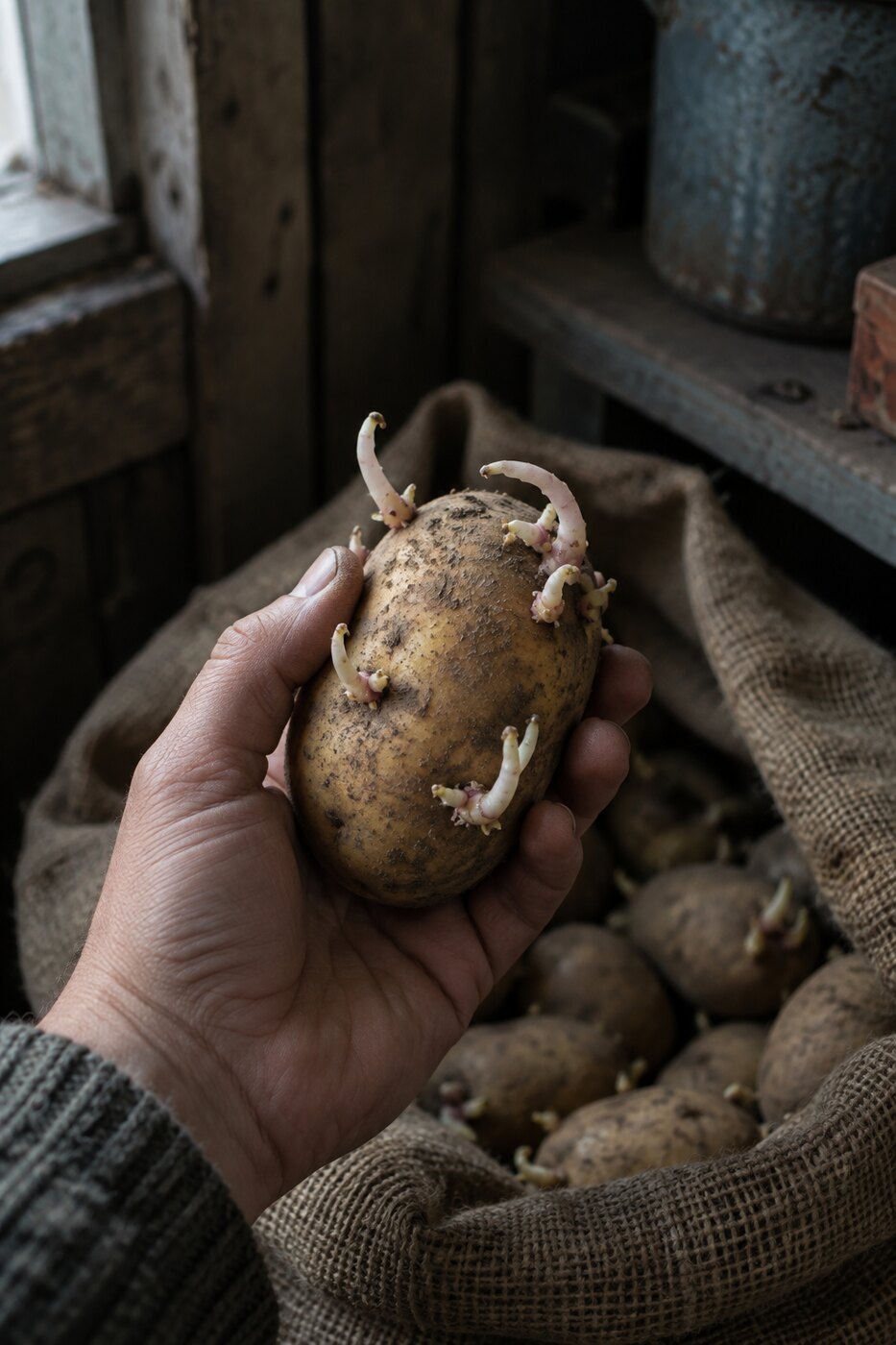
The bin lives in the back room, the one that never quite warms up, where the cold slides down off the north wall and pools on the floor. That is the point of the room. It is where things go to keep. The potatoes came in October in a burlap sack, and the sack has been settling ever since, going slack and lopsided as the pile inside it shrinks, so that now it half-collapses when you open the neck, folding in on itself like something tired.
I went in for four potatoes for supper. That was the whole errand. Reach in past the loose cool ones on top, feel for the big ones that have worked their way to the bottom, bring up a handful. The room smelled of earth and burlap and, under that, the faint sweetness that means the pile has started to turn somewhere I can’t see yet.
The first three were fine. Cold, firm, a little gritty with the dirt they came out of the ground wearing. The fourth came up wrong in my hand before I even had it to the light.
It was heavy in the wrong way — heavy at one end and giving at the other. When I turned it over, the eyes had gone to work. Pale sprouts, three of them, the longest as long as my finger, reaching up out of the eyes in that blind way roots and shoots both have. They were white going to lavender at the tips, thick and brittle, and they had grown toward nothing in particular because there was no light in the bin to grow toward. They had grown anyway. The skin around each eye had puckered and pushed up to let them out. And the far end of the potato, away from the sprouts, had gone soft — not rotten, not yet, but yielding, the flesh underneath collapsing to feed the shoots, the skin there loose and wrinkled and ready to slip off if I pushed it.
Last month this was food. I want to be exact about that. In November I would have peeled it without a second look and it would have been supper and that would have been the end of the potato. It sat in the dark being food, being a thing I owned for the purpose of eating, filed under supper, waiting on me.
And I didn’t come. I came for the ones on top instead, week after week, and this one waited at the bottom in the cold and the dark, and somewhere in the waiting it stopped being food. Nobody told it. It ran out of patience with the category I had put it in. A potato is not really a vegetable the way a carrot is a vegetable; a potato is a tuber, which is to say it is a plant’s savings account, a lump of stored intention buried against the season it will need to grow. Left alone long enough, it does what it was built to do. It spends itself. It quits being the thing I was saving and starts being the thing it was saving for. The eyes open. The starch I meant to eat gets pulled up into shoots. The potato stops keeping and starts becoming.
Which leaves me holding it in the cold room, having to decide what it is now, because it clearly is not going to decide to be supper again.
I could cut around it. Snap the sprouts off — they come away easy, with a small wet crack at the base — and cut the soft end off and throw it to the hens, and peel what’s left and use it tonight with the other three. There is good potato in there still, firm and white, if I am willing to cut past the part that has changed its mind. Half of it is still the thing I came for. Cooking it would be a way of overruling it, of insisting on the old category, and the potato would not object, because a cut potato objects to nothing.
Or I could carry it out to the garden. Not now, not into frozen ground, but set it aside on the sill in the cold room, sprouts up, and let it finish the idea it started. Come May, cut it into pieces with an eye to each, and put those eyes in the dirt, and let this one potato that would have been a single supper turn into a hill of them. Let the thing it decided to become in the dark be the thing it gets to be.
I stood there longer than four potatoes for supper deserves.
I set it on the sill. Not a real decision — just not the hens, not yet, and not the pot tonight. The other three went to the kitchen. This one stayed in the cold room in the gray light off the north wall, on its side where I balanced it, the soft end down.
The sprouts, when I looked back from the door, had not gotten the message that anything had been settled. They went on reaching up off the sill into the cold, pale and patient, feeling for a light that still wasn’t there.