From the outside the coat is fine. Better than fine. It is the coat you would grab off the hook without thinking, brown canvas gone soft and pale at the folds, the collar dark where a neck has ridden against it for years. There is a stain on the left breast that has stopped being a stain and become part of the color. The cuffs are frayed in the way that reads as earned, not as failure. Held at arm’s length it looks whole. It looks like a coat that has been used hard and has kept its side of the bargain.
You would never guess by looking that the right shoulder came apart two winters ago.
I remember when it went. Reaching back for something in the truck bed, arm stretched, and a sound like a seam does not usually make — not a pop but a long low tearing, felt more than heard, running along the shoulder where the sleeve joins the body. The canvas hadn’t torn. The seam had. The thread that held two panels together had rotted in its channel, the way old thread does, quietly, for years, until one reach asked it for what it no longer had. The sleeve hung a half-inch loose. Air came in at the shoulder. From the outside you could see a pucker and a dark line, and if you didn’t fix it, the tear would walk itself down the arm until the sleeve came off in your hand.
So I turned the coat inside out on the kitchen table, and that is where the honest part of the coat lives.
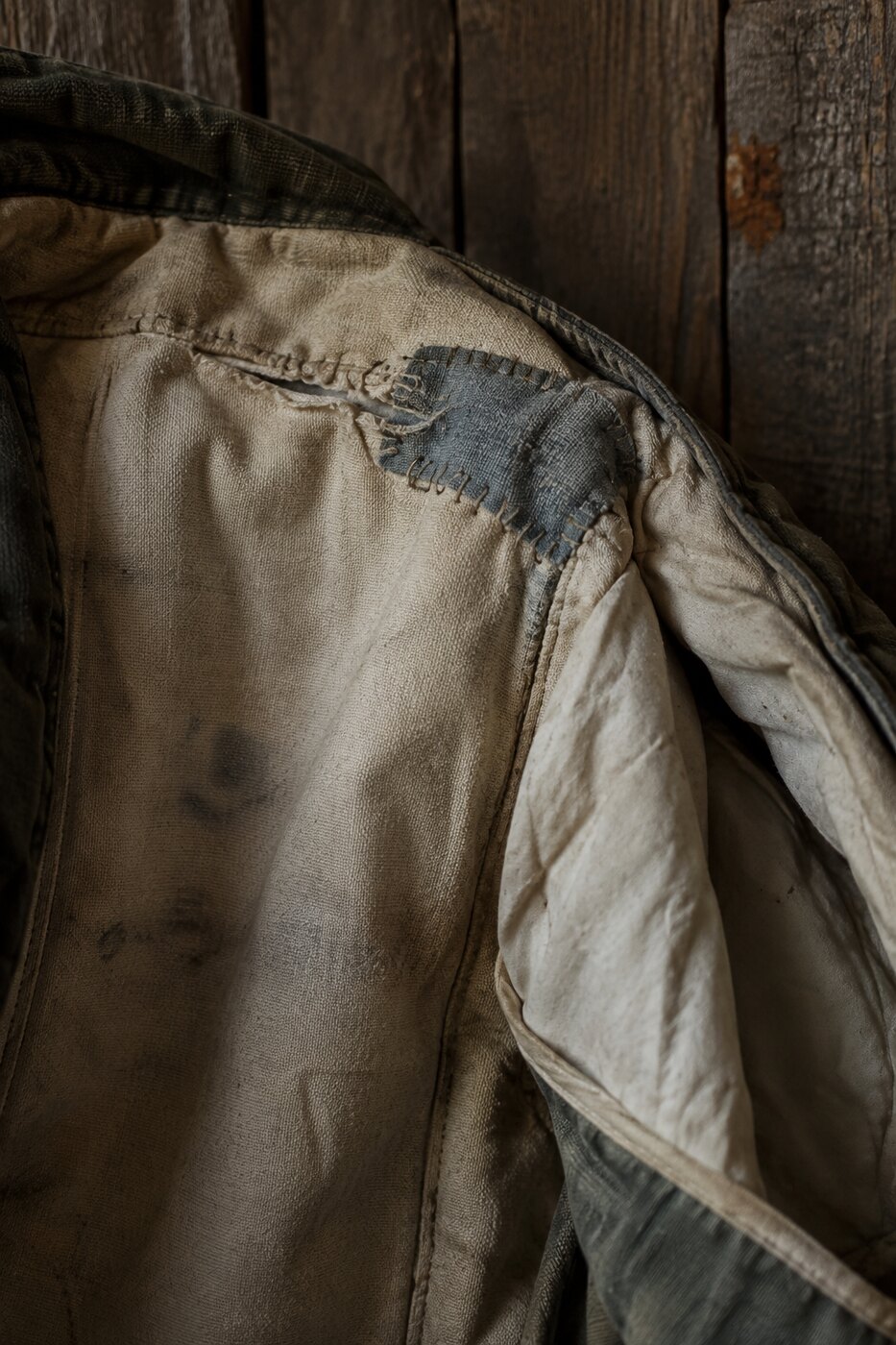
The inside is nothing like the face. The lining, a thin cotton check that was maybe red once, is grayed and split along its own seams, and it does not pretend otherwise. The inside of the canvas is lighter than the outside, unweathered, the true brown the coat was before the weather got at it. And everywhere the outside is smooth, the inside is a record of every place the coat has been hurt and held together. A button reinforced with a knot the size of a tick. The pocket bag darned twice. And at the shoulder, the patch.
It is not a good-looking thing. I want to be clear about that. It is a rough square of other cloth — a piece of an old duck jacket, a different brown, stiffer, cut with scissors that left one edge longer than the other. I laid it over the torn seam from the inside, folded the raw canvas edges under each other first so the tear couldn’t keep running, and sewed the patch down over the whole business with waxed thread doubled through a glover’s needle. The stitches on the straightaway are big and confident, a quarter-inch apart, because the straightaway is not where the trouble is. Near the corners the stitches go small and crowd together, three where there was room for one, because the corner is where a patch lifts first, where the load wants to peel it up, and I did not trust myself to leave any gap for the load to get its finger into. The corners of that patch are the most careful sewing I have done in my life, and no one will ever see them, including me, most days.
Then I pulled the split lining back down over all of it and tacked it at the edges. And now the inside looks almost decent again. The patch is hidden under the lining, the mess is behind the check cloth, and the coat can be turned right-side out and hung on the hook and grabbed without a thought.
That is the whole trick of the thing, and I stood at the table holding the coat inside out for a while, thinking about it, though thinking is maybe too grand a word.
The face of the coat gets all the wear and none of the work. The stain, the fade, the frayed cuffs — that is the part that shows, and it holds together only because of a square of mismatched duck cloth that will spend the rest of its life in the dark, taking the load of every reach and never being looked at. The shoulder that carries the sleeve is not the smooth brown shoulder you can see. It is the ugly patch you cannot. Turn the coat right-side out and you have hidden the one part that is actually doing the job, and shown off all the parts that are only along for the ride.
I don’t think there is anything sad in that. It is just how a repair works. The honest mess goes on the wrong side, and the wrong side holds up the right one, and the whole arrangement depends on the mess being willing to work where it will never get the credit. A patch that needed to be admired would be sewn on the outside, and a patch on the outside is just a wound with thread in it. This one asked for nothing but to hold.
I turned the coat back the right way. It swallowed the patch. From the outside, again, fine — soft brown, dark collar, the stain that is a color now. You would put it on and feel the shoulder take your arm and think nothing of it, which is exactly what the shoulder wants.
I put it on. It was warm at once, the way canvas is warm, holding the heat back against you. Warm in the shoulder especially, where two browns that don’t match are pressed together in the dark under a torn red lining, folded edge over folded edge, and one long stitch at the far corner that I doubled back on twice because I could not shake the feeling it would be the first to go.