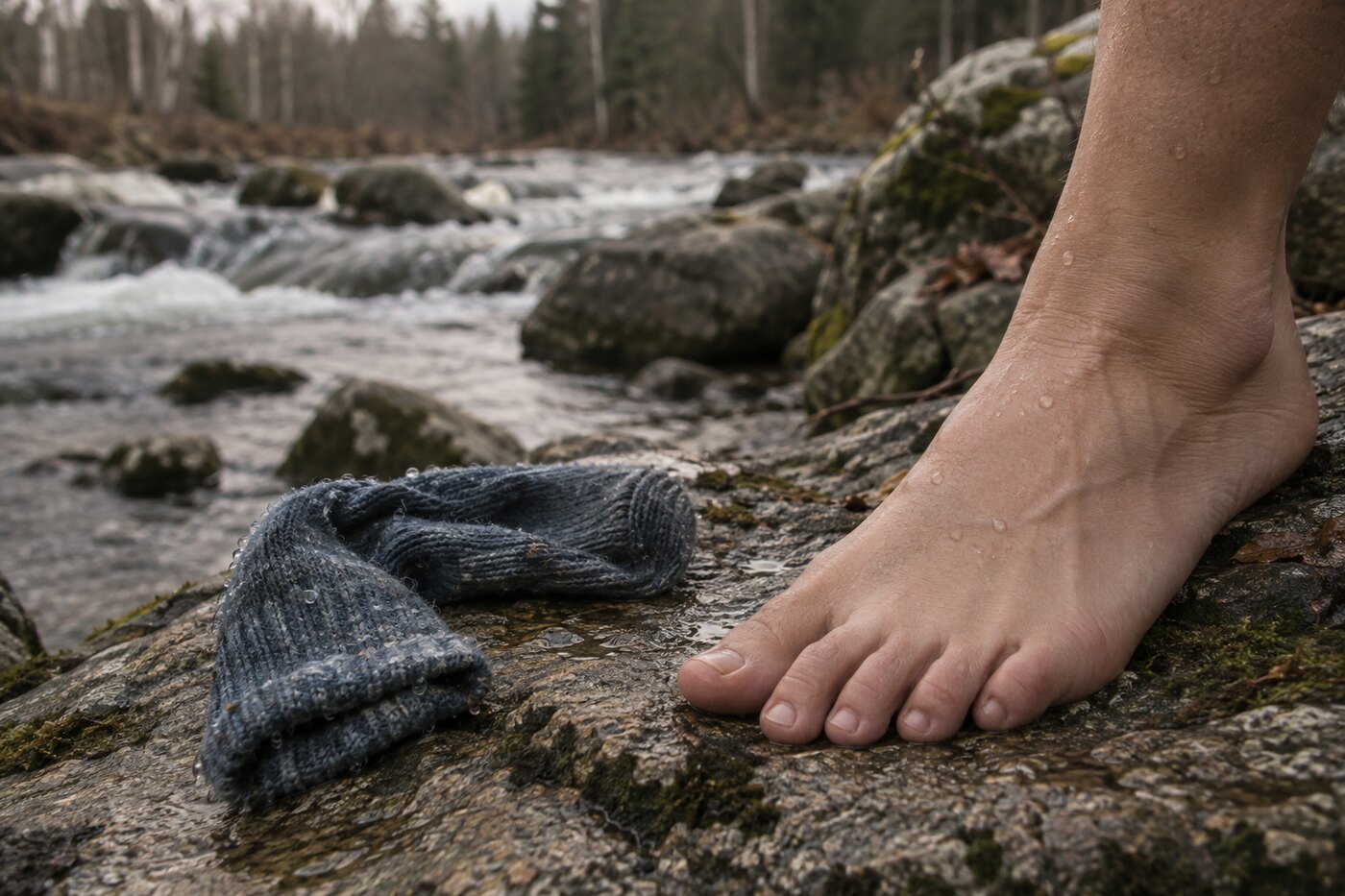
The creek looked smaller from the bank. It always does. Water read from above and from dry ground is a modest thing, a ribbon, a few rocks with a shine between them, and you stand there and you make the calculation that has ended more socks than any other calculation in the outdoors, which is: I can rock-hop that.
You cannot rock-hop that. Or you can rock-hop most of that, which is worse, because rock-hopping most of a creek deposits you with real momentum onto the one rock that turns out to be the wet one, the one with the fine invisible film of algae that the water keeps polished, and the foot goes out sideways with a decisiveness the rest of you cannot match, and there is a moment — it is a long moment, it has a lot of thinking in it for how short it is — where you are committed to a step that is already wrong. And then the boot is in the creek. Not the edge of the boot. The boot. Down past the laces, down where the tongue can’t help you, into the cold.
The cold is the first news and it is honest news. Creek water in this country is snowmelt with a short memory, and it comes through the leather and through the sock and onto the skin all in about the time it takes to say a bad word, and the skin reports it immediately, a clean shocking cold that is almost a burn. That part is nearly bearable because it is at least dramatic. It is the part after that gets you. Because you pull the foot out — fast, everyone pulls the foot out fast, as if speed helps, as if the water inside the boot cares — and now you are standing on the far bank with one wet foot, and the drama is over, and the long dull tenancy begins.
A wet wool sock does not stay wet at the foot. That is the thing nobody warns you about and that you only learn by having it done to you. The water climbs. Wool wicks, that is its whole reputation, that is why we wear it, and it wicks in every direction including up, and so the cold that started at the sole begins a patient migration up the ankle. You feel it move. You are walking, trying to walk it warm, and you can feel the wet line advancing up the sock a fraction of an inch at a time, past the ankle bone, up toward the shin, the sock delivering the creek to parts of your leg that never touched the creek. By the time it settles you have a sock that is uniformly damp from toe to calf and a foot that has entered a new and permanent climate.
And then there is the sound. The squelch. You cannot un-hear the squelch once it starts. It is the sound of water being pushed out of the wool and the boot’s insole with each compression of the step and then sucked back in on the lift, a small wet report, once per stride, for as long as you walk, which is to say for miles, which is to say for the entire rest of the day. Squelch. Squelch. The dry boot on the other foot makes no sound at all, which somehow makes the wet one louder, a call with no response, a limp you can hear.
I want to be fair and say I did the reasonable thing. I stopped and took the boot off and wrung the sock out. You do this. It accomplishes almost nothing and you do it anyway because doing something is better than doing nothing, and because there is a grim little satisfaction in the wringing, the gray creek water twisting out of the wool in a rope and spattering on the rock. I wrung it hard. I got a surprising amount out. Then I put the same wet sock back onto the same wet foot and laced the same wet boot back up, because I did not have a dry sock, because who carries a dry sock, because I am the kind of man who rock-hops a creek that cannot be rock-hopped and such a man does not carry a dry sock. And the wrung sock was, for about four steps, marginally less awful, and then the boot’s own dampness re-soaked it and we were back where we started, minus four steps’ worth of hope.
There is a full-body theology to wet feet with miles left. It works on you from the ground up. It starts as a foot problem and it does not stay a foot problem. It becomes a mood, and then it becomes a lens, and by the third mile it has become a small quiet argument with the whole enterprise of being out there, the kind of argument you have entirely inside your own head with a creek that is not listening. The cold foot makes the tired leg more tired. The squelch makes the long trail longer. Reality had edited my plan, and it had done the editing through the sock, which is where reality most likes to make its notes, down at the point of contact, at the friction, in the exact place where the body meets the ground and cannot look away.
I made the truck. You always make the truck; that is the one mercy, the truck is real and it is where you left it. I got the boots off on the tailgate and peeled the socks and they came off in that particular way wet wool comes off, reluctant, turning half inside out, the toe holding on last. I hung them over the side mirror because I did not want them in the cab. The foot that had been wet all day was pale and ridged and cool, the skin gone soft and pleated the way it goes, the print of the sock’s weave pressed into it in a fine grid.
The socks dripped off the mirror onto the gravel while I found the dry pair in the door. Two dark spots spread under them and joined. The wool was still giving up water it had carried since the creek, hours ago, miles ago, a slow patient draining that did not seem to be in any hurry to end.